🌊 Kayak Trim Calculator
Balance paddler and gear so your kayak sits level, tracks cleanly, and responds predictably in calm or moving water.
🎤Quick Balance Presets
⚙Trim Inputs
Use overall hull length from stern to bow.
Beam helps describe how sensitive the hull feels to trim changes.
This is the range you consider close enough to neutral.
Include clothing and any worn-on-body gear.
Measure to the center of the paddler's mass.
Bow storage, deck bag, or forward hatch cargo.
Use the load center, not the edge of the item.
Stern crate, dry bag, or rear hatch cargo.
Positions aft of the midpoint push stern deeper.
Water, spare paddle, or any load near the centerline.
If gear sits at the seat, keep it near the paddler position.
The calculator treats the kayak midpoint as the neutral point. Loads forward of midpoint push the bow down; loads aft of midpoint push the stern down. The result shows the shift needed to re-center the trim.
📋Trim Reference Cards
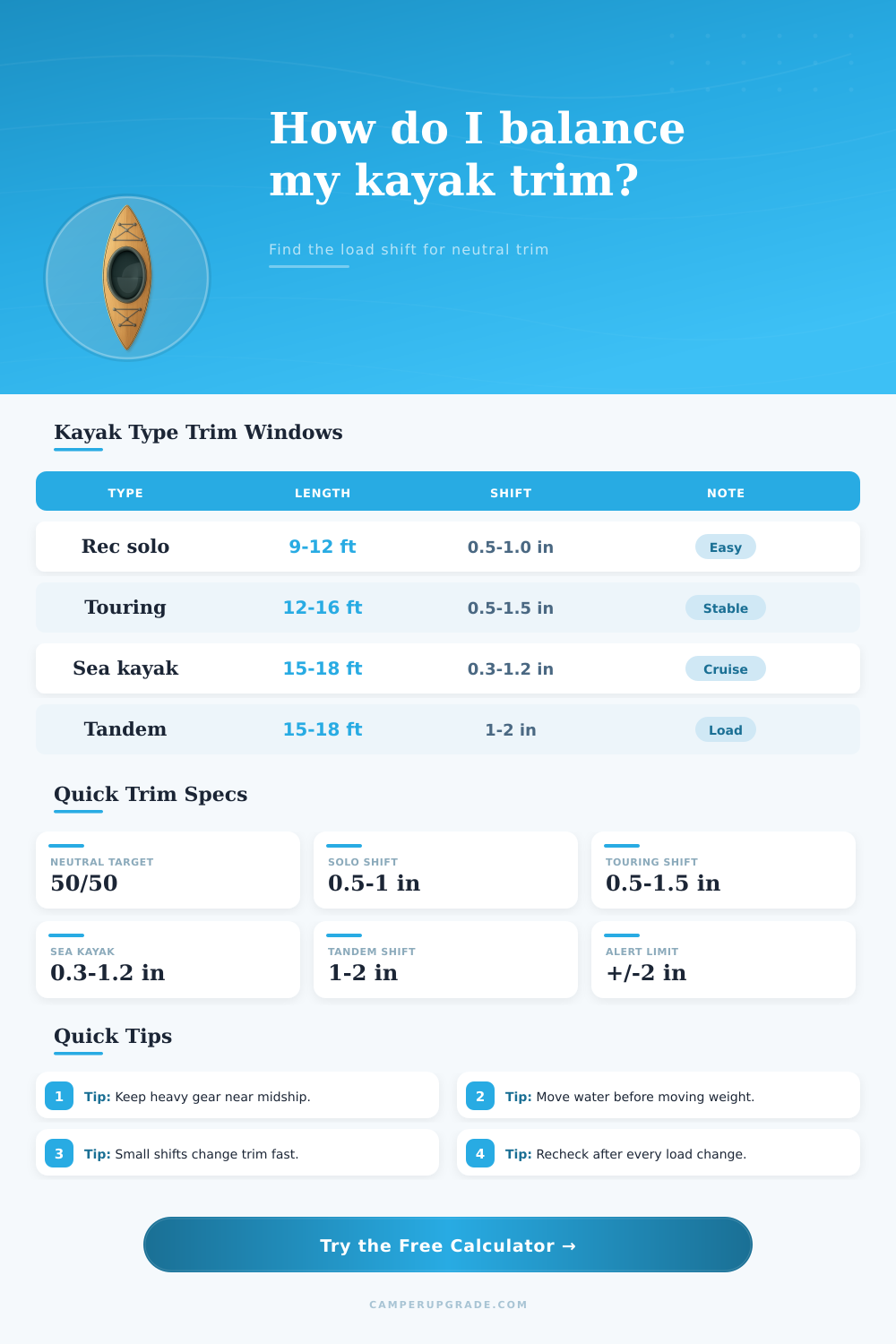
📈Trim Window By Kayak Type
| Kayak Type | Typical Length | Safe Shift | Trim Feel |
|---|---|---|---|
| Recreational solo | 9-12 ft | 0.5-1.0 in | Forgiving |
| Touring kayak | 12-16 ft | 0.5-1.5 in | Predictable |
| Sea kayak | 15-18 ft | 0.3-1.2 in | Efficient |
| Tandem kayak | 15-18 ft | 1-2 in | Load sensitive |
📊Load Placement Guide
| Item | Best Zone | Reason | Effect |
|---|---|---|---|
| Water bottle | Center | Easy access | Neutral |
| Dry bag | Near midship | Less swing | Small effect |
| Cooler | Aft hatch | Stable storage | Stern heavy |
| Deck bag | Forward deck | Quick grab | Bow heavy |
📐Trim Correction Cheat Sheet
| Symptom | Likely Cause | Move | Goal |
|---|---|---|---|
| Bow buries | Too much forward load | Shift 1-2 in aft | Level keel |
| Stern drags | Too much aft load | Shift 1-2 in forward | Cleaner tracking |
| Weaves side to side | Trim too far off center | Recheck midpoint | Straighter stroke |
| Feels sluggish | Heavy ends | Centralize gear | Faster response |
Kayak trims is the balance between the paddler, the gear, and a kayak hull. Kayak trim is important because kayak trim determine how a kayak move through the water. Poor kayak trim will make for a dificult kayak to paddle and will result in inefficiency movement of the kayak.
Kayaks want to be float level in the water at the midpoints. Kayaks is most efficient with their weight split evenly between the bow and the stern of the kayak. Placing the weight of the paddler into the bow of the kayak will make that bow dip into the water.
How to Balance Your Kayak
Similarly, placing the weight of the paddler into the stern of the kayak will make that stern of the kayak sit to low in the water. Both of these instances will cause drags on the kayak, making it more difficult for the paddler to propel the kayak forward. The position of the weight in the kayak is often more important than the amount of weight that is on the kayak.
For example, placing a twenty pound bag in the bow and another twenty pound bag in the stern will create an imbalance for the kayak. This kayak will be prone to instability when encountering waves. However, if you move those same bag to the center of the kayak, the kayak will be more stable.
One way to avoid creating an imbalance is to ensure that you place all heavy items near the midship of the kayak. The kayak trim will change based on the design of the kayak. Kayaks with a wide design are more forgiving and will allow for more flexibility of the trim.
Kayaks with a narrow design will require more precision from the paddler. Thus, if a narrow kayak sea kayak is used, you must take more care with the trim of the kayak. An imbalance in the kayak can be identified by observe how the kayak move through the water.
If the bow of the kayak dip into the water, it is bow-heavy. In this case, gear should be moved toward the stern of the kayak. If the stern of the kayak dip into the water, the kayak is stern-heavy.
In this case, gear should be moved towards the bow of the kayak. If the kayak weave from side to side, it is extremely unbalance. Environmental factor may change the trim of the kayak while on the water.
For example, the wind may push the bow of the kayak downwind, or the current may pull on the low stern of the kayak. These conditions will impact the trim of the kayak. It is important to recheck the trim of the kayak after stopping paddle or moving gear on the kayak.
Additionally, you should test the trim on land prior to launch the kayak. In order to maintain proper trim for kayaking, follow these steps:
First, determine where to place gear based off the length and width of the kayak. Second, make sure that you place all heavy item near the center of the kayak.
Third, adjust your seating position to even out the trim of the kayak. Finally, recheck the trim of the kayak after any moves in the kayak or change in the weather conditions. By managing the trim of the kayak, you will ensure the kayak stays level in the water.
If the kayak remains level in the water, it will track in a straight line and be more easier to kayak.