⛵ Boat Capacity Calculator
Estimate safe payload, passenger count, and reserve margin from your boat's dimensions, load, and operating conditions.
Use the loaded length overall, not just the brochure figure.
Measure the widest normal beam at deck level.
Use the expected operating draft with people aboard.
Higher freeboard gives more reserve above the water.
Include the hull, deck, and fixed fittings only.
Enter 0 if the plate rating is unknown or unreadable.
Use the printed person count when you have the plate.
The calculator compares this against the safe limit.
Use a realistic average for the full group.
Add coolers, tackle, anchors, and loose gear.
Use the installed outboard or propulsion weight.
A full portable tank can change the result fast.
Fresh water, washdown water, or bait tank fill.
Count batteries, trolling motor packs, and add-ons.
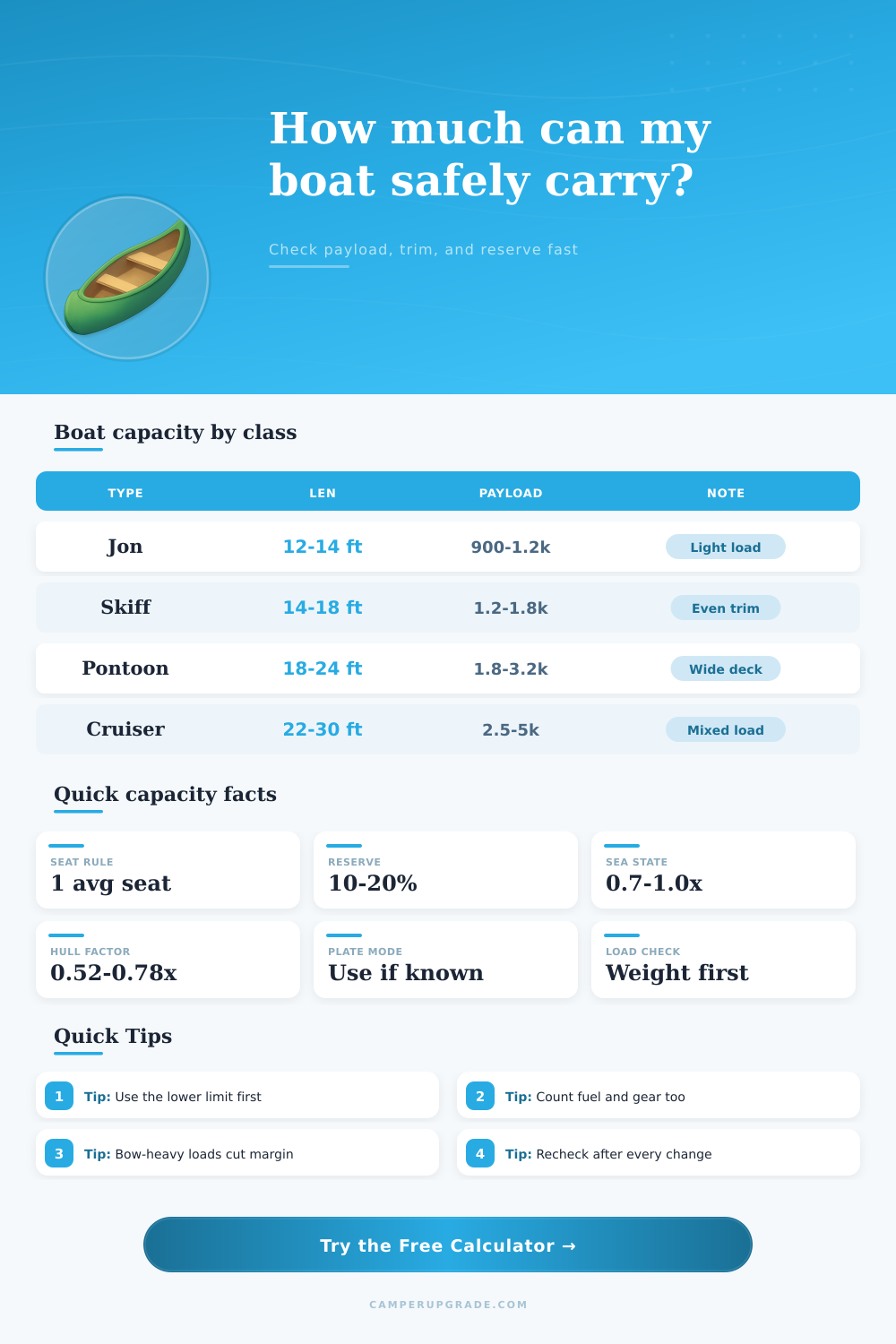
| Boat class | Length band | Safe payload | Typical note |
|---|---|---|---|
| Dinghy / tender | 8-12 ft | 400-900 lb | Light crew |
| Jon boat | 10-14 ft | 700-1,300 lb | Flat load |
| Aluminum skiff | 12-18 ft | 1,000-1,900 lb | Shallow run |
| Bass boat | 16-20 ft | 1,500-2,500 lb | Tight trim |
| Pontoon boat | 18-24 ft | 1,800-3,500 lb | Wide deck |
| Bowrider | 18-24 ft | 1,700-3,200 lb | Mixed load |
| Center console | 20-30 ft | 2,300-4,800 lb | Crew plus gear |
| Cabin cruiser | 24-34 ft | 3,200-6,800 lb | Fixed gear |
| Hull form | Payload factor | Trim factor | Best use |
|---|---|---|---|
| Flat bottom | 0.85x | 1.02x | Calm water |
| Mod-V | 0.92x | 1.00x | General use |
| Deep-V | 0.76x | 0.94x | Chop and wake |
| Pontoon | 1.06x | 1.05x | Stable deck |
| Catamaran | 1.02x | 1.04x | Wide stance |
| Rounded | 0.72x | 0.96x | Slow cruise |
| Tunnel | 0.88x | 0.98x | Shallow run |
| Semi-planing | 0.96x | 1.00x | Balanced mix |
| Condition | Payload factor | People factor | Effect |
|---|---|---|---|
| Protected | 1.00x | 1.00x | Baseline |
| Calm lake | 0.98x | 0.99x | Minor trim care |
| Nearshore chop | 0.90x | 0.92x | Slack margin |
| Rough water | 0.78x | 0.86x | Cut load fast |
| Offshore | 0.70x | 0.80x | Very conservative |
| Bow-heavy | 0.86x | 0.92x | Forward trim |
| Stern-heavy | 0.92x | 0.95x | Transom squat |
| Clustered | 0.84x | 0.88x | Side-to-side shift |
This calculator is for planning and comparison. Confirm the boat's actual plate, manufacturer guidance, and local operating limits before loading a real vessel.
Boat capacity refer to the amount of weight that a boat can safely carry before it becomes unstable or sink. Understanding the capacity of a boat is crucial because the capacity of a boat determine the safety of the individuals on board the boat. Boat capacity is calculated through the weight of the passengers, the weight of the fuels, the weight of the gear, and the weight of motors on the boat.
If the boat carry more than the capacity measurement, the boat will sit more lower in the water and will be more difficult to steer. The capacity plate on the boat specify the maximum amount of weight and the number of individual that the boat can carry. The capacity plate should be checked before sailing on the boat because it displays an legal limit of the boats capacity.
Boat Capacity and Safe Loading
The capacity plate assume that the boat will even distribute the weight of the passengers and that the boat will not encounter any weather condition throughout its sailing trip. The hull of the boat must also be consider when determining the boat’s capacity. Depending on the type of hull the boat use, the capacity will be different.
For instance, a flat bottom boat will carry more differently than a deep-V boat due to the way they is constructed. Another essential element when determining the boat’s capacity is the distribution of the weight of the individuals on the boat. If the weight is push to one end of the boat, that end will plunge into the water’s waves and will make it difficult for the boat to be steer properly.
If the weight is placed in the stern of the boat, the stern will sit too low in the water and cause the motor to work hard to propel the boat. It is best to distribute the weight of the individuals toward the middle of the boat and to even distribute the weight from side to side. The weight of the fuel that is contain within the boat is another element to include when calculating the capacity of the boat.
The weight of the fuel is significant, and it is essential to consider this when calculating the total weight of the boat. Additionally, all gear that is load into the boat will add to the weight of the boat. Every item has a certain weight, and it consume a portion of the boats capacity.
Weather and water conditions can impact the capacity of the boat when on the water. If the water is calm and there are no wave, the boat can carry more weight. However, if the water is choppy and rough, the weight on the boat should be reduce.
The waves can exert a force on the hull of the boat and cause the boat to take on water if it is too heavy loaded. In areas that are more offshore and rough waters, it is best to reduce the amount of weight placed on the boat due to the dangerous nature of these waters as compared than calm bay waters. To calculate the safe payload of the boat, the dry weight of the boat should first be determine.
Then the weight of all the items that cannot be move will be added to the dry weight of the boat. The next step is to determine the weight of the live load, which include the passengers and the gear in the boat. Finally, the total weight of the boat, the fuel, the gear, and the passengers will be subtract from the maximum capacity of the boat as state on the capacity plate.
There should of a safety buffer of ten or twenty percent of the boats total capacity to allow for unexpected situation. Common mistake with boat capacity are when individuals ignore the total weight of the passengers and the gear on the boat. Most individuals does not consider the weight of each passenger as each adult weigh a specific amount.
Additionally, the weight of children and gear is also often forget when calculating the total weight of the boat. The total weight of the boat should be recheck each time item are loaded into the boat. If the boat feel unstable or sit too low in the water, items need to be unload from the boat to ensure stability.
Finally, calculating and maintaining the safe capacity of the boat will allow the boat to remain stable and safe for those on board the vessel.