🏕 Hammock Sleep System Temperature Calculator
Estimate the comfort limit, safety floor, and weather margin for your hammock quilts, pad, tarp, and sleep layers.
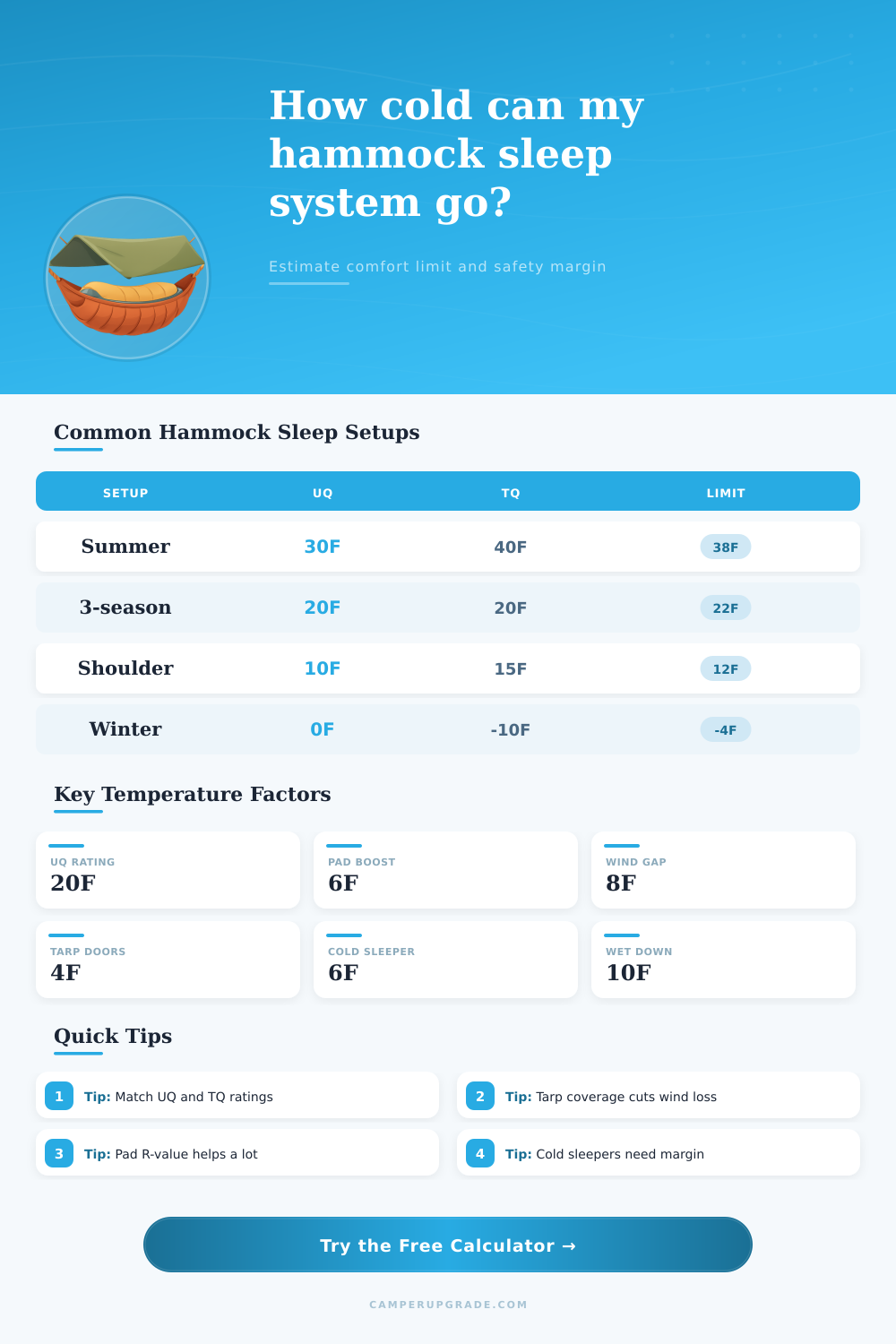
| Setup | Underquilt | Top Quilt | Typical Limit |
|---|---|---|---|
| Warm summer | 40F | 50F | 45F |
| Three-season | 20F | 20F | 22F |
| Shoulder camp | 10F | 15F | 12F |
| Deep winter | 0F | -10F | -4F |
| Hot sleeper | 30F | 30F | 28F |
| Cold sleeper | 10F | 10F | 14F |
| Factor | Example | Temp Effect | Why It Matters |
|---|---|---|---|
| Wind | Open site | -3 to -9F | Strips heat fast |
| Tarp | Doors closed | -2 to -6F | Blocks cold air |
| Pad | R 2 to 4 | +4 to +10F | Stops convection |
| Fit | Dialed UQ | -2 to -8F | Kills gaps |
| Layers | Midweight | -2 to -5F | Raises comfort |
| Humidity | Damp night | +1 to +5F | Down loses loft |
| Scenario | UQ / TQ | Pad / Tarp | Comfort Use |
|---|---|---|---|
| Summer edge | 40F / 45F | R 1.5 / 50% | Mild trips |
| Three-season | 20F / 20F | R 2.0 / 65% | Most camps |
| Shoulder cold | 10F / 15F | R 3.0 / 80% | Late fall |
| Winter block | 0F / -10F | R 4.0 / 95% | Deep cold |
| Layer Set | Fit Quality | Site Type | Temp Bias |
|---|---|---|---|
| Minimal | Dialed | Sheltered | -4F |
| Light | Good | Tree line | -2F |
| Midweight | Loose | Open | +4F |
| Heavy | Drafty | Ridge | +8F |
To provide insulation in hammock camping require a specific system. Unlike tents, hammocks doesnt allow sleeping bags to hug the sleeping person. The curved shape of the hammock causes cold spots for form on the persons shoulders, hips, and feet.
To prevent these cold spots, a person must use an underquilt and a top quilt. The underquilt drapes beneath the sleeping person inside the hammock, while the top quilt cover the sleeping person like a blanket. Wind is a major factor in hammock camping because wind will move heat away from the sleeping person.
How to Stay Warm in a Hammock
Wind can move through the gaps between a hammock and a quilt. In cold weather, if a tarp does not cover at least seventy percent of the hammock, a person will lose their body heat rapid. To prevent this, a person should choose a camping spot with dense trees, which will naturaly block the wind from the sleeping person.
Additionally, a person can use tarp doors to create a natural windbreak that will help keep warmth inside the sleeping system. A sleeping pad is another essential part of a hammock camping insulation system. A sleeping pad provide resistance against heat loss from the sleeping person.
The R-value of a sleeping pad determines the sleeping pads resistance against conductive heat loss from the persons body. Even a lightweight sleeping pad will provide warmth for sleeping area where an underquilt cannot reach. If a sleeping person is camping in freezing temperatures, it is recommended that a person use a sleeping pad because a sleeping person will rely on their metabolic heat to keep themselves warm.
Some people may require more warmth than others because some people are cold sleeper. Cold sleepers will radiate heat from their bodies faster then other people. If a person is a cold sleeper, they might need quilts rated ten degrees warmer than the manufacturer state.
One way to increase warmth within a hammock is by wearing a midweight base layer. The fit of the quilt is another essential factor. A sleeping person should use an underquilt that fit tightly into the hammock, otherwise, cold air can enter the sleeping system.
High humidity in the sleeping environment will make the air within a hammock feel damp. When the air in a quilt is damp, the down will compress. Compressed down will lose it’s ability to trap warm air, thus, reducing the warmth it can give to the sleeping person.
Therefore, people who sleep in coastal areas should use extra insulation in their hammock. The ratings of both the underquilt and the top quilt should match. If the sleeping person use quilts with mismatched ratings, they might feel cold because their body will work to even out the temperatures between the two quilt.
The type of hammock will also affect the sleeping person. A person using a gathered-end hammock can sleep in any season. On the other hand, a person using a spreader bar hammock can use it in cold weather.
A person can use several measurement to determine if their sleeping system is working correctly. The comfort limit will tell the sleeping person the temperature range at which they will sleep through the night without feeling cold. The safety floor will determine the sleeping persons lowest body temperature they can survive.
The margin against the forecast will give the sleeping person an idea of how much warmth they have to spare. If the margin is twelve degree or more, they will likely have a relaxed sleep. If the margin is under five degrees, they should of add more sleeping layer or find a different sleeping shelter.
Common mistakes in hammock camping include relying only on the label on the quilt. A sleeping person should not rely only on quilt labels but also check the area where they will sleep for wind and moisture presence. Another mistake is to ignore the R-value of the sleeping pad.
Lastly, another mistake is to use an ultralight quilt if sleeping in cold weather. To avoid these mistakes, test the sleeping system in your backyard before heading out on camping trips. Testing the sleeping system will allow sleeping persons to adjust the fit of the quilts and the tarp so that they get the warmth they require to sleep soundly.