🏕 Hammock Spreader Bar Calculator
Estimate bar length, line tension, hang drop, and structural safety for bridge, chair, and gathered-end hammock setups.
Round bar model assumes a solid rod when wall thickness is 0 and a tube when thickness is above 0.
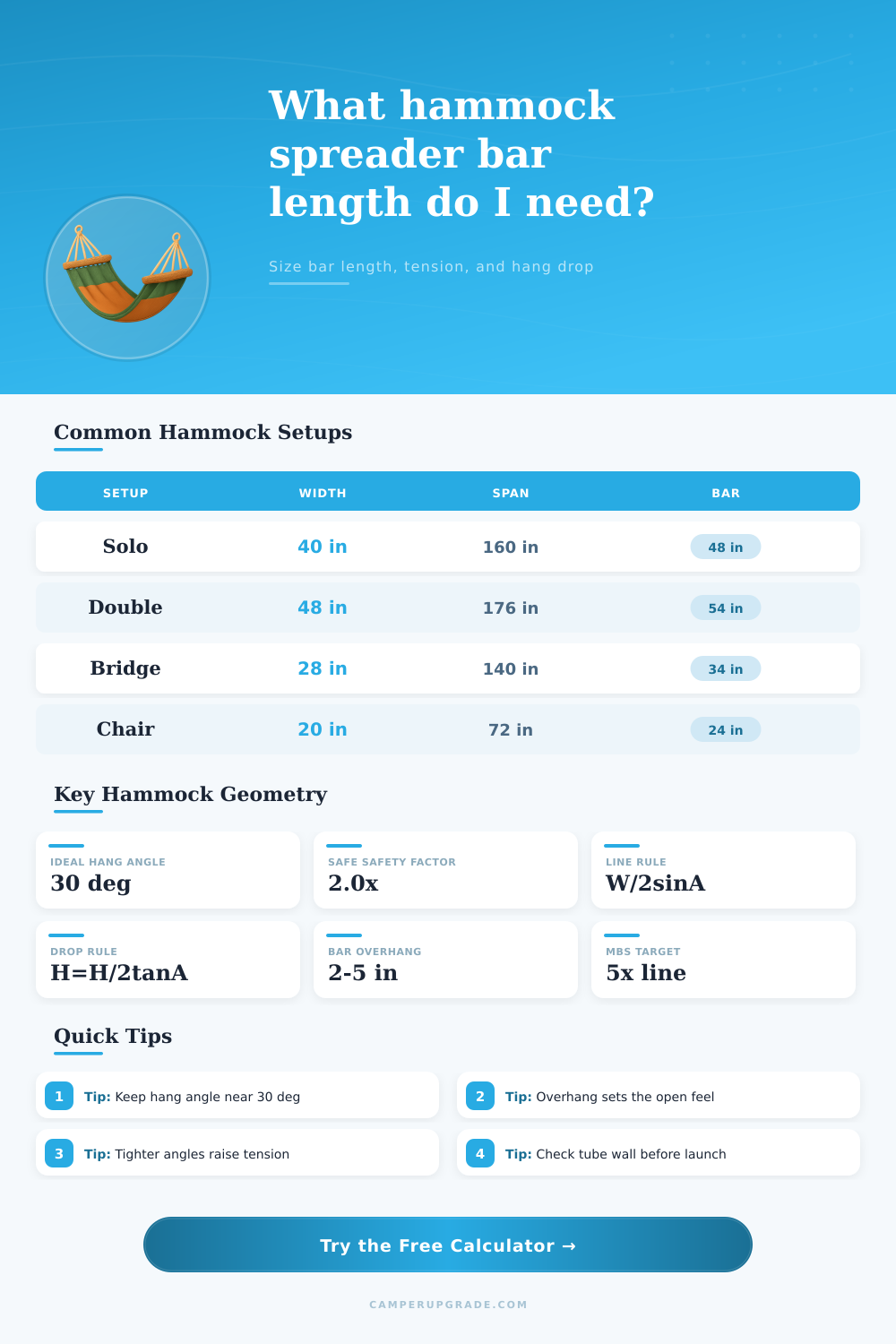
| Setup | Fabric Width | Anchor Span | Bar Length |
|---|---|---|---|
| Solo Camp | 40 in | 160 in | 48 in |
| Double Lounge | 48 in | 176 in | 54 in |
| Bridge Hammock | 28 in | 140 in | 34 in |
| Chair Swing | 20 in | 72 in | 24 in |
| Family Daybed | 60 in | 192 in | 70 in |
| Backyard Lounge | 56 in | 180 in | 64 in |
| Angle | Tension Factor | Drop Ratio | Use Case |
|---|---|---|---|
| 15 deg | 3.86x | 0.27x | Very tight |
| 20 deg | 2.92x | 0.36x | Bridge style |
| 25 deg | 2.37x | 0.47x | Firm lounge |
| 30 deg | 2.00x | 0.58x | Comfort zone |
| 35 deg | 1.74x | 0.70x | Deep sag |
| 40 deg | 1.56x | 0.84x | Soft setup |
| Material | OD x Wall | Weight | Best Use |
|---|---|---|---|
| Bamboo | 1.5 in x solid | Light | Ultra-light |
| Ash | 1.5 in x solid | Mid | Camping |
| Aluminum | 1.25 x 0.065 | Very light | Packable |
| Fiberglass | 1.25 x 0.08 | Light | Budget tube |
| Carbon Fiber | 1.0 x 0.06 | Ultra-light | Premium |
| Steel | 1.0 x 0.065 | Heavy | Heavy-duty |
A spreader bar are used to maintain the width of a hammock. The size of the spreader bar will determine the comfort and safety of the individual using the hammock. If the spreader bar is too short for the hammock, the hammock will pinch the shoulder of the person using it.
If the spreader bar is too long for the hammock, the hammock will sag in a way that does not provide sufficient support to the body while resting in the hammock. If the spreader bar is too flimsy for the hammock, the spreader bar may snap under the weight of the person who are resting in the hammock. This could lead to injury to the person.
Choosing the Right Spreader Bar for a Hammock
The width of the hammock fabric is a fixed measurement. The spreader bar has to account for this measurement. The person who is purchasing or constructing a hammock should choose a spreader bar that is sized to account for the width of the hammock fabric and provides an overhang on each end of the spreader bar.
The overhang on each end of the spreader bar should be at least a few inches to ensure that the suspension lines of the hammock do not slip off of the spreader bar. The overhang on each end of the spreader bar also determines the opening of the hammock when the person is lying in the hammock in a diagonal position. The diagonal position is the most comfortable position for the person when resting in the hammock as it avoids the development of pressure points on the persons body.
If the overhang is too short the person may feel as if they is being squeezed in the hammock. If the overhang is too long the hammock may be too wide for the individual and may place extra tension on the suspension lines of the hammock. Another factor to consider when constructing a hammock is the placement of the anchor points for the suspension lines of the hammock.
The suspension lines will attach to two anchor points that is attached to trees or other objects. The distance between these two anchor points is referred to as the anchor span. The suspension angle is the slant of the suspension lines from the tree to the end of the hammock.
A suspension angle of 30 degrees is often considered to be an ideal angle when setting up a hammock. If the suspension angle is less than 30 degrees the hammock will sag more between the tree. However, if the suspension angle is more than 30 degrees the hammock will sag less between the two trees.
Another factor to consider when constructing a hammock is the amount of tension in the suspension lines. The angle at which the suspension lines are hung between the trees creates this tension. The further the angle of the suspension lines from horizontal, the more tension that is placed into the suspension lines.
The tension in each suspension line is the weight of the sleeping person and their gear divided by two. This is because the weight of the person and their gear is distributed equally to each end of the hammock. However, the angle of the suspension lines also multiplies the tension in each suspension line.
For instance, if a person who weighs 180 pounds sets up their hammock so that the suspension lines are at a 30 degree angle the tension on each suspension line will be around 200 pounds. However, if the person setups their hammock at a 15 degree angle so that the suspension lines are very close to the ground the tension on each end of the hammock will be around 700 pounds. Additionally, this tension on each end of the hammock also creates a bending moment in the middle of the spreader bar.
Wood is often used to make solo spreader bars. However, people often use aluminum and carbon fiber to make the larger spreader bars since these materials are strong. When calculating the load that a spreader bar can support, a person should use certain safety factors.
A person should multiply the load by two or more to allow for wind gusts or movement of the hammock. A calculator can help a person to determine the section modulus of the spreader bar compared with the limits of the material. The section modulus can be calculated from the diameter and the wall thickness of the spreader bar.
The thickness of the wall will determine if the spreader bar will bend too much during its use. Depending on the type of hammock that is to be established between the trees, different measurements for the spreader bars will be needed. For those camping who will only have one hammock setup, 48-inch spreader bars with four-inch overhangs are often used.
Additionally, solo campers often use hammocks that are 40 inch in width. For those camping with a friend, 54-inch spreader bars are often used, as are hammocks that are 48 inches in width. For bridge hammocks, the spreader bars will be smaller in measurement, such as 34-inch spreader bars since bridge hammocks do not rely as much upon the spread between the trees for maintaining the hammocks shape.
Finally, for hammock chairs the spreader bars will be the smallest in length, such as 24-inch spreader bars due to the narrowness of the hammocks that are used for hammock chairs. The material from which the spreader bars are made will impact the weight and strength of those bars. For instance, bamboo is a lightweight material but has a lower modulus value and more flex compared with other materials.
Additionally, ash and oak are dense materials with good strength but add to the overall weight of the spreader bar. Aluminum 6061 can be made thinner to reduce the overall weight of the spreader bar but is stiff in structure. Carbon fiber is also very stiff but often more expensive than other materials.
Steel has the highest strength but is the heaviest material. Ensuring that the wall thickness of a metal spreader bar is checked ensures that the spreader bar’s wall thickness defines the strength of the bar. Common mistakes made when setting up a hammock include making an estimation of the length of the spreader bar.
Instead of making estimations, the actual measurements of the distance between the trees should be taken. Additionally, other mistakes include not ensuring that the minimum breaking strength of the ropes is enough for the tension that will be placed upon them. The breaking strength of the ropes should be at least five times the peak line load.
So, if the tension created by camping on the hammock is 200 pounds, the minimum breaking strength of the ropes should be 1000 pounds. Finally, other mistakes include not inspecting the spreader bar prior to using the hammock. Common defects in the spreader bar include cracks that may have developed due to the movement of the trees when shipping or storing the hammock.
Additionally, the hammock should be tested while lying on the ground to ensure that there are no bows in the spreader bar.