⛺ Ridgeline Height Calculator
Plan tarp ridge height, pole height, pitch angle, and shelter clearance with camper-ready geometry
Balanced pitch for sleeping and weather protection.
More people or gear usually means more headroom.
Overall tarp length along the ridgeline.
The side-to-side span that drives ridge height.
Distance between support points or tree anchors.
How much gap you want above ground at the low edge.
Enough room to sit up or move gear comfortably.
Steeper angles raise the ridge and shed water faster.
Fabric stretch and wet weather always add sag.
Wind profile shifts the final height recommendation.
Distance from the tarp peak to the pole tip or tie point.
Extra reserve helps with gusts, stretch, and uneven ground.
| Style | Best use | Base math | Height note |
|---|---|---|---|
| A-frame | Balanced camp | Half width x tan | Good all-around |
| Lean-to | Open front | Full span x tan | High front edge |
| Porch | Shade and cook | Full span x low tan | Tall open face |
| Diamond | Rain fly mode | Half width x tan | Compact ridge |
| Hammock | Suspended sleep | Span plus pad | Needs overhead room |
| Storm shed | Wind protection | Low angle pitch | Lowest profile |
| Mode bias | Comfort vs wind | Factor shift | Changes final height |
| Sag reserve | Wet weather | Add allowance | Prevents roof touch |
| User height | Sit-up room | Comfort headroom | Recommended edge gap |
|---|---|---|---|
| Short solo | 28-34 in | 56-60 in | 8-10 in |
| Average adult | 32-38 in | 60-66 in | 10-12 in |
| Tall adult | 36-42 in | 66-72 in | 10-14 in |
| Gear pile | 24-30 in | 48-54 in | 12-16 in |
| Cooking cover | 38-44 in | 72-80 in | 14-18 in |
| Storm mode | 18-24 in | 36-42 in | 6-8 in |
| Family lounge | 34-40 in | 64-70 in | 10-14 in |
| Hammock use | 30-36 in | 60-64 in | 8-12 in |
| Tarp size | Span | Best for | Typical ridge |
|---|---|---|---|
| 7x9 ft | 6-7 ft | Solo UL | Low A-frame |
| 8x10 ft | 7-8 ft | 1-2 people | Balanced ridge |
| 10x10 ft | 8-10 ft | Square tarp | Versatile pitch |
| 10x12 ft | 9-11 ft | Two-person | Roomier ridge |
| 12x12 ft | 10-12 ft | Base camp | High cover |
| 12x14 ft | 11-13 ft | Group shade | Long center line |
| 14x16 ft | 12-15 ft | Cooking cover | High porch pitch |
| Trail fly | variable | Storm use | Low and tight |
| Support | Height band | Use case | Rule of thumb |
|---|---|---|---|
| Trekking pole | 46-55 in | A-frame peak | Matches half width |
| Adjustable pole | 54-72 in | Porch lift | Use if front opens |
| Tree anchor | 48-90 in | Lean-to high side | Keep ropes level |
| Rear stake | 6-12 in | Low edge | Stay close to ground |
| Ridgeline tie | 2-6 in | Tarp peak knot | Allow for cord stretch |
| Guyline | 4-10 ft | Most pitches | Longer in bad ground |
| Snow load | lower | Winter camps | Pitch steeper |
| Wind line | shorter | Exposed ridges | Keep profile low |
| Scenario | Inputs | Result | Notes |
|---|---|---|---|
| Solo sleeper | 8x10 / 45 deg | Mid ridge | Easy sit-up room |
| Two-person camp | 10x12 / 40 deg | Higher ridge | Better shoulder room |
| Cooking shade | 12x14 / 30 deg | Tall front | Open working space |
| Windy ridge | 10x10 / 55 deg | Low ridge | Most stable profile |
| Hammock camp | 11x9 / 42 deg | Clear overhead | Check suspension sag |
| Family lounge | 14x16 / 28 deg | Large cover | Needs extra poles |
| Rain fly | 9x7 / 50 deg | Tight ridge | Low and fast setup |
| Storm pitch | 10x10 / 60 deg | Lowest ridge | Prioritize shedding |
Ridgeline height is a critical measurement for a tarp. The ridgeline height will determine how the tarp manages wind and rain, as well as the headroom that a person will have while within the tarp. Setting the ridgeline height too low can result in a person hitting there head on the tarp when they is standing or moving within the tarp.
In contrast, if the ridgeline height is set too high, the wind may catch the tarp which will allow the guylines to be pulled loose from the tarp. Thus, understanding the ridgeline height will allow a person to create a tarp that maintains stability with the environment that it will be used in. The first consideration in establishing the ridgeline height is the span and the pitch angle of the tarp.
How to Set the Ridgeline Height of a Tarp
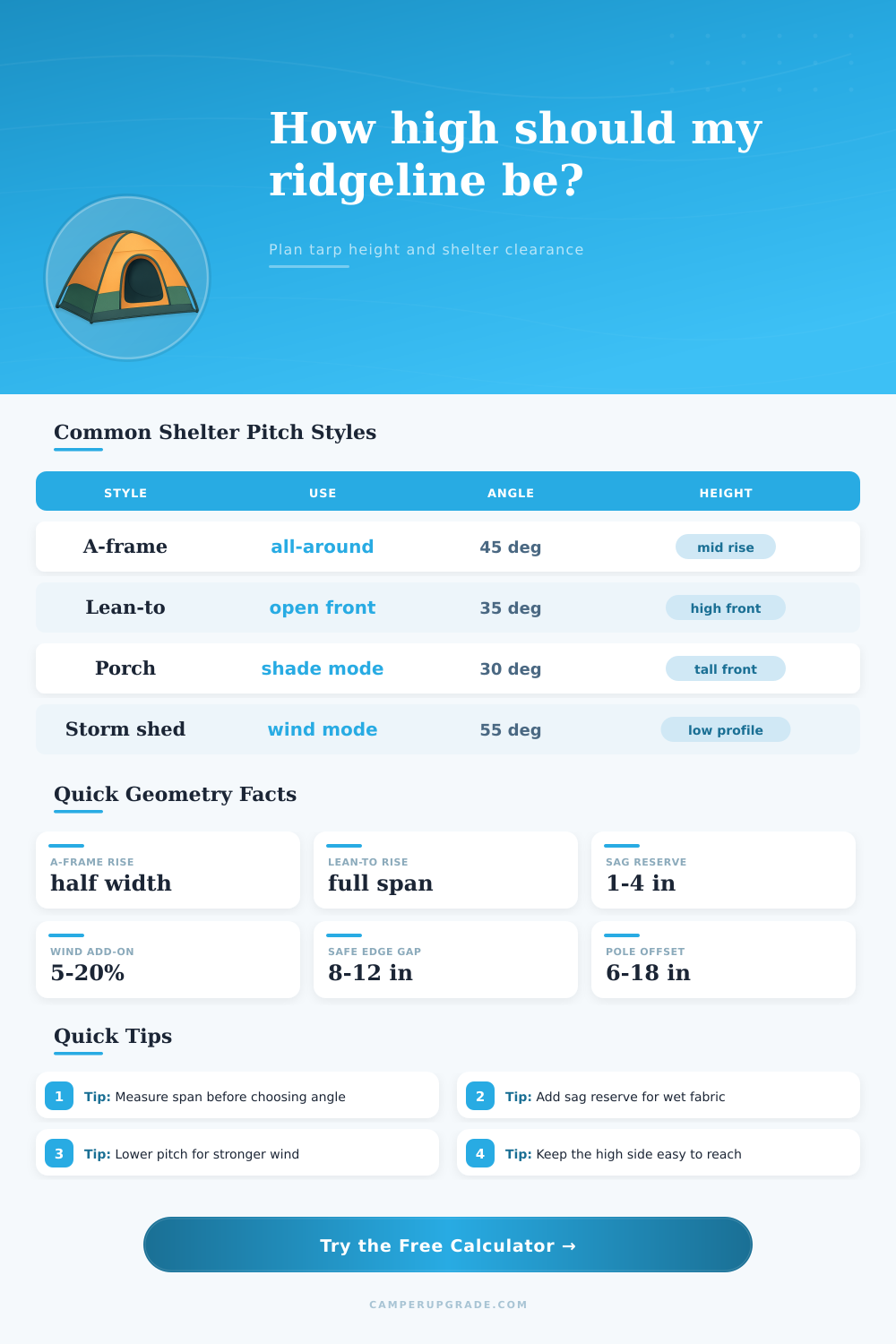
The span of the tarp is the distance between the two point where the tarp will be anchored to. For an A-frame tarp, the user will split the width of the tarp in half to determine the center of the tarp, and the pitch angle will be used to calculate the ridgeline height. For a lean to tarp setup, however, the user will use the full width of the tarp on the high side of the lean-to tarp.
Because the distance between the two anchor points may be less than the overall dimensions of the tarp, it is necessary to measure the span between the two anchor points prior to pitching the tarp. Two environmental factor will impact the ridgeline height of a tarp: the wind and the rain. The influence of the wind will require a lower ridgeline height for the tarp, as a lower ridgeline will reduce the amount of surface area that is exposed to the wind.
The rain, however, will require a steeper pitch angle to allow for the rain to run off the tarp rather than collect on it’s surface. When the tarp is exposed to the rain, the fabric will sag due to the weight of the water that accumulates on the tarp. This fabric sag will lower the ridgeline height of the tarp.
To account for this sag, the user should pitch the ridgeline height higher by a few inches to allow for the fabric to sag while the tarp is exposed to the rain. The type of tarp and the number of individuals that will use the tarp will dictate the ridgeline height. For instance, the ridgeline height for a tarp that a single hiker is to use can be lower than the ridgeline height required for a group of individuals to use the tarp.
An open porch tarp will have a higher ridgeline height at the front edge of the tarp to allow space for an individual to cook meals while within the tarp. In contrast, a diamond fly tarp design will have a lower ridgeline height because the diamond fly tarp is designed to be used in a more compact manner. The headroom that should be provided within the tarp should allow for an individual to sit in the tarp without hunching there back.
For an average adult, sixty inches of headroom is often the target for the center of the tarp. Certain measurements for ridgeline height and pitch angle are utilized to determine the ridgeline height. Forty-five degrees is a common pitch angle for the tarp.
In cases of storms, however, a steeper pitch angle will shed water more efficient from the tarp. Fifty-five degrees is a common pitch angle for instances of storms. A shallower pitch angle can be used to allow the tarp to recieve more shade from the sun.
A shallower pitch angle, though, allows the rain to pool on the tarp. The user should clear the edge of the tarp of water by eight to twelve inches to prevent the pad from become wet. Common mistakes in determining the ridgeline height of a tarp can result in difficulties with the tarp design.
One of the most common is failing to account for any ground that may be uneven between the two anchor points for the tarp. The ridgeline height will not be even if the ground is not even between the two anchor points. Another mistake is to forget the pole offset.
The distance between the top of the pole and the peak of the tarp is often between six and eighteen inches. This offset between the pole and the tarp may make the guylines appear too short when measuring from the bottom of the tarp. Finally, many may make the mistake of providing maximum headroom for the individuals that will utilize the tarp.
While headroom is important to consider, if the ridgeline height is too high the tarp can act like a sail in the wind. This type of tarp is often difficult to keep stable in the wind. Thus, if a person can remember each of these factors and considerations, they can determine the ridgeline height of the tarp that will be most comfortabley and stable for those that will use it.