🏕️ Custom Tent Footprint Calculator
Size your groundsheet, tarp, and storm buffer for a custom tent layout with imperial or metric inputs
| Style | Shape bias | Best use | Note |
|---|---|---|---|
| Dome | Boxy | Weekend camp | Least waste |
| Tunnel | Long | Windy trips | Needs rear room |
| Cabin | Wide | Family camp | More porch space |
| Tipi | Round | Snow camp | Use center pole |
| Wedge | Low | Bikepacking | Shorter height |
| Roof | Compact | Vehicle top | Low windage |
| Fly | Flexible | Fast shelter | Needs guyouts |
| Hex | Angular | Shared use | Stable perimeter |
| Interior size | Good for | Footprint note | Buffer |
|---|---|---|---|
| 7 x 4.5 ft | Solo sleep | Fits most 1P tents | 10-12% |
| 8 x 5 ft | Couple sleep | Typical 2P dome | 12-15% |
| 10 x 6 ft | Family sleep | Room for gear | 12-18% |
| 12 x 8 ft | Basecamp | Large cabin floor | 15-20% |
| 14 x 10 ft | Group cover | Long tarp zone | 15-22% |
| 6 x 4 ft | Bikepacking | Trim to fit | 8-10% |
| 9 x 7 ft | Rooftop tent | Shorter overhang | 10-14% |
| 11 x 9 ft | 4-season | Allow guy room | 14-18% |
| Material | Weight | Strength | Best use |
|---|---|---|---|
| Tyvek | Light | Tough | DIY footprint |
| Poly tarp | Med | Waterproof | Budget layer |
| Silnylon | Very light | Slippery | Ultralight pack |
| Polycryo | Ultra light | Fragile | Fast trim fit |
| OX tarp | Heavy | Durable | Basecamp use |
| PVC mesh | Heavy | Stable | Rough ground |
| Foil liner | Light | Reflective | Cold floor |
| Canvas | Heavy | Classic | Long stays |
| Setup | Stake line | Extra room | Why it helps |
|---|---|---|---|
| Fair weather | 2-3 ft | Small | Simple pitch |
| Breazy night | 3-4 ft | Medium | Less flap |
| Storm mode | 4-5 ft | Large | Guyline slack |
| Snow camp | 5 ft+ | Large | Drift room |
| Beach camp | 4 ft | Medium | Sand anchor |
| Rooftop camp | 2 ft | Small | Low windage |
| Basecamp | 4-6 ft | Very large | Comfort margin |
| Fly pitch | 3-5 ft | Medium | Water shed |
A footprint are the area of the ground that is covered by a tarp or groundsheet that is place beneath and around the tent. Footprints is important to tents in that it will protects the tent floor from damage and it will help with the management of the space around the tent. Many peoples make the mistake of ignoring the footprint requirement of the tent and instead choosing a footprint for the tent based off the dimensions of the tent showed on the box.
Using these dimension as the sole basis to choose a footprint for the tent, however, can cause problems with the tent. For instance, if the footprint are too small for the tent floor, then that tent floor can become wet due to the rain that falls on the tent and runs off of the tent fly. Several different clearance for a tent must be considered when calculating the footprint of the tent.
How to Choose the Right Tent Footprint
One of these is the wall clearance, which is the space between the tent wall and the footprint. This space is necessary to allow condensation to not enter the sleeping bag. Next is the vestibule room, which is the area provided for boot or stoves.
This area is used to add to the footprint of the tent. Entry buffer are provided at the tent door, and they provide additional space for movement when entering the tent. Lastly, the guy line slack is the area required for the guylines that will help to tension the tent proper.
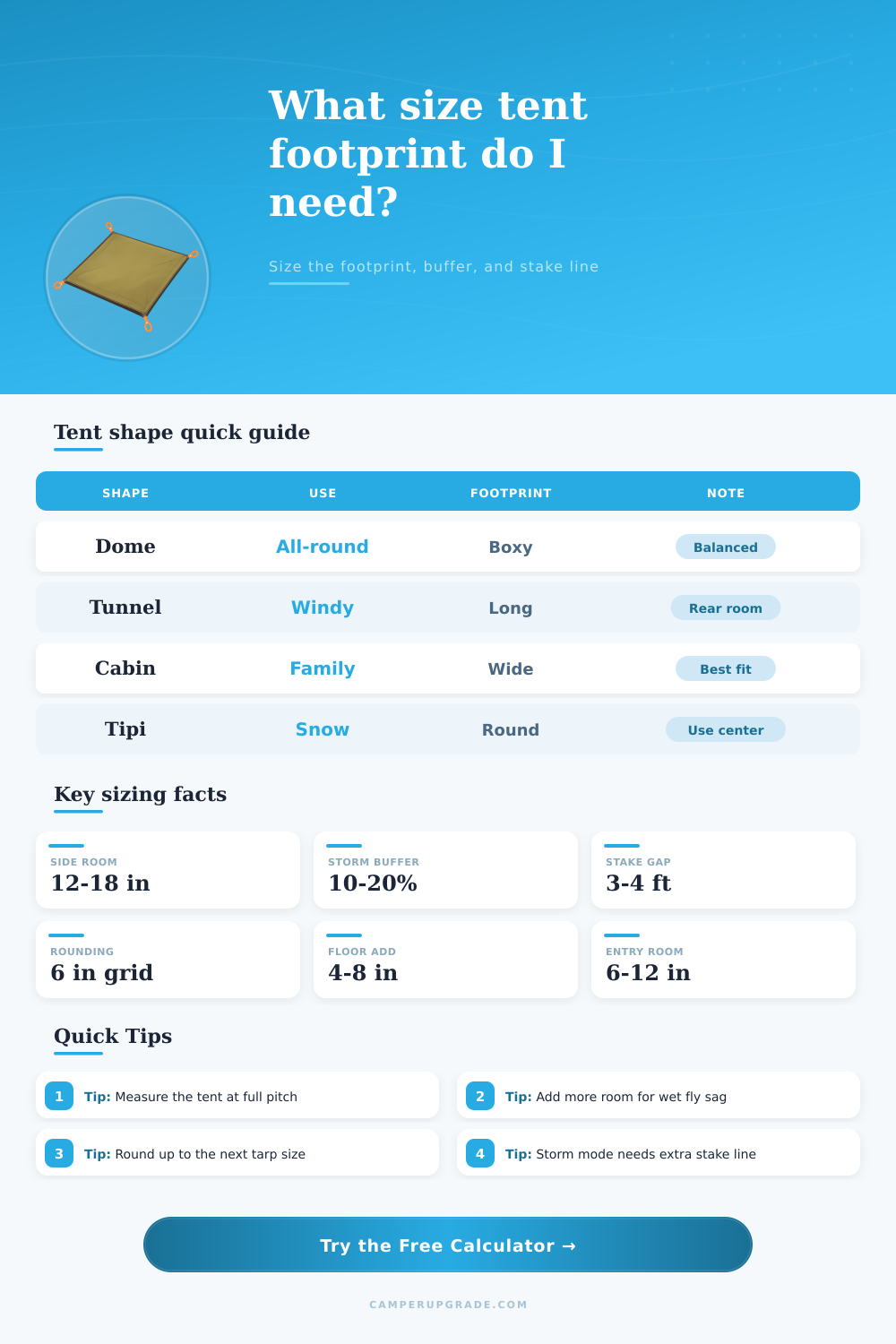
The tent shape will dictate the footprint that the tent use. For instance, dome tents have a more boxy shape to them, thus providing for a footprint that is of the same shape. Tunnel tents is long and narrow, thus their footprint will provide extra length for the rear end of the tent.
Tipi tents are circular and use a pole in the center of the tent, thus a footprint that allow for space for that pole. Lastly, cabin tents are very wide to allow additional gear to be stored within the tent, thus providing a large footprint for the tent. The different tent shape require different footprint size.
In addition to the tent dimensions, an additional consideration is in incorporating a storm buffer into the tent footprint calculations. This is especially true if the camping trip will include bad weather. A storm buffer is the additional size provide to the footprint that will allow for extra space to handle heavy rain and high winds.
Due to the tendency of rain to cause the tent fly to sag, the footprint can become wet if it isnt provided with extra space. High winds will require the tent to be tensioned, which will require extra space for the tent stake. The footprint tent material will impact in what ways the cook use the footprint.
For instance, silnylon is used in many tent, but it can become slippery if the tent is under tension. Oxford tarps is heavy materials and they are durable, which makes them suitable for base camps. Tyvek is a very tough material that can be easily cut but is difficult to use in certain environment.
Thus, the type of footprint tent will require a footprint material to match the tents camping need. Some of the most common mistake with tent footprints are to ignore the total space that the tent will require. People may only measure the tent floor, but they must also take into consideration the tent fly and guylines.
Another mistake is to attempt to use a minimalist footprint for the tent to save weight. A minimalist footprint will cause the tent fabric to flap and allow for the tent to become wet. Additionally, when measuring the tent for footprint size, ensure that the tent is fully pitched and the tent fly is fully extend.
When the tent is in this position, the footprint will ensure that the footprint is large enough to cover all necessary area for the tent.