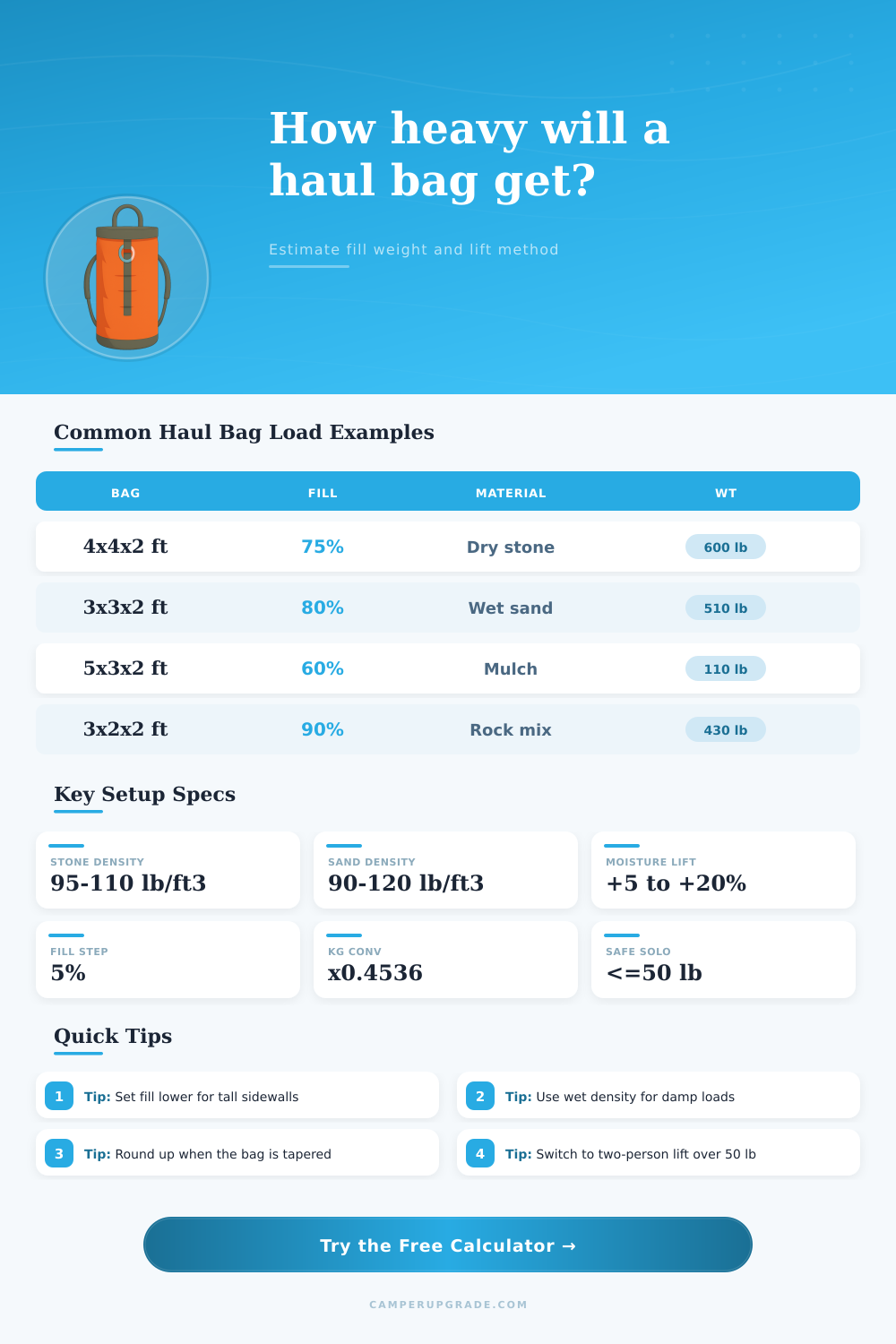
Big Wall Haul Bag Weight Calculator
Estimate filled bag weight, payload volume, and safe handling method for stone, sand, mulch, and other wall-haul loads.
Material density reference
| Material | lb/ft3 | kg/m3 | Typical note |
|---|
Bag style factor guide
| Style | Factor | Volume feel | Best for |
|---|
Fill level to load guide
| Fill | Half-full | Three-quarter | Full bag |
|---|
Handling band guide
| Weight band | Method | People | Note |
|---|
Tip: If the bag is tall and narrow, reduce fill before you adjust density. Geometry changes the load as much as the material does.
Tip: Wet sand, damp soil, and compacted stone can jump fast. Re-run the calc after rain or after a load has settled overnight.
In order to accurately estimate the weight of an haul bag, it is first necessary to understand why it is important to be able to determine the weight of the haul bag. The ability to understand the weight of the haul bag allow a person to plan a lift that will be safe for the individual that is to perform the lifting of that haul bag. If a person dont understand the weight of the haul bag, the person may attempt to lift the haul bag that is too heavy for that individual, which could lead to injury to that person.
Because haul bags can contain many different type of materials, the density of those materials can change. For instance, stone is a material that has a high density, but mulch is a material that has a low density. Thus, the weight of the haul bag can change based off the type of material that is placed into the haul bag.
How to Estimate the Weight of a Haul Bag
In addition to considering the type of material that will be placed into the haul bag, it is also necessary to consider the effects of moisture on the weight of the haul bag. Moisture will add to the weight of the materials, and that added weight can be twenty percent or more of the total weight of the materials. For instance, dry stone will have a different weight than wet stone, and the same with dry sand versus wet sand.
Thus, the weight of the haul bag must account for the effects of moisture on the materials. Additionally, different materials will settle different within the haul bag. For instance, sand will settle into the corners of the haul bag.
As a result of the settling of these materials, the density of the materials within the haul bag will increase. Thus, the weight of the haul bag will increase with the settling of those materials within the haul bag. In order to calculate the weight of the haul bag, it is first necessary to calculate the volume of the haul bag to be moved.
The volume can be calculated by multiplying the length of the haul bag by the width of the haul bag and the height of the haul bag. You can then adjust the calculated volume for the fill level of the haul bag and the shape of the haul bag. Finally, you can multiply the calculated volume of the haul bag by the density of the materials to be placed within the haul bag to calculate the total weight of the haul bag.
Based upon the total weight of the haul bag, there are guidelines as to how that haul bag should of be handle. For haul bags that weigh less than fifty pounds, one individual is capable of perform the lifting of that haul bag. For haul bags that weigh more than fifty pounds, two individuals is required to lift the haul bag.
Finally, individuals should not lift haul bags that weigh more than ninety pounds, but instead should move them with the use of a cart or other moving machine. Finally, it is always better for an individual to use a conservative estimate when calculating the weight of a haul bag. Using a conservative estimate ensure that the individual does not suffer an injury when lifting the haul bag.
For instance, if the estimate for the weight of the haul bag is too low, it will be easy to use additional individuals or tools to move that haul bag. However, if the weight of the haul bag is overestimated, those additional individuals will think that the haul bag is lighter than it is actualy, and individuals may suffer an injury attempting to move that haul bag. Thus, it is important to always account for moisture, density, and settling within the haul bag when calculating the weight of that haul bags.