🏔️ Climbing Rope Length Calculator
Plan rope length for lead climbs, rappels, top ropes, fixed lines, and multi-pitch routes
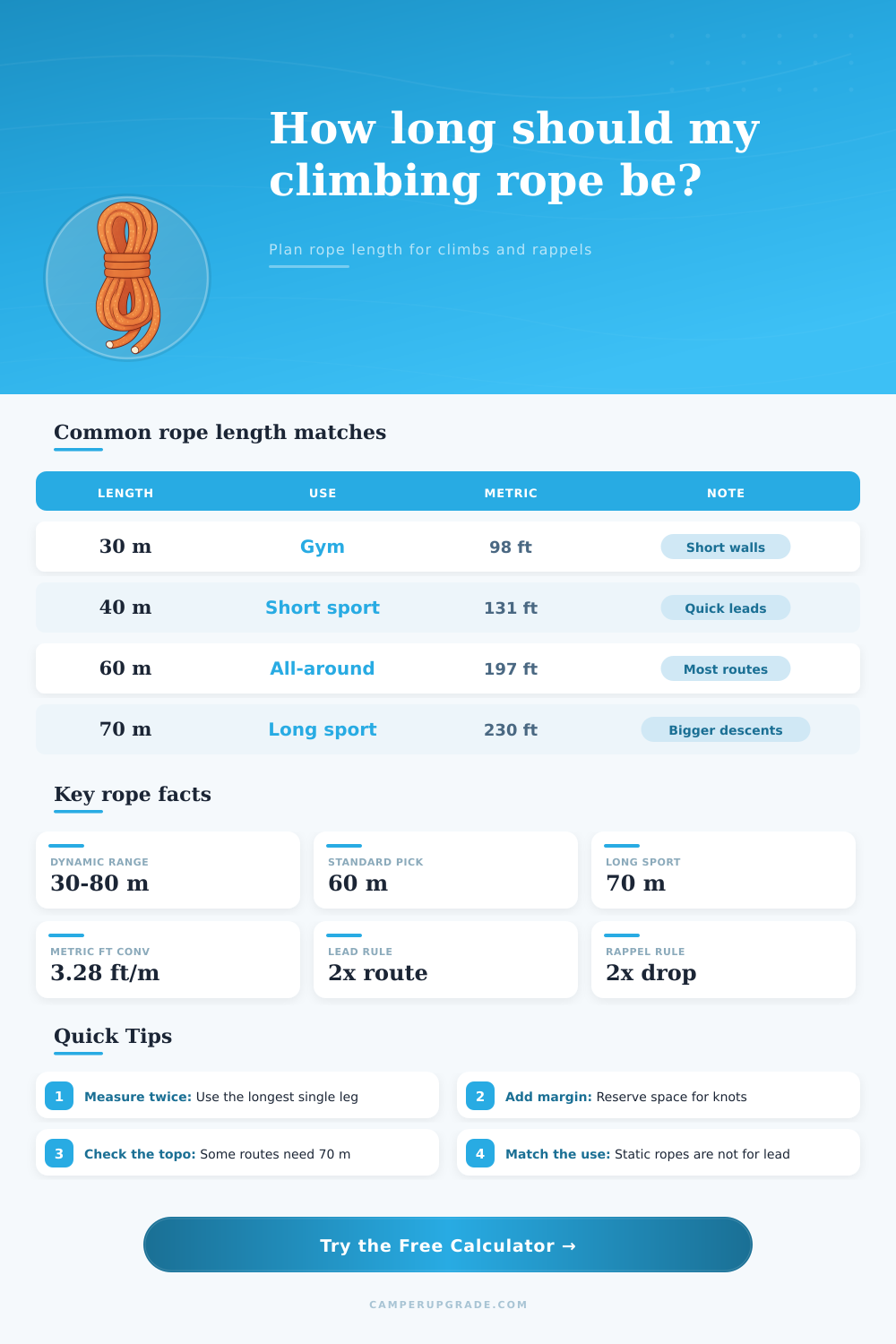
| Length | Feet | Typical use | Notes |
|---|---|---|---|
| 30 m | 98 ft | Gym wall | Short indoor lines |
| 35 m | 115 ft | Indoor / gym | Longer gym routes |
| 40 m | 131 ft | Short sport | Compact crags |
| 50 m | 164 ft | Sport / trad | Mid-length routes |
| 60 m | 197 ft | All-around | Most common pick |
| 70 m | 230 ft | Long sport | Some routes need it |
| 80 m | 262 ft | Big routes | Extra descent room |
| 100 m | 328 ft | Specialty use | Alpine or rescue |
| Use | Base math | Rope type | Best fit |
|---|---|---|---|
| Top rope lower | 2 x span | Dynamic single | Gym and cliffs |
| Lead climb lower | 2 x span | Dynamic single | Sport and trad |
| Rappel | 2 x drop | Dynamic or static | Downclimb backup |
| Fixed line | 1 x line | Static line | Haul or rescue |
| Multi-pitch lead | Max pitch | Dynamic pair | Wandering routes |
| Multi-pitch rappel | 2 x total | Dynamic pair | Descending long routes |
| Gym lead | 2 x wall | Dynamic single | Indoor ropes |
| Rescue line | 1 x line | Static line | Fixed-load tasks |
| Allowance | Typical value | Why it exists | When to add it |
|---|---|---|---|
| Anchor setback | 1-3 m | Edge and rigging space | Outdoor lowers |
| Knot tail | 1 m | Keep tie-in tail safe | Any climb or rappel |
| Belay station | 0.5-2 m | Build a comfortable stance | Multi-pitch |
| Planning reserve | 10% | Coverage buffer | Unknown topo |
| Stretch allowance | 5-10% | Loaded rope elongation | Dynamic ropes |
| Route drag | 1-2 m | Wandering line slack | Traverses |
| Extra rappel | 1 m | Exit and knot room | Long descents |
| Custom margin | 5% | Personal comfort | Remote climbs |
| Scenario | Input | Suggested rope | Notes |
|---|---|---|---|
| Gym top rope | 18 m wall | 30 m | Short indoor rope |
| Short sport | 25 m pitch | 50 m | Small crag routes |
| All-around sport | 30 m pitch | 60 m | Standard choice |
| Long sport | 35 m pitch | 70 m | Topo check required |
| Double-pitch | 2 x 20 m | 60 m | Both pitch and rappel |
| Long rappel | 30 m drop | 60 m | Two-leg descent |
| Fixed line | 40 m line | 50 m | Static line use |
| Rescue line | 55 m line | 60 m+ | Leave spare room |
When determining the length of a rope for climbers, the length of the rope is one of the crucial factor that will ultimately determine whether or not the person can complete that climb and return to the ground. Many people makes mistakes with the length of the rope that they purchase for there climbing adventures. Most of the time, the length of the rope isnt just based on the measurement that are listed in the guidebook for the area that they are planning to climb.
People must take into account the length of the anchor points, the length of the rope that will stretch when descending the rock wall, and the length of the rope that they will use to tie in knot when climbing. If an adventure plan includes the proper length of rope, the person will have an easier time climbing the mountains and completing the climb. However, if the person does not make plan for the correct length of rope for the climb, they will find themselves in a position where they have to improvise with the rope that they have.
How to pick the right rope length for climbing
For most climbing adventures, the length of the rope that will work best is a rope that is at least two times the length of the pitch of the climb. For example, if a person is leading a 30-meter pitch, they will require a 60-meter rope to perform the climb and descend the mountain. When rappelling, the climber will have to double the rope to allow for the person to descend the mountain on a rope attachment to the mountain.
However, there are several factor that can change the length of the rope that a person will need for the adventure. First, the location of the anchors for the climb may be back from the edge of the cliff by one or two meters. This will consume some of the rope that a climber will require for their climb.
Additionally, when a climber stretches dynamic ropes during a fall, the rope will stretch to allow for the rope to extend beyond the length of the fall that occur. In this case, the rope will have to be longer than the length that would otherwise be require for the climb. Another activity that is common in climbing gyms is top roping.
During this activity, people can become complacent about the length of the rope that they use. For instance, if the climbing gym features an 18-meter wall, a person may think that a 30-meter rope is going to be sufficient for that climb. However, they must also take into account the setback of the anchor point for that climb.
If the anchor point for that climb is two meters from the edge of the climbing gym wall, then the rope will not be long enough to complete the climb to the top of the gym wall. Even though the stretch of the rope is less of a concern during top roping activities, the length of the tail of the rope is important. Some people will purchase the shortest rope that will meet the requirement for that gym wall.
However, the shorter the rope, the more likely that the rope may get pinched against the anchor point for the climb. Thus, the length of the rope should be measured from the belayer to the highest point of the climb and back to the belayer, and there should be extra length in the rope to accommodate the climbing gear. Finally, sport leading is an activity that is different than top roping.
For this type of sport climbing activity, a 60-meter rope is the standard length for climbers. This length of rope is long enough for most climbing routes that are 28 meters or less in length. However, if the person intends to climb a 35-meter pitch in the mountains, then a 60-meter rope will not be sufficient for the climb.
In this case, a 70-meter rope would be better for the sport leading activity. If a person uses half ropes or twin ropes, they can rappel further distances. However, half ropes and twin ropes require more management.
When sizing a rope for climbing, measure for the longest leg of the climb, not the total distance of the climbs. For instance, a two-pitch route may be easily climbed with 50 meters of rope for each pitch, but the distance to rappel the entire route would be double the total drop of the route. Multi-pitch climbs present more complexity with the need for space to establish belay stations at each pitch.
For instance, three 25-meter pitches would total 75 meters of climbing distance, but the rope for rappelling would have to cover 100 meters of rope. Many leaders will carry two 60-meter ropes for rappelling to accommodate for different climbing systems, but a long rope is useful for single-pitch routes. Static lines are another type of rope used in rock climbing but with a different purpose than dynamic ropes.
Static lines do not stretch like dynamic ropes. They are useful for hauling gear uphill but are not used to lead a climb up a vertical rock face. Some of the common error in rock climbing include ignoring the requirements for the type of rope to be used.
For instance, the length of the rope needed for a route may be noted at 30 meters in a guidebook. A novice climber might purchase a 60-meter rope without knowing that the setbacks in the anchors for each pitch could steal three meters of rope per leg of the climb. Another common mistake is forgetting to account for the length of rope needed to tie in a figure-eight knot for the climber.
This will result in the belayer not having enough rope for the tail of the knot. To avoid these and other mistake, climbers should reserve at least 10 percent of their rope for the unknown, such as wandering off of the marked route. Account for the stretch of the rope when measuring the length of rope needed for each route.
This will ensure that the rope can reach the marks necessary to climb the rock face with the rope when under load. Measure the length of rope needed for the specific route that will be ascended. Some climbing gyms have shorter walls to climb, whereas big walls and rescue climbs may require 80 meters or 100 meters of rope to ascend and descend the rocks.
Always read the fine print in the guidebooks for notes on minimum length of rope for specific types of rappels. Always test the rope system on the ground while ensuring that there is enough rope for the figure-eight knot to be tied in properly. The diameter and the weight of the rope will impact how easily a person can ascend the rock face.
Using a heavy rope may create more drag when ascending than a lighter rope. By anticipating the specifics of the route and appropriately sizing the rope for the challenges of that route, rock climbers will have enough rope to ascend the rock face of any degree of difficulty.