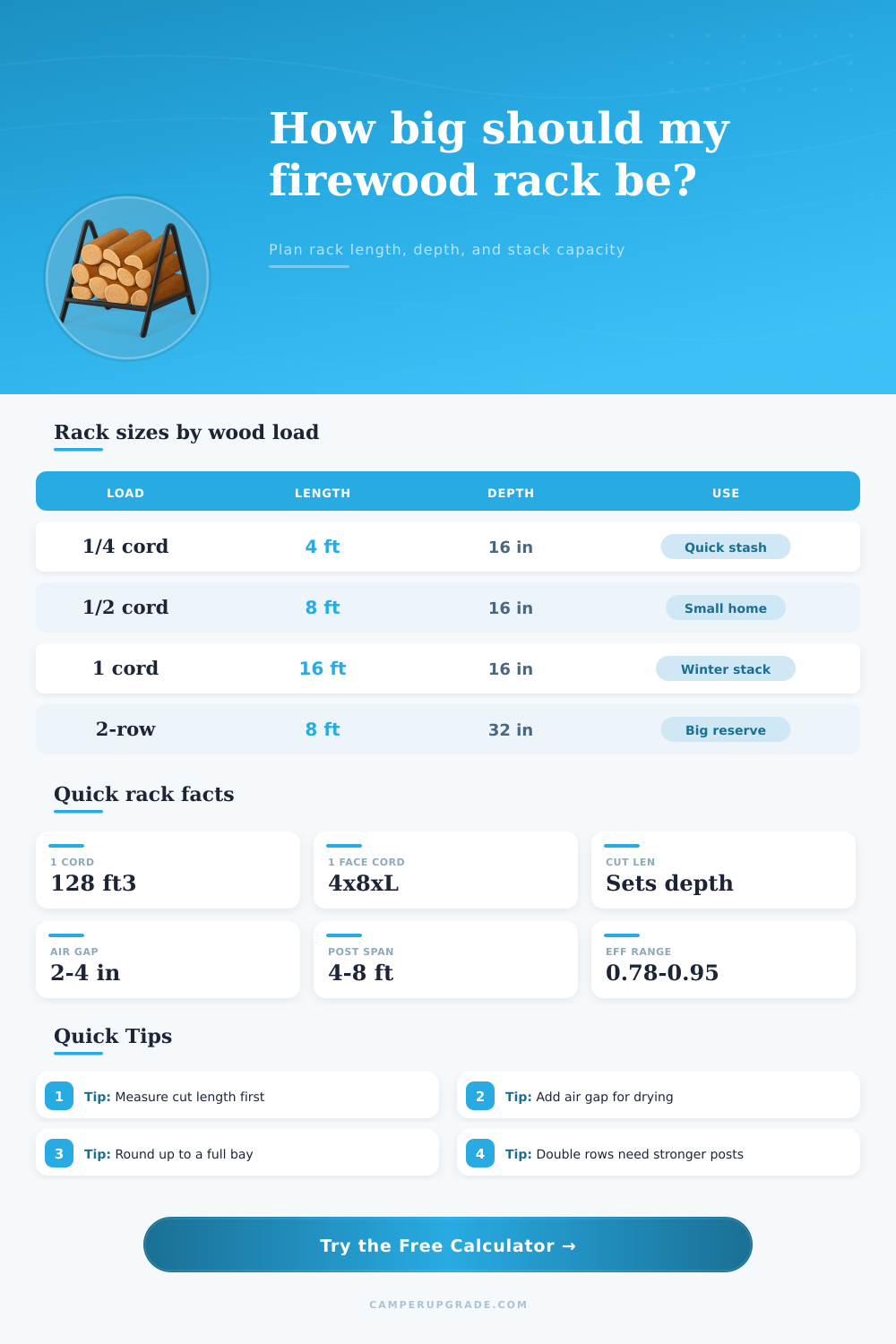
Firewood Rack Size Calculator
Plan the right rack length, depth, height, and row count for any firewood stack.
Full breakdown
| Rack size | Length | Depth | Common use |
|---|
| Cut length | Single row | Double row | Note |
|---|
| Style | Factor | Gap | Use |
|---|
| Span | Posts | Best for | Note |
|---|
Tip: Use cut length as the depth baseline.
Tip: Round up to the next full bay span.
A firewood rack is a structure that is use to store firewood. Additionally, a firewood rack is also a tool that assist in the seasoning of the firewood. If a firewood rack is built with the correct dimension and with the proper planning, the firewood will stay dry.
However, if a person builds a firewood rack with the incorrect dimensions, the firewood may become a soggy mess. A firewood rack allows for airflow to the firewood, and it elevates the firewood off of the ground to avoid any moisture from the ground. Many people will try to store their firewood against a wall or fence to save space.
How to Build and Use a Firewood Rack
However, if the firewood is stored against a fence or wall, it may fall down. In order to build a firewood rack that will properly accommodate the firewood that will be split, the length of the firewood should be considered when constructing the rack. The length of the firewood will dictate the depth of the rack.
The depth of the rack should be measured in relation to the length of the firewood, and there should be a few extra inches provide for the person’s hands to be able to easily grab the firewood. If a person constructs the firewood rack with a very tight stack of firewood, then the rack will hold more firewood. However, because firewood will choke when drying in this fashion, it is not the best way to store firewood.
Alternatively, constructing the firewood rack with a loose stack of firewood will allow the firewood to breathe. However, this will waste some of the storage space within the rack. Another consideration in the building of a firewood rack is the number of rows of firewood that will be stored in the rack.
If you are constructing a rack with two rows of firewood, the amount of firewood that can be stored is doubled. However, the posts will need to be more thick to support the weight of the firewood in the second row. The number of rows that are constructed can be calculated by considering the number of cord of firewood that will be burned during the winter months.
For instance, if a household burns half a cord of firewood during the three-month winter period, the firewood rack will need to be constructed to hold half a cord of firewood. If the firewood rack will be constructed in an area that experiences alot of wind, constructing it as an open-air firewood rack may be best for allowing the wood to dry. Alternatively, in an area that receives a lot of rain, constructing a covered firewood rack or placing the rack within a shed bay will protect the firewood from excessive rainfall.
In this case, though, the firewood may lose some of its density to allow for the coverage. Hardwood wood, such as oak, may be stored in the firewood rack in a breezy manner as this hardwood holds moisture for a long period of time. Green pine, which contains sap, should also be stored in a breezy manner to allow the sap to dry.
The support structure for the firewood rack will determine the number of firewood rack post that will be needed. A firewood rack that is four feet in span will require fewer posts. The posts will need to be made of stiff wood.
For firewood racks that span eight feet in length, more posts will be needed. Additionally, the rack may need to incorporate cross-bracing to the posts to ensure that the rack does not sag under the weight of the firewood that is placed within the rack. Air gaps should be left between the rows of firewood that is stored in the firewood rack.
Two inches of space between the rows of firewood will allow moisture to escape from the core of the firewood rack. The core of the firewood rack is the portion of the firewood rack whose firewood stays wet the longest. Additionally, the height of the firewood rack should be constructed to approximately four feet in height.
This will allow the person to easily reach the firewood without the use of a ladder. However, if the firewood rack is to be constructed to tall heights, it will need to be braced in order to ensure that the rack does not topple over. The type of firewood that will be stored in the firewood rack will have an impact upon the way in which the firewood rack is to be used.
For instance, birch will season quickly when stored in a firewood rack; however, if the airflow in the firewood rack slows, the birch may mold. Oak holds moisture for a long time, so placing hardwoods like oak in the firewood rack in a breezy manner may be best. Locust wood burns for a long time, so locust logs may require deeper rows in the firewood rack.
The length of the firewood to be stored in the firewood rack will also impact the depth of the firewood rack. For instance, firewood that splits into 12-inch lengths requires firewood racks that are 16 to 18 inches deep. Stove logs that are 20 inches in length will require firewood racks that are 24 to 26 inches deep in order to allow for the firewood to be easily inserted into the rack.
The materials that are used to construct the firewood rack should be strong enough to support the weight of the firewood that is stored within the rack. Four-by-four pressure-treated wood can be used for the posts of the firewood rack. Additionally, two-by-four wood can be used for the slats that make up the firewood rack.
The slats should be constructed to be slightly narrower than the length of the firewood to be stored. The posts of the firewood rack will need to be anchored deep into the ground. Additionally, the posts should be anchored at least 30 percent below the ground level so that the expansion of the roots of plants that grow in the ground does not be undermine the firewood rack.
If you are going to cover the firewood rack in a shed or barn or constructing it to cover the firewood rack with a roof, the roof should be slightly sloped to allow for the water that falls on the rack to run off of the roof. Most firewood racks will last for five years of use if maintained and if the wood that is stored in the rack is treated correctly. Additionally, if the firewood rack is constructed with galvanized hardware, it will last longer than if standard wood hardware is used to construct the rack.
Finally, in addition to knowing how the firewood rack is to be constructed and what type of firewood may be stored in the rack, there are steps that can be taken to load the firewood rack with firewood. The biggest and driest pieces of firewood should be placed at the bottom of the rack. Additionally, the wood should be stacked in a manner in which the ends of the firewood logs are crisscrossed.
This will provide additional stability to the firewood rack when the logs are stacked in this fashion. Only the top of the firewood should be covered with a tarp in order to allow moisture to escape from the wood. The tarp should be tuck in the sides of the firewood rack and lifted slightly to allow air to move through the firewood rack.
Finally, the firewood rack should be rotated so that some of the firewood is taken from the front of the rack and additional firewood is loaded into the rear portion of the firewood rack.