Campfire Wood Storage Calculator
Size the right storage length, depth, height, and reserve space for any campfire wood stack.
Full breakdown
| Load | Stack | Depth | Storage note |
|---|
| Split length | Single bay | Double bay | Note |
|---|
| Method | Efficiency | Clearance | Best use |
|---|
| Span | Posts | Best for | Note |
|---|
Tip: Best use cut length as the depth baseline.
Tip: Round up to the next full bay span.
Proper wood storage are necessary for maintaining a successful campfire. Proper wood storage will ensure that the wood remain dry and ready for use for starting a campfire. If a person dont plan for proper wood storage, a person may have issues with the dampness of the wood or the collapse of the woodpiles.
Some of the factors to consider prior to storing firewood include the dimensions of the wood, the volume of the wood require, and the method of stacking the stored firewood. The length of the firewood splits will determine the size of the wood racks. For twelve-inch splits, a person will need to use a shallow wood rack and use precise stacking method for the twelve-inch firewood splits.
How to Store Firewood for a Campfire
For eighteen-inch splits, a person will have a deeper wood rack and the eighteen-inch splits will create more larger flames. The length of the splits will dictate the amount of space that a person will need for there wood storage rack. This must be considered when a person begin to store their firewood to ensure that their storage remain organized.
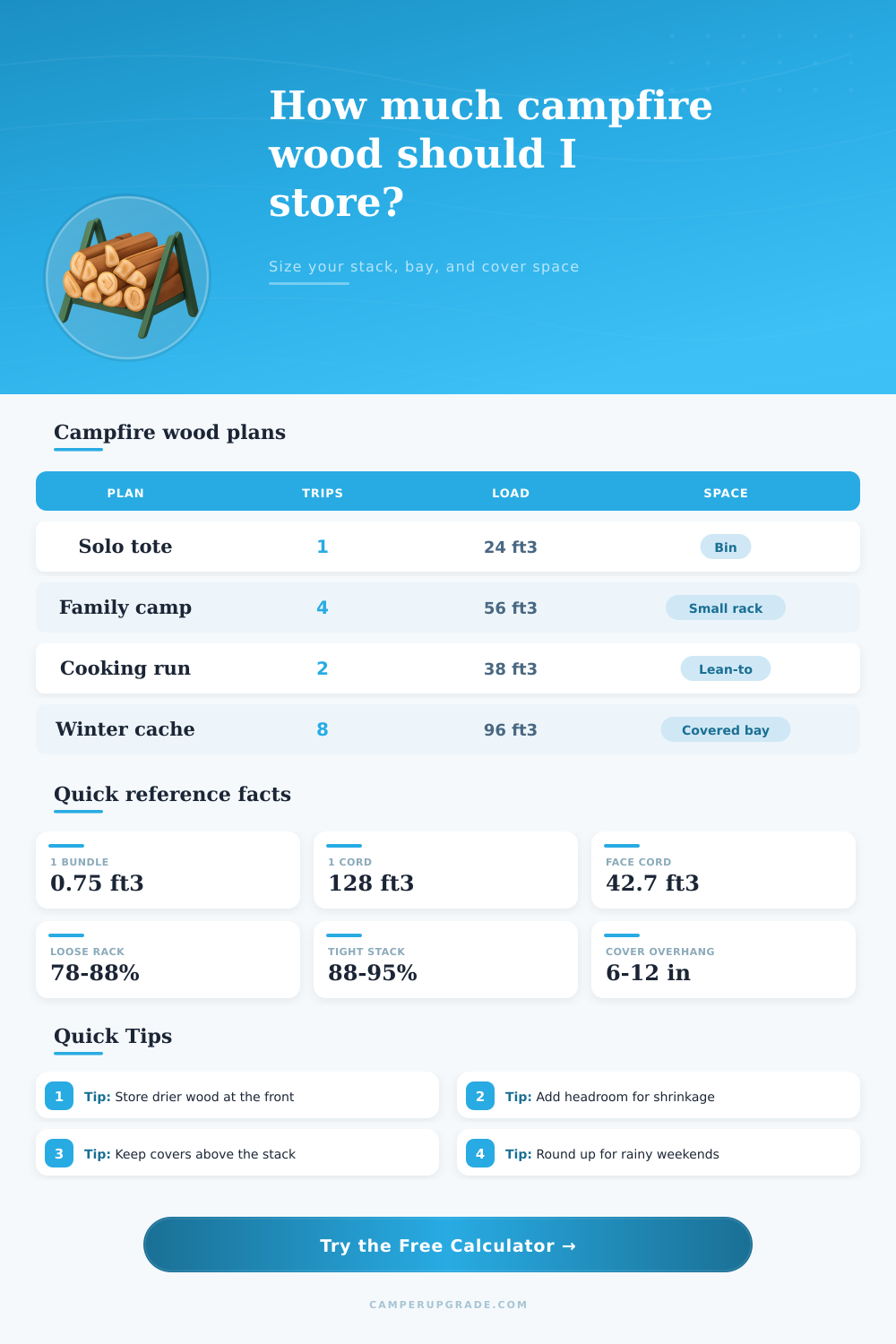
The amount of wood that a person will require will depend on the length of the camping trip and the number of individual that will be camping. For instance, a single person who is camping for the weekend will require approximately twenty-four cubic foot of wood. In contrast, a family that is camping for four nights will require fifty-six cubic feet of wood.
Twenty-four cubic feet of wood will be necessary for camp cooking stove, and ninety-six cubic feet of wood may be required for winter storage. The density of the stacked firewood will dictate how much firewood can fit into a specific area. Tight stacking is ninety-five percent efficient at utilizing space.
Breezy stacking allow air to circulate through damp wood and is eighty-four percent efficient. Loose stacking of firewood is seventy-eight percent efficient but more wasteful of storage areas. Open racks must allow for the firewood to breathe but shed may store firewood close to the walls.
Additionally, using a pallet base for firewood storage will lift the wood off the ground and will prevent the wood from absorbing moisture from the muds. Four-foot racks require three support post to remain stiff. An eight-foot rack will require five support posts to remain sturdy and avoid bowing under the weight of the stored firewood.
If the rack bow under the weight of the stored firewood, it may become a safety hazard for the individual that is camping. Including two-inch air gaps between rows of stored firewood will allow for proper airflow through the stored firewood. Firewood covers is necessary to protect the stored firewood from the elements.
The cover should not touch the stored firewood. The cover should overhang the wood rack by six to twelve inches to ensure that the stored firewood does not absorb humidity from the cover. Additionally, the driest firewood should be stored at the front of the rack to allow for easy access of the firewood.
Due to the knowledge that firewood shrink as it seasons, extra headroom should be provided within the wood rack. A face cord contain forty-two cubic feet of firewood when stored neatly. If stored in a loose firewood rack, the firewood will take up only seventy-eight to eighty-eight percent of the total areas.
The wood that is stored in a rack will change over time. The green wood will shrink by ten to twenty percent when seasoned. Therefore, a person must allow for this when stocking firewood.
If a person plans on storing firewood on the ground, they should consider the terrain. If the ground is sloped, level pallet will allow for even storage of firewood such that it does not roll off the pallets. If the soil is sandy, a gravel base will keep the firewood rack from sinking into the ground.
Many people makes mistakes when they build a wood rack. One of the most common mistake is that people do not account for the thickness of the support posts. People build wood racks too highly without providing enough clearance at the base for the bottom logs to dry out and potentially rot.
Finally, the depth of each row of firewood will multiply the total area of the firewood rack. Ensure that a person consider all factors prior to building a wood rack, and the firewood will remain dry and the campfire will burn steady.