🌲 Firewood Moisture Calculator
Measure wet-basis moisture, estimate water load, and plan the drying time needed for cleaner, easier burning wood.
Use the total stack, tote, or load you want to dry-plan.
| Band | Wet MC | Dry basis | Best use |
|---|---|---|---|
| Kiln dry | 0-12% | 0-14% | Kindling |
| Excellent | 13-16% | 15-19% | Top heat |
| Seasoned | 17-20% | 20-25% | Normal burn |
| Damp | 21-25% | 26-33% | More drying |
| Greenish | 26-30% | 35-43% | Stack first |
| Fresh cut | 31-40% | 45-67% | Long season |
| Wet round | 41%+ | 69%+ | Not ready |
| Wet core | Meter low | Core wet | Split again |
| Species | Density | Meter offset | Drying note |
|---|---|---|---|
| Oak | Dense | +1% | Stable drying |
| Ash | Medium | -2% | Reads a bit low |
| Hickory | Very dense | +2% | Holds moisture |
| Maple | Medium | 0% | Good baseline |
| Pine | Light | -6% | Dries fast |
| Cedar | Light | -7% | Quick response |
| Birch | Medium-light | -1% | Even drying |
| Beech | Dense | 0% | Slow, even dry |
| Locust | Very dense | +2% | Tricky core |
| Cherry | Medium | -1% | Moderate speed |
| Factor | Choice | Multiplier | Meaning |
|---|---|---|---|
| Split size | Kindling | 1.28 | Fastest dry |
| Split size | Small splits | 1.12 | Quick dry |
| Split size | Standard splits | 1.00 | Baseline |
| Split size | Chunky splits | 0.86 | Slower dry |
| Split size | Rounds | 0.72 | Very slow |
| Airflow | Open rack | 1.18 | Strong air |
| Airflow | Breezy row | 1.08 | Good flow |
| Airflow | Moderate | 1.00 | Normal flow |
| Airflow | Sheltered | 0.86 | Protected |
| Cover | Top cover | 1.06 | Open sides |
| Current MC | Water share | Dry share | Ready note |
|---|---|---|---|
| 10% | 10% | 90% | Excellent |
| 15% | 15% | 85% | Very good |
| 20% | 20% | 80% | Useable |
| 25% | 25% | 75% | Borderline |
| 30% | 30% | 70% | Still wet |
| 40% | 40% | 60% | Green load |
| 50% | 50% | 50% | Very wet |
| 60%+ | 60%+ | 40%- | Fresh cut |
Firewood moisture contents is an important factor to consider when use wood stoves to burn wood. The moisture content of firewood will determine the amounts of heat that can be emitted from the fire. If the firewood contain a high amount of moisture, the firewood will produce smoke yet produce less heat.
However, if the firewood contains less moisture, the firewood will burn more cleanly and produce more heat. Thus, firewood moisture content must be managed in order to efficiently heat an room with the firewood. Firewood that contains high amounts of moisture are known as green wood.
Why Dry Firewood Is Better and How to Dry It
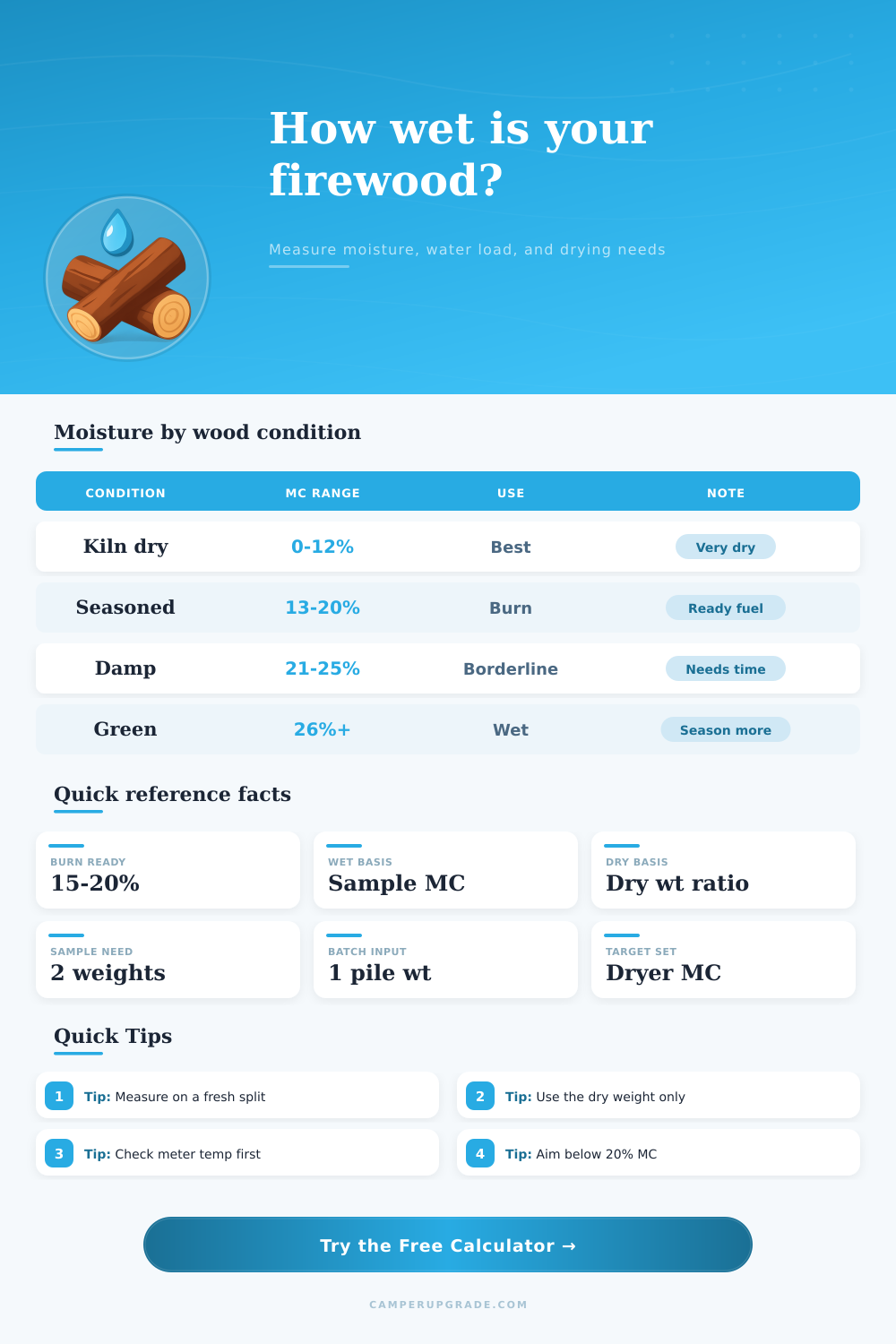
Green wood is freshly cut wood from trees, and it contains a high amount of water. Due to the high moisture content of green wood, it isnt suitable for burning in a stove. For optimal burning of firewood, moisture content should be below 20%.
If firewood contains more than 20% moisture, the firewood will create a creosote buildup in the chimney of the stove. The way in which a person stacks firewood will impact the rate at which the moisture content of the firewood decrease. If firewood is piled into a large stack under a tarp, the moisture content of the firewood will decrease slowly due to the inability of air to circulate around the firewood.
However, if the person stack firewood into a single row with a cover only provided on the top of the firewood, the air can circulate around the firewood allowing moisture to evaporate. Additionally, firewood should also be lifted off of the ground to allow air to circulate underneath the firewood. Finally, splitting the firewood into smaller pieces will increase the surface area of the firewood, leading to an increased rate of evaporation of moisture from the firewood.
Some species of wood will dry at different rates then others. For instance, wood species that has open grains, like pine and cedar, will lose moisture quickly. In contrast, wood species that are very dense, like hickory and locust, will hold moisture within there center for longer periods of time.
Thus, the moisture content within the center of the wood pieces must be measured to accurately assess moisture content of firewood. Firewood moisture content can be measured with a moisture meter or with an oven-drying method. A moisture meter will provide a quick measurement of the moisture content of firewood; however, the meter should be calibrated to the species of wood being measured.
Additionally, the oven-drying method is more accurate in measuring moisture content. To use this method, a person will weigh a sample of firewood, dried it in an oven, and then the person will weigh the dried firewood again to determine the percentage of moisture content of the firewood sample. Several samples of firewood should be tested from different portion of the firewood stack.
For instance, moisture content may vary for firewood at the top of the firewood stack compared to the bottom of the firewood stack. Using dry firewood when burning in a wood stove provides a variety of benefits. For instance, dry firewood will produce more heat per cord of firewood burned, and it will produce less smoke.
Additionally, dry firewood will create less creosote buildup in the chimney of the stove, which make the stove safer to use. Furthermore, dry firewood will burn more completely than wet firewood, which means that there is fewer particulates released into the air. Finally, if wet firewood is used in the stove, the stoves glass will become dirty from the smoke created by the wet firewood, which must be cleaned more often.
Youll find that dry wood is much more comfortaly to use. It’s a lot better than using wet wood which could of caused a chimney fire.