🌲 Pine Firewood BTU Calculator
Estimate usable heat from pine cords, moisture, stack shape, and stove efficiency with realistic woodpile math.
Fixed modes use standard woodpile volumes. Custom stack uses your dimensions.
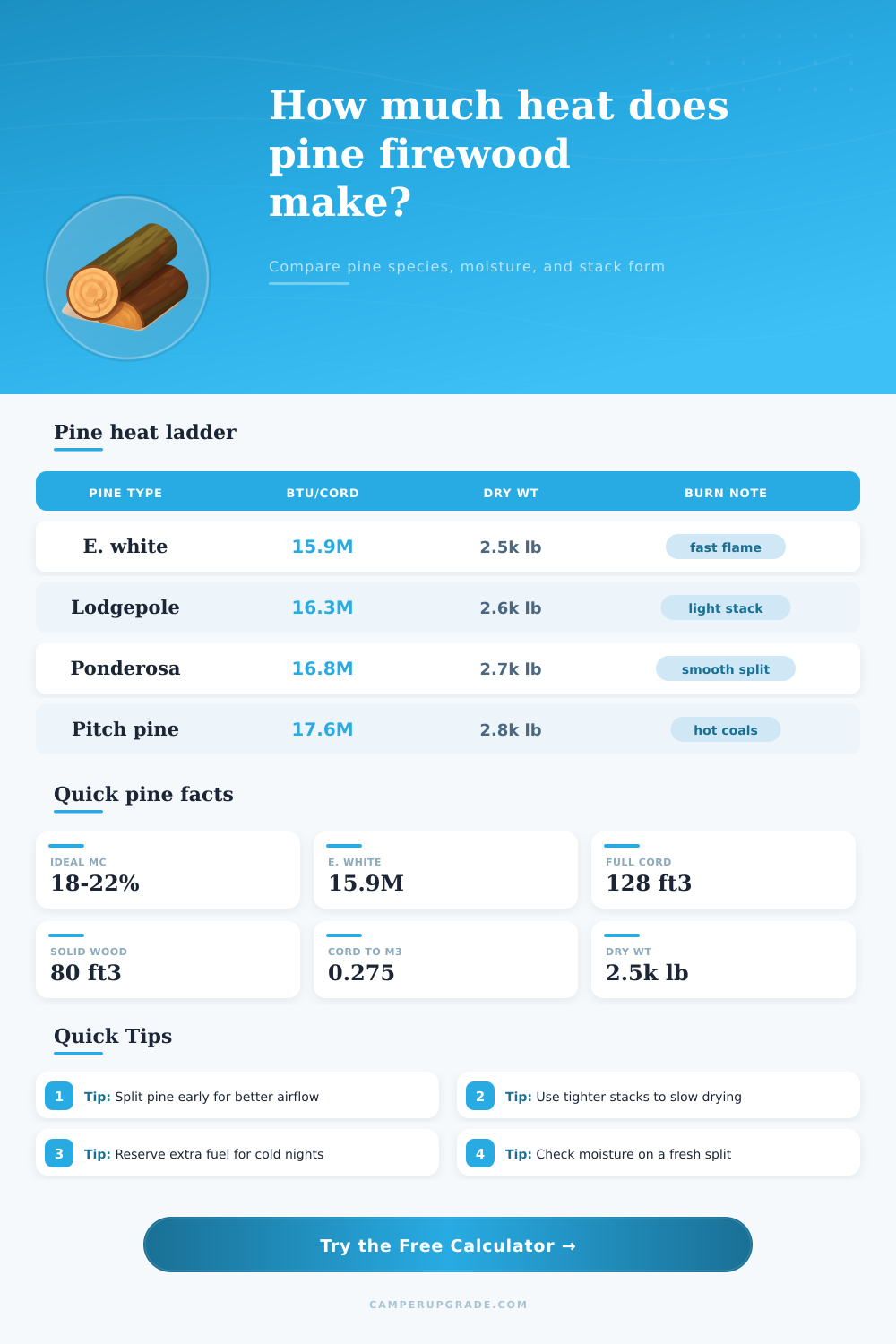
| Species | BTU/Cord | Dry Wt | Burn Note |
|---|---|---|---|
| E. white pine | 15.9 MMBtu | 2,500 lb | Fast flame |
| Lodgepole pine | 16.3 MMBtu | 2,580 lb | Light stack |
| Ponderosa pine | 16.8 MMBtu | 2,650 lb | Smooth split |
| Pitch pine | 17.6 MMBtu | 2,800 lb | Hot coals |
| Measure | Cord Eq. | Stack Ft³ | Use |
|---|---|---|---|
| Full cord | 1.00 | 128.0 | Base unit |
| Face 16 | 0.33 | 42.7 | Thin wall |
| Face 18 | 0.38 | 48.0 | Common rack |
| Face 24 | 0.50 | 64.0 | Deep rack |
| Moisture | Factor | Seasoning | Note |
|---|---|---|---|
| 12% | 1.05 | 18+ mo | Very dry |
| 18% | 1.01 | 12-18 mo | Ready |
| 24% | 0.93 | 6-12 mo | Damp edge |
| 30% | 0.84 | 0-6 mo | Hard start |
| Load | BTU/hr | Hours | Note |
|---|---|---|---|
| Camp glow | 8,000 | 14-18 | Fast flame |
| Cabin heat | 10,000 | 10-14 | Easy pace |
| Night bank | 14,000 | 8-11 | Good reserve |
| Cold snap | 16,000 | 6-9 | Smaller load |
Check moisture on a fresh split, not the shell.
Use tighter stacks when you want slower loss.
Pine is one of the woods that many people uses for heating purposes. People use pine because pine is often easy to find and easy to split. However, there are different types of pine, and the type of pine will burn to produce different amount of heat.
For instance, eastern white pine is a light wood that burn quickly, whereas pitch pine is a denser type of wood that can create hotter coals that last for longer periods of time. To manage the wood supply, people must understand how pine burns and how pine dries so that they can maximize the amount of heat output from the pine. People need to take into account the measurement of the wood that they use for heating.
Using Pine Wood for Heat
A cord of wood contain 128 cubic feet of wood. The common mistake that many people make is purchasing wood that people have loosely stacked. If wood is loosely stacked, it will contain up to 20 percent less wood then it would if it were tightly stacked.
People can use a calculator to determine the volume of the pine wood they have and to convert those measurements from feet to meter or from meters to feet. In the case of wood, people use a 16-inch face cord measurement to determine how much of the 16-inch face cord they have available for heating. Another essential factor to consider for burning pine is the moisture content.
If the pine has too much moisture in it, it will not burn good and will release very little heat. Freshly cut pine contains 40 percent moisture content or more, which make the wood stove produce steam instead of heat. For the best heating output from the pine, the moisture content should be between 18 and 22 percent.
To reach this moisture level, people can season the pine. If the pine is season for six month, it will be somewhat dry. However, if it is allowed to season for a year or more, the pine will be dry enough to produce a steady amount of heat.
People can split the pine to allow it to dry faster, or they can choose to stack the wood tightly or loosely. People also should consider the efficiency of the woodstove they use. Most woodstoves will not reach 100 percent efficiency.
The most common efficiency for moddern woodstoves is 80 percent, whereas older woodstoves will lose a significant amount of heat through the chimney. To determine the usable heat output of the pine, calculate the gross BTU output of the pine and then subtract the amount of heat that is lost to the stove’s inefficiency. For example, if a cabin requires 12,000 BTUs of heat per hour to remain warm, calculate how many hours a specific amount of pine will last at that output level.
If people use dry ponderosa pine, one face cord of pine may provide eight to ten hours of heat output. However, that output may change if the moisture content of the wood increase. There are numerous different species of pine that people can use for heating.
Eastern white pine is a light wood that people can use to start fires since it will burn quickly. Lodgepole pine is a slim wood that is suitable for small stove since it is a lightweight wood. Ponderosa pine is balanced and will burn steadier without too much popping.
Pitch pine is a dense wood with a significant amount of resin, which make it great for creating very hot coals. People can also mix different type of pine to create an even burn in the fire. People should avoid some mistake when it comes to using pine for heating.
One of the most common mistakes is using the outside of a log to test the moisture content of the wood. This is inaccurate because the center of the log will remain wetter than the outside of the log. Instead, people should split the log to reveal the moisture content in the center of the log.
People should store their wood off the ground so that the pine can be exposed to the air. Only the top portion of the wood should be covered to protect the wood from rain. People should also ensure that there is a reserve of pine logs that can be used during the extreme weather months when the pine will be required to provide more heat output.
Depending on the heat output that is desired in the cabin, the amount of pine that will be burned over time will change. For instance, if the desired heat output is 8,000 BTUs per hour, less wood will be required over a longer time period. In the scenario where the desired heat is 16,000 BTUs per hour, more wood will be required over a shorter time period.
In either scenario, ensure that there is a 10 percent reserve of wood when purchasing the pine. If people take the time and effort to properly manage the moisture content of the logs and to purchase the correct species of pine, the pine logs will provide steady heat throughout the night.