🌳 Walnut Firewood BTU Calculator
Estimate usable heat from walnut cords, moisture, split size, and stove efficiency with realistic stacked-wood math.
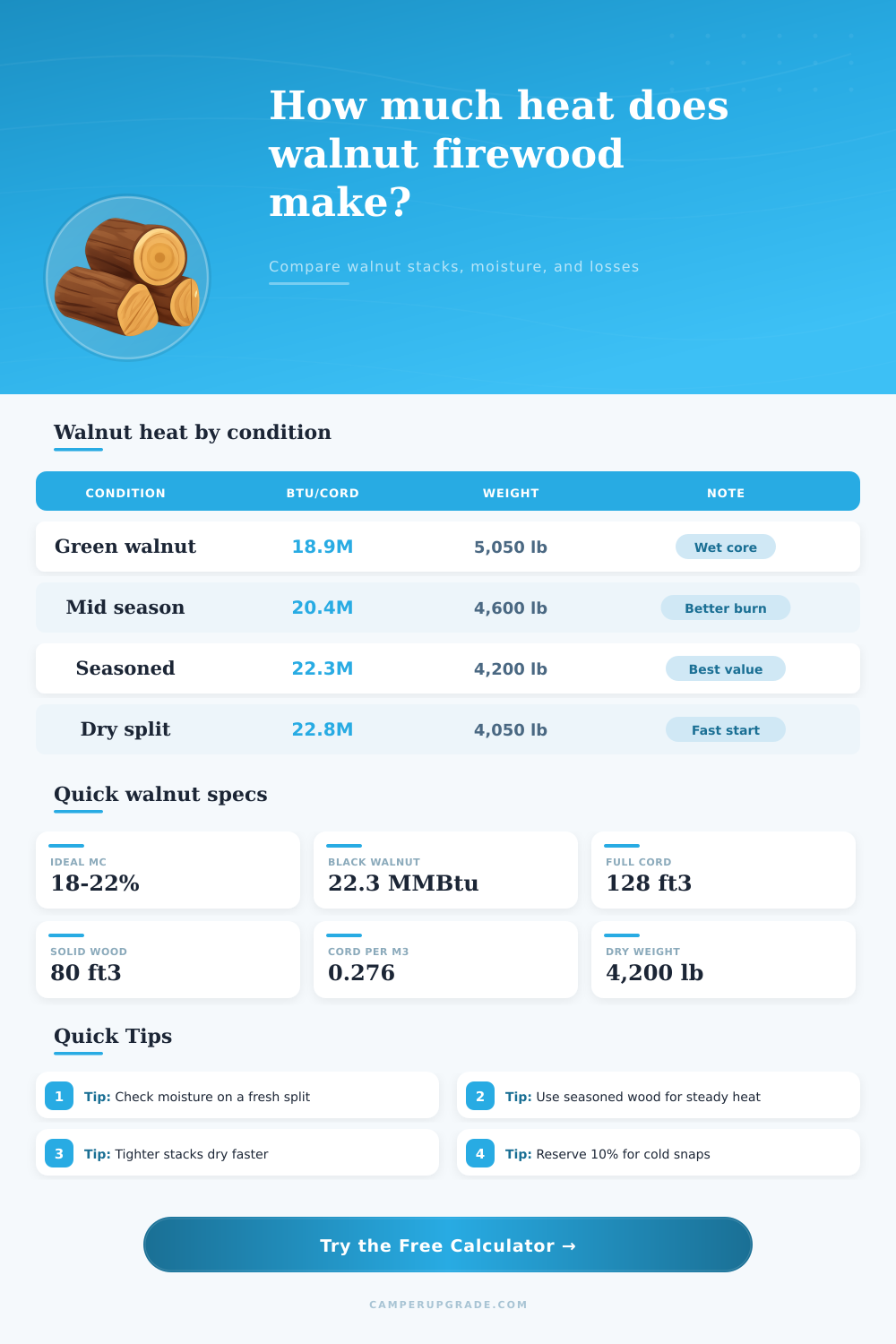
| Condition | BTU/Cord | Weight | Note |
|---|---|---|---|
| Green walnut | 18.9 MMBtu | 5,050 lb | Wet core |
| Mid season | 20.4 MMBtu | 4,600 lb | Better burn |
| Seasoned | 22.3 MMBtu | 4,200 lb | Best value |
| Dry split | 22.8 MMBtu | 4,050 lb | Fast start |
| Measure | Cord Eq. | Stack Ft3 | Use |
|---|---|---|---|
| Full cord | 1.00 | 128 | Base unit |
| Face 16 | 0.33 | 42.7 | Short wall |
| Face 18 | 0.38 | 48.0 | Common rack |
| Face 24 | 0.50 | 64.0 | Deep rack |
| Moisture | Factor | Split | Burn note |
|---|---|---|---|
| 12% | 1.05 | Small | Very dry |
| 18% | 1.01 | Medium | Ready |
| 24% | 0.93 | Large | Wet edge |
| 30% | 0.84 | Rounds | Hard start |
| Task | BTU/hr | Hours | Note |
|---|---|---|---|
| Small cabin | 8,000 | 8-12 | Easy load |
| Main heat | 12,000 | 6-10 | Typical stove |
| Cold snap | 16,000 | 4-8 | Hard burn |
| Night bank | 20,000 | 3-6 | Deep coal |
Measure moisture on a fresh split, not the outside shell.
Use the lower BTU result for cold weather planning.
Walnut is an type of wood that can be used as fuel for heating cabins and homes. Many individuals wants to ensure that the walnut they use will provide enough heat throughout the winter months. The amount of heat that the walnut will release, however, is dependent upon the moisture content of the walnut as well as the way in which a person stacks the walnut.
If the walnut have a high amount of moisture, it will release less heat than walnut that has less moisture content within its material. Black walnut burn hotter and releases more heat than other types of walnut, such as English and orchard walnut. Black walnut is a denser type of walnut.
How to Dry and Burn Walnut Wood for Heat
With its density, black walnut retain the coals produced from burning the wood for a longer period of time. If an individual cut black walnut logs, they will notice that the fresh logs are very heavy due to the presence of sap within the logs. A fresh cut black walnut weigh around 5,000 pounds per cord.
Once these logs season, however, they will weigh around 4,200 pounds per cord. The loss of the weight of the logs is due to the loss of moisture from the logs. As walnut lose moisture, it will release more heat.
The moisture content of the walnut logs is critical to the efficiency in which the walnut will burn. Ideal moisture content is 20% or less. If the moisture content of the walnut are 30% or more, the walnut will produce smoke and will not burn as efficient as it should.
Testing the moisture content of the walnut require splitting the log fresh and checking the split end rather than the dry exterior of the logs. For the best results, seasoning the walnut for 12 months is the minimum recommended time, but seasoning the wood for 18 months will enhance the heat output of the walnut. The way in which the logs are stacked will impact the drying rate of the walnut.
Piles of walnut that are covered will dry faster than logs that are in loose piles. Small splits of walnut will dry faster than large logs of walnut. A face cord is a common measurement of the amount of walnut that an individual own.
A face cord that is 16 inches in depth contain approximately one-third of a cord of walnut. To calculate the total number of cords of walnut that an individual owns, they may multiply the length, height, and the depth of the logs that they own, and then divide that total by the scale of a cord of wood. Depending on the appliance in which the walnut will be burned, the amount of heat that the appliance will output may vary.
For example, a wood stove will release more heat than an outdoor wood boiler. As such, the individual must account for the type of appliance when calculating the amount of walnut that is necessary for the individual. An individual should of always purchase between 10% and 15% more walnut than the amount that they calculate is necessary to ensure that they have enough fuel to endure the winter months within their desired climate.
Many individuals make mistake when preparing walnut logs to burn in their fireplace or stove. The most common mistake is from the assumption that the walnut logs are ready to burn. Using green rounds of walnut will result in the production of creosote inside the fireplace.
Additionally, if the logs are not split, there can be dampness in the center of the log, which will reduce the heat that that log gives off. An individual can use small splits of walnut logs to quickly gain heat in their hearth or stove, or they can use larger logs of walnut to slow maintain a glow throughout the night. The heating capacity of walnut is measured in BTUs.
One cord of seasoned, dry black walnut will produce approximately 22.8 million BTUs of heat, while green walnut will produce approximately 18.9 million BTUs of heat. The difference in BTUs is due to the amount of moisture that is within the green logs. An individual can calculate how many hours the walnut will provide heat to there home by dividing the total BTUs of the logs by the BTUs that their home requires per hour.
For example, if an individual’s cabin require 8,000 BTUs per hour, they will divide the total BTUs of the amount of walnut logs that they have by 8,000 to determine how many hours that the walnut will last. To maintain the walnut logs that are burning within an hearth or stove, a tarp should cover the logs. Additionally, the person should elevate the logs off the ground upon which they are placed.
If the logs are raised off the ground, air gaps will be create around the logs. These air gaps will allow the logs to dry, yet the logs will not rot. If an individual properly manages the moisture and size of the logs, the walnut will provide warmth to the individuals in the home throughout the winter months.