🌲 Ash Firewood BTU Calculator for Heat Output
Estimate usable heat from ash stacks by species, moisture, split size, bark, and appliance efficiency.
📋Quick Presets
🧮Calculator Inputs
Enter the mass of the stack, tote, or sample you want to rate.
20% means 20 lb of water per 100 lb of oven-dry wood.
Represents how much of the fuel energy becomes useful heat.
📋Ash Heat Snapshot
🌲Ash Species Reference
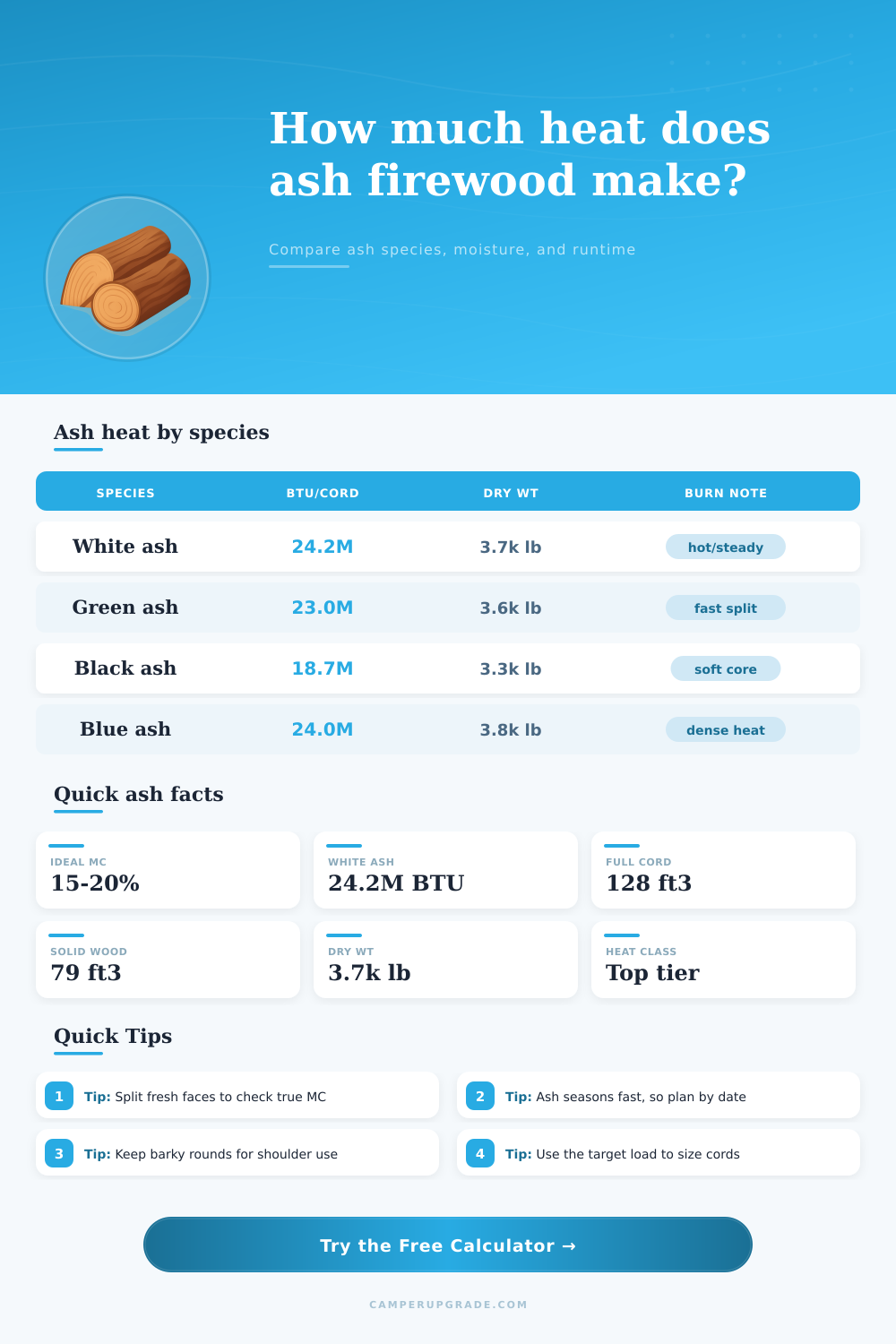
| Species | Dry BTU/lb | Seasoned cord lb | Heat note |
|---|---|---|---|
| White ash | 8600 | 3800 | Long, steady heat |
| Green ash | 8550 | 3600 | Fast split |
| Black ash | 8400 | 3300 | Soft core |
| Blue ash | 8580 | 3820 | Dense heat |
| Oregon ash | 8420 | 3250 | Moderate heat |
| Pumpkin ash | 8530 | 3550 | Quick burn |
💧Moisture Impact Table
| Moisture | Dry frac. | Net BTU/lb | Use case |
|---|---|---|---|
| 0% MC | 1.00 | 8600 | Oven dry |
| 10% MC | 0.91 | ~7600 | Very dry |
| 20% MC | 0.83 | ~7000 | Good stove fuel |
| 30% MC | 0.77 | ~6300 | Still wet |
| 40% MC | 0.71 | ~5700 | Greenish stack |
| 60% MC | 0.63 | ~4700 | Fresh split |
| 80% MC | 0.56 | ~4000 | Recently cut |
| 100% MC | 0.50 | ~3400 | Very green |
🔧Split and Seasoning Factors
| Condition | Factor | Behavior | Best use |
|---|---|---|---|
| Rounds / unsplit | 0.94 | Slow drying | Outdoor stack |
| Chunky splits | 0.98 | Moderate airflow | Long burns |
| Standard splits | 1.00 | Balanced burn | General heat |
| Small splits | 1.03 | Faster ignition | Shoulder season |
| Kindling | 0.92 | Quick flash | Fire start |
| Fresh cut | 0.90 | High steam loss | Not ideal |
| One season | 0.96 | Mostly dry | Heat stack |
| Two seasons | 1.00 | Stable fuel | Best all-around |
📈Energy Benchmarks
| Benchmark | Typical value | Units | Note |
|---|---|---|---|
| Oven-dry wood | ~8600 | BTU/lb | Chemical basis |
| Seasoned oak cord | ~22-28 | MMBtu/cord | Species dependent |
| Seasoned softwood cord | ~15-20 | MMBtu/cord | Lower density |
| Water evaporation | 970 | BTU/lb water | Moisture loss |
| 1 BTU | 1.055 | kJ | Metric bridge |
| 1 MMBtu | 1.055 | GJ | Large heat load |
| 1 lb fuel | 0.45 | kg | Mass conversion |
| 1 cord | 128 | ft3 | Stack volume |
Ash wood is an source of fuel that can be used to heat a home. The wood provide heat to a home through the combustion of the ash wood. In order to understand in what way ash wood can provide heat to a home, it is first important to understand the units in which the heat output of ash wood can be measured.
The units that is used to describe the amount of heat that ash wood produces are known as British Thermal Units (BTUs). The BTUs of ash wood are important in that raw flame from the wood will not necessarily provide heat to the livig space of a home. There are different type of ash wood that may be used to generate heat for homes.
How Ash Wood Heats Your Home
Some examples of ash wood include white ash, black ash, and blue ash. White ash is a type of ash wood that produce long and steady coals, and the wood is often more easier to split than oak wood. Black ash is a type of ash wood that burns more soft than white ash.
Blue ash is a type of ash wood that is very dense; because blue ash is dense, it will last longer than other type of ash wood. The density of ash wood is one of the main factor that determines the amount of heat that the wood may emit. The more dense the ash wood is, the wood will produce the most heat.
Another factor in the amount of heat that may be produced by ash wood is the moisture content of the ash wood. The moisture content of ash wood will reduce the amount of heat that the ash wood can produce. Water within the ash wood will absorb 790 BTUs for every pound of water that is within the ash wood to turn the water into steam.
If the moisture content of ash wood is 20 percent, then the ash wood will lose a significant amount of heat. Green ash wood can contain as much as 60 percent moisture content. High moisture content within the ash wood will create a smoky fire within the combustion chamber of the stove.
High moisture content within the ash wood will cause creosote to build up within the chimney pipe of the stove. In order to determine the moisture content of the ash wood, it is recommended to split the ash wood to observe the interior of the wood; the bark of the ash wood may appear dry, but the interior of the wood can be wet. The size of the ash wood splits can impact the burning of the ash wood.
Standard splits of ash wood is balanced to burn for a certain length of time, and allow for the proper amount of oxygen to reach the coals within the ash wood. Large splits of ash wood are often used in large stove, as the large pieces of ash wood will burn for longer periods of time. Small splits of ash wood will ignite more quick than large splits of ash wood.
Unsplit rounds of ash wood will dry more slow than split piece of ash wood. This is due to the moisture that can be trapped within the heartwood of the unsplit rounds of ash wood. The bark that is present on the ash wood can also impact the burning of the ash wood.
Splits of ash wood that contain less bark will burn more efficient than splits of ash wood that contain more bark. The efficiency of the stove in which the ash wood is burned is one factor that can impact the amount of heat that is delivered to the living space of the home. Modern stove often have high ratings of efficiency; older stoves may have low ratings of efficiency.
Efficiency can be maximized by controlling the draft settings that are present on the stove; controlling the draft allow for more BTUs of energy from the dry ash wood to be released. In order to properly manage the ash wood that is to be used in the stoves of a home, certain practice should be followed. One practice that should of been followed is to store the ash wood under an cover; this will ensure that the ash wood remains dry.
Additionally, the ash wood should be stored off the ground; storing the ash wood off the ground will prevent the ash wood from becoming wet. Randomly testing pieces of ash wood is another practice that should be followed; one wet piece of ash will reduce the heating potential of the batch of ash wood. Ash wood will season in about nine month; however, the ash wood must be dry prior to burning.
If green ash wood is burned in the stove, it will not produce as much heat than ash wood that has been allowed to dry; additionally, the ash will create moreer effort for the homeowner to clean the stoves grate.