🌲 Hickory Firewood BTU Calculator
Measure dense hickory stacks, factor moisture and split quality, and see how much usable heat your wood can deliver.
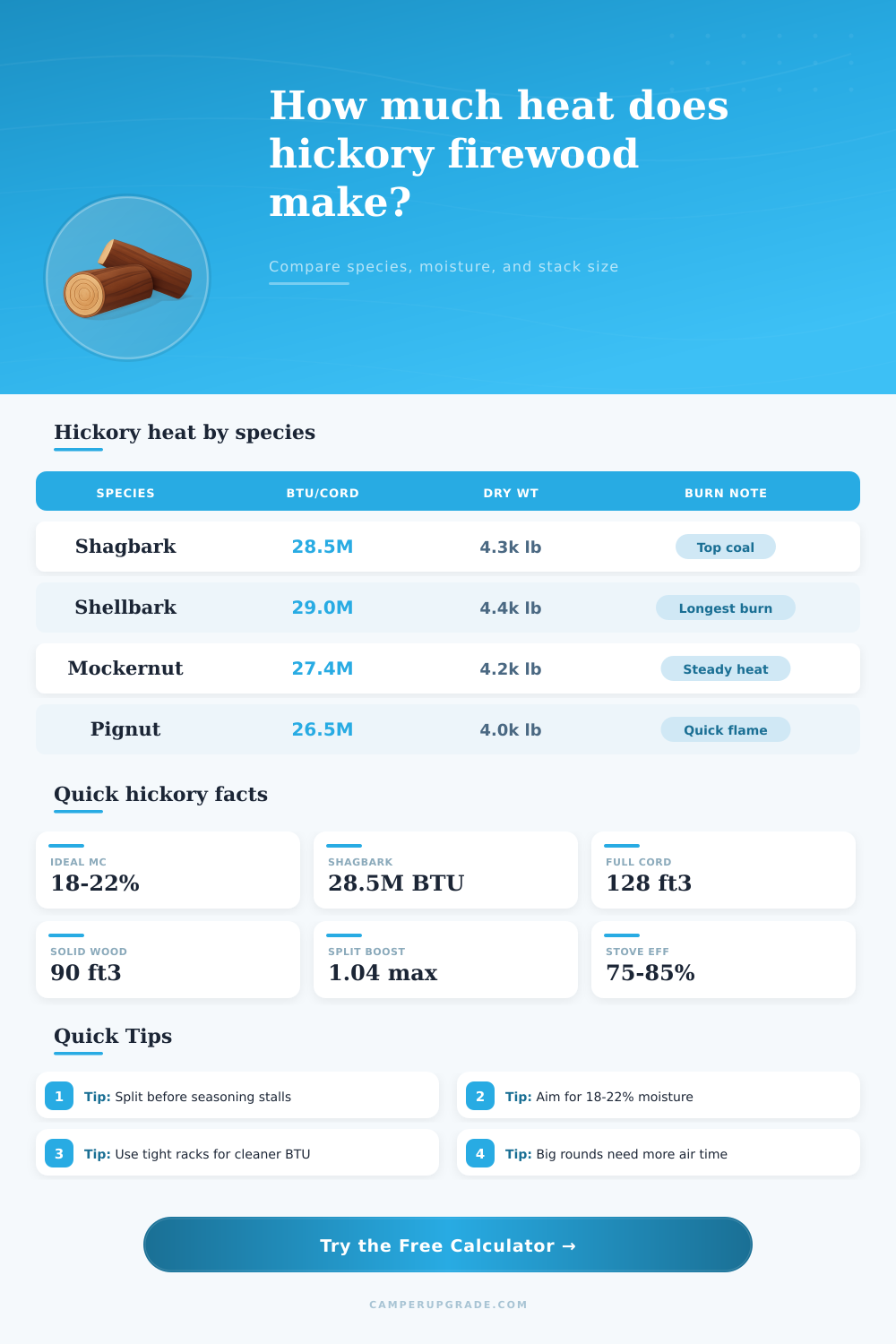
| Species | BTU per cord | Dry weight | Burn character | Best use |
|---|---|---|---|---|
| Shagbark hickory | 28.5M | 4.3k lb | Deep coals | Primary heat load |
| Shellbark hickory | 29.0M | 4.4k lb | Slow fade | Longest overnight burn |
| Mockernut hickory | 27.4M | 4.2k lb | Steady flame | Balanced shoulder season |
| Pignut hickory | 26.5M | 4.0k lb | Quick start | Fast reloads and kindling |
| Bitternut hickory | 25.8M | 3.9k lb | Bright burn | Lighter mixed loads |
| Red hickory | 24.8M | 3.8k lb | Hot flame | Short, sharp heat bursts |
| Mixed hickory | 27.0M | 4.1k lb | Rounded heat | General stove topping |
| Moisture range | Heat factor | Heat shift | Hickory note |
|---|---|---|---|
| 15-18% | 1.06 | +6% | Very crisp coal bed |
| 18-22% | 1.00 | Base line | Best everyday burn |
| 23-28% | 0.92 | -8% | Steam starts to show |
| 29-35% | 0.83 | -17% | More smoke, less heat |
| 36%+ | 0.72 | -28% | Wait for more seasoning |
| Stack style | Fill factor | Cord yield | Best fit |
|---|---|---|---|
| Tight rack | 1.00 | 1.00 cord | Clean math, tight rows |
| Standard rack | 0.96 | 0.96 cord | Normal split stack |
| Loose stack | 0.90 | 0.90 cord | Airier, rougher pile |
| Rough pile | 0.84 | 0.84 cord | Field stack or quick drop |
| Fuel profile | Split factor | Bark factor | Burn feel |
|---|---|---|---|
| Small splits | 1.05 | 1.00 | Fast ignition and quick rise |
| Medium splits | 1.00 | 0.99 | Even, balanced hickory heat |
| Large splits | 0.95 | 0.97 | Slower start, longer coal bed |
| Rounds | 0.90 | 0.94 | Slowest start, deepest burn |
Hickory is a type of wood that burns well and produces a high amount of heat. For these reasons, hickory are often used as firewood, and hickory produces more heat per cord than species like oak or maple. There are different species of hickory, and each species of hickory burn differently.
Shagbark hickory produce glowing coals that retain heat for long periods. Shellbark hickory burns for a long time and requires a slow start to ignite the fire. Pignut hickory starts quick, making it a good firewood for starting a fire quickly.
How to Burn and Store Hickory Firewood
Mockernut hickory burns steady. Depending on the type of fire you want to start and burn, you can choose the best species of hickory to use in your firewood stove. How you arrange the hickory is also important because the way you arrange the hickory will determine how much wood you have.
If you store the wood tight together, you will use the wood efficient. If you store the wood loosely, you are adding excess air into the fire, which will reduce the amount of actual wood. To determine how much firewood you will get from your hickory stack, you will need to measure the footprint, the height, and the depth of your hickory stack.
If you do not measure your hickory stack proper, you will end up with an incorrect measurement of the amount of firewood you have. Moisture is another factor that will affect the burning of the hickory. The moisture in the firewood will reduce the amount of heat that the wood will produce when burning.
Freshly cut hickory can contain up to 30% water. The water will change into steam and waste heat that will warm your room. You should aim for around 20% moisture in your hickory log.
If you allow the hickory to season for 18 to 24 months, it will reach 20% moisture. Split the hickory logs into medium sized pieces before you add them to your firewood stove. Medium-sized pieces will ignite and burn at a steady rate.
The amount of bark on the hickory will also impact the burn of the hickory. Hickory with heavy bark will produce more ash and burn less efficient than hickory logs with little or no bark. You can use the draft settings on your firewood stove to adjust how the hickory burns.
A high draft setting works best with pignut hickory. A calm draft setting will work best with shellbark hickory. Moddern firewood stoves are more efficient at burning hickory than old-fashioned firewood stoves.
Modern stoves can reach 80% efficiency whereas old stoves waste heat through the chimney. You can calculate the heat output of hickory logs by determining the difference between the gross BTU and the usable BTU. Gross BTU is the total amount of heat that dry wood will produce when burning.
The usable BTU is the actual amount of heat that will warm your room. You can calculate the burn time for hickory logs by determining how many hours the hickory will burn at a specific BTU per hour. Hickory produces between 6,000 and 7,000 BTU per pound when dry.
Knowing the dry weight of the logs will allow you to calculate how much heat the hickory will produce. Many people makes mistakes when burning hickory. Common mistakes are using green hickory or burning loose hickory.
Both of these mistake cause the firewood to burn quickly. Do not use green hickory because it has too much moisture in the wood. Dont store your hickory loosely because it will allow the wood to burn too fast.
If you season the hickory proper and store it proper, the wood will produce glowing coals that will retain heat for a long time. You can burn either small or large pieces of hickory. Small pieces will produce heat quick but will burn quick.
Large pieces will produce beds of glowing coals that will last longer. Store your hickory under a cover so the wood does not absorb moisture from the air. Store the hickory on elevated rack to prevent the wood from touching the ground.
You can test moisture in the hickory by feeling the wood. If the hickory feels dry, it has proper moisture content. If the hickory feels spongy, it has too much moisture.
If you measure your hickory proper and manage the moisture in the wood, it will produce the amount of dense heat for your home.