🧳 72 Hour Kit Weight Calculator
Balance water, food, shelter, and carry weight for a realistic emergency load
| Climate | Water / Day | Weight / Day | Why it changes |
|---|---|---|---|
| Mild urban | 1.0 gal | 8.34 lb | Normal pace |
| Hot dry | 1.25 gal | 10.43 lb | Heat loss |
| Cold wet | 0.95 gal | 7.93 lb | Lower sweat |
| Storm coast | 1.10 gal | 9.18 lb | Stress carry |
| Winter car | 1.00 gal | 8.34 lb | Cabin reserve |
| Heat wave | 1.35 gal | 11.27 lb | High risk |
| Food style | cal/oz | lb / 2000 cal | Best fit |
|---|---|---|---|
| Wet pantry food | 70 | 1.79 lb | Home tote |
| Balanced ration | 100 | 1.25 lb | General kit |
| Field meal pouch | 120 | 1.04 lb | Compact bag |
| Dense bars | 140 | 0.89 lb | Tight space |
| High perf mix | 150 | 0.83 lb | Fast carry |
| Family tote | 90 | 1.39 lb | Kids kit |
| Shelter | Base wt | Per person | Best use |
|---|---|---|---|
| Poncho shelter | 2.5 lb | 0.8 lb | Solo carry |
| Tarp + bivy | 4.5 lb | 1.2 lb | Two people |
| Compact tent | 6.5 lb | 1.6 lb | Buddy kit |
| Family tent | 10.5 lb | 2.1 lb | Family load |
| Vehicle sleep | 8.0 lb | 1.4 lb | Truck bed |
| Winter tarp | 7.5 lb | 1.9 lb | Cold air |
| Scenario | People | Days | Typical load |
|---|---|---|---|
| Solo go-bag | 1 | 3 | 25-35 lb |
| Couple vehicle kit | 2 | 3 | 45-60 lb |
| Family home tote | 4 | 3 | 90-120 lb |
| Winter roadside | 2 | 3 | 55-75 lb |
| Office drawer cache | 1 | 3 | 20-28 lb |
| Trailhead pack | 1 | 3 | 28-40 lb |
| Pet-inclusive kit | 3 | 3 | 70-95 lb |
| Overland box kit | 4 | 3 | 100-130 lb |
| Component | Weight | Why it matters |
|---|---|---|
| Water container | 0.8-1.5 lb | Protects carry |
| Food bag liner | 0.2 lb | Moisture barrier |
| Spare socks x2 | 0.5 lb | Dry feet |
| Headlamp + cell | 0.3 lb | Night task |
| First aid pouch | 0.7 lb | Fast access |
| Compact stove | 1.1 lb | Hot meals |
| Fuel canister | 0.9 lb | Short burns |
| Phone battery | 0.4 lb | Longer runtime |
| Paper docs | 0.1 lb | ID and plan |
| Gloves + hat | 0.6 lb | Cold buffer |
| Sanitation kit | 0.8 lb | Waste control |
| Pet supplies | 1.5 lb | If needed |
A 72-hour kit contains the supplies that will allow individual to be self-reliant for the first three days of an emergency. The kit must be balance; if it has too many item, the kit will be too heavy for individuals to carry. If the kit is too heavy, it will slow the individuals down in the emergency.
Therefore, you must consider the weight of a 72-hour kit so that the kit is manageable for the individual and there transport methods. Water is one of the primary component of a 72-hour kit. However, water is also one of the most weight components of a 72-hour kit.
Make a 72-Hour Kit You Can Carry
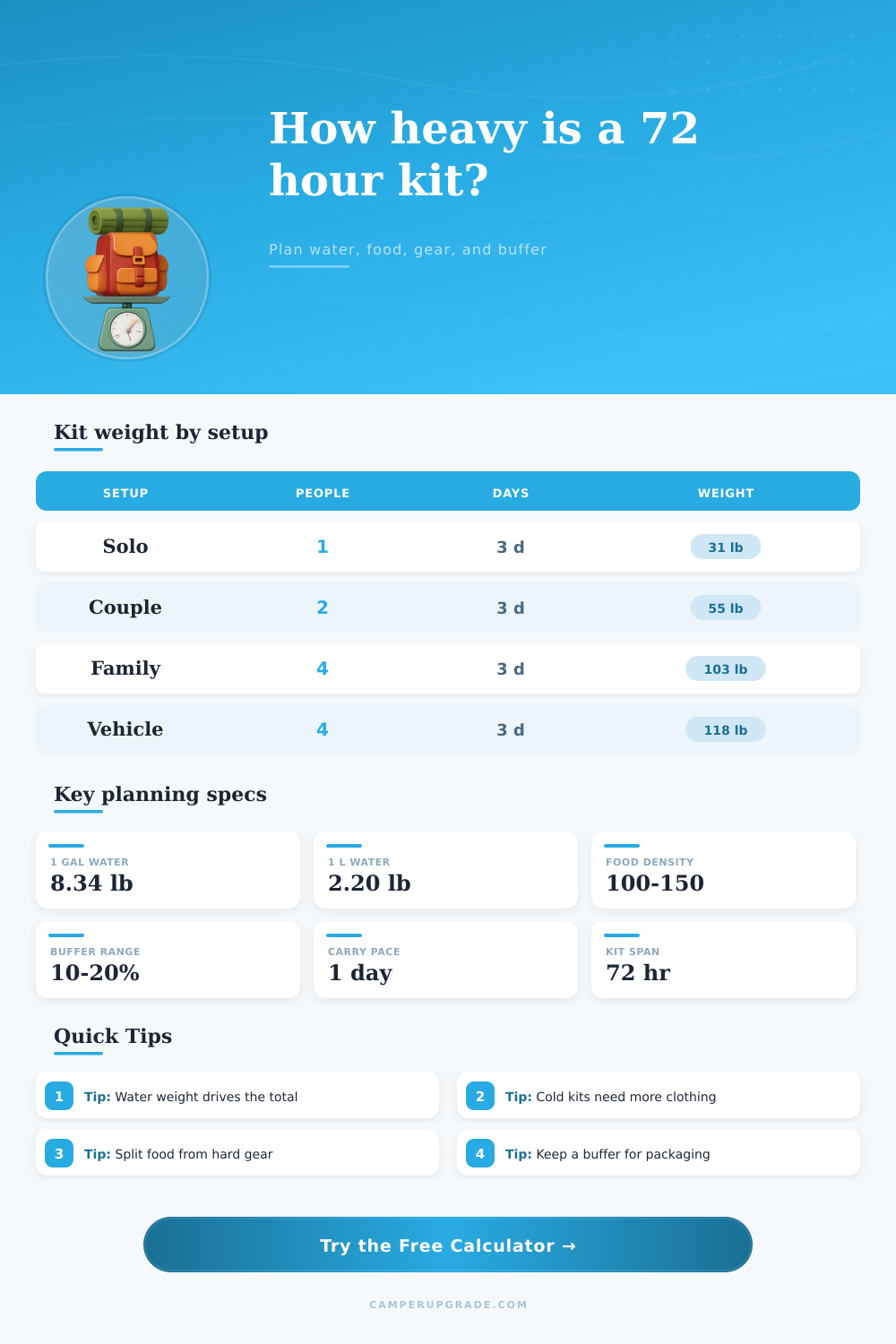
An individual need approximately one gallon of water per person per day. One gallon of water weigh over eight pounds. Thus, the weight of the water will cause a 72-hour kit to be too heavy for an individual to manage.
You must account for the weight of the water and the container for the water in the kit. Food is another of the major component of a 72-hour kit. The food must contain enough calorie to provide the individual with the energy they need to survive the first three days of an emergency.
The best food to include are those that are high in calories, or calorie dense. Energy bars contain more calories per pound than other food products. Therefore, foods that are not calorie-dense will make the 72-hour kit too heavy for an individual to carry.
The climate in which an individual live will have an effect on the items included in the 72-hour kit. The climate will also affect the weight of the 72-hour kit. If the individual lives in a climate that is hot and dry, they will need more water for dehydration.
If the individual lives in a climate that is cold and wet, they will need more clothing and shelter. Therefore, the 72-hour kit must be adjusted according to the climate in which an individual live. The number of people you will be supporting will impact the size of your 72-hour kit.
A 72-hour kit for one person will weigh less than a 72-hour kit for a family due to the fact that a family will require more water, food, and shelter. Additionally, if you are preparing for potential emergencies that may require you to take care of pets, be sure to also include pet food and supplies in your kit. The addition of these supply will add to the total weight of your 72-hour kit, so be sure to plan for this increased weight.
Another consideration to make when preparing your 72-hour kit is to include a buffer for supplies. You can create a buffer for your 72-hour kit by including items like extra duct tape or additional plastic bag to your kit. Adding a buffer of between 10 and 20 percent of the total weight of your kit is a common way to ensure that your kit can account for any change that may occur within the 72-hour period.
However, ensure that the buffer does not increase the total weight of your 72-hour kit to the point that it becomes too heavy to carry. Some of the mistake that people make when preparing their 72-hour kits are either overpacking the amount of water that they include in their kit or underpacking the calories that they include. Packing too much water will increase the weight of the kit, while packing too few calorie will leave an individual feeling weak due to not having enough energy for physical movement.
Additionally, another common mistake is to assume that the food needs of a child are the same than the food needs of an adult, which is untrue. Finally, be sure to test your 72-hour kit. Testing your 72-hour kit will allow you to measure the weight of your kit and practice carrying that weight.
By doing so, you will be able to determine if the weight of your kit is too heavy for you to carry or for your vehicle to transport. Based off these test, you can remove item from your 72-hour kit or change the type of food and water that you use to reach an ideal weight for your kit. An ideal 72-hour kit will contain all of the supplies that you may need to survive 72 hours without your usual source of supplies, but will also be light enough to easily move to the location where you will spend those 72 hours of emergency survival.