🍲 MRE Calorie Calculator
Estimate mission calories, meal packs, case count, and carry weight for field planning
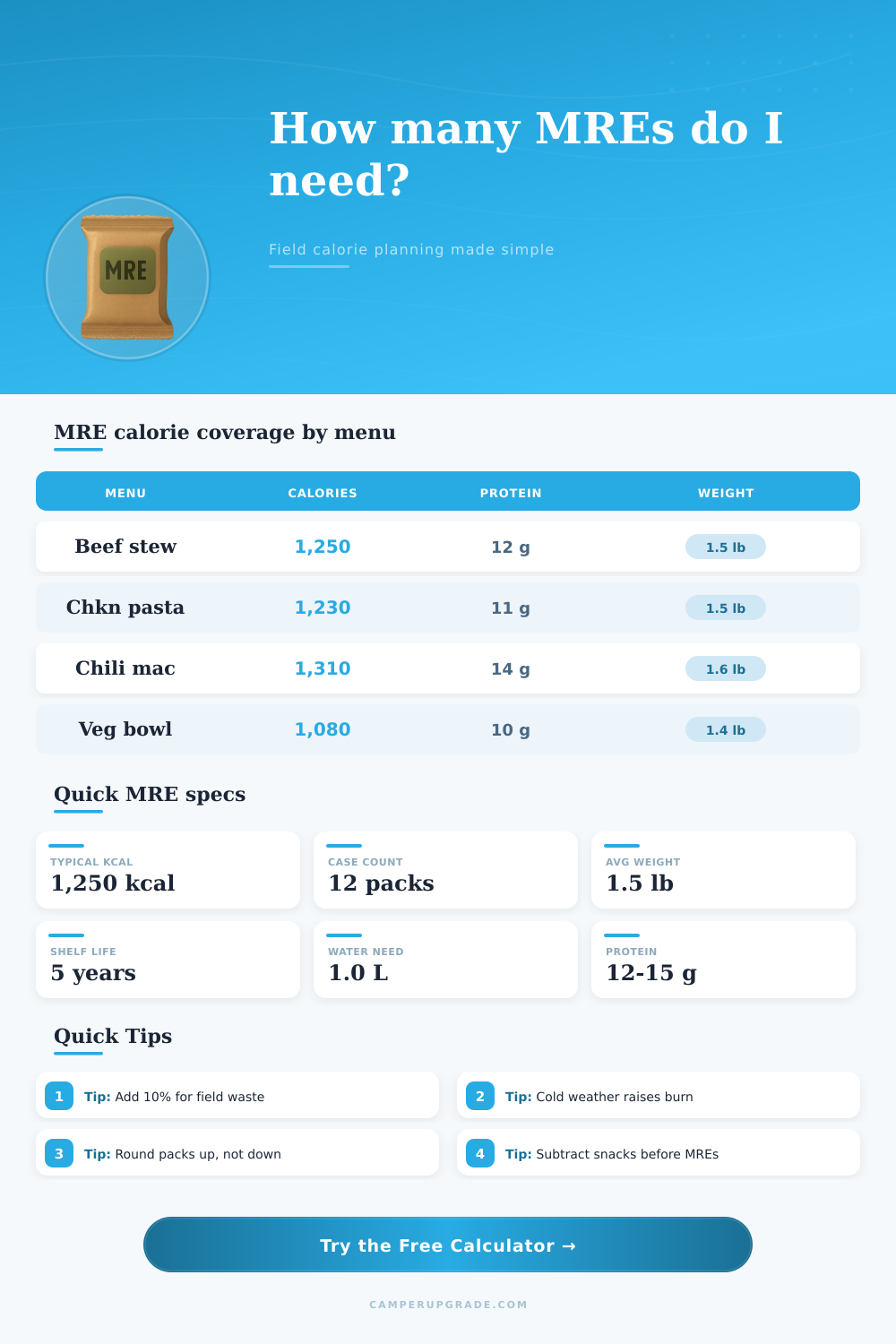
| Menu | Calories | Protein | Weight |
|---|---|---|---|
| Beef stew | 1,250 | 12 g | 1.5 lb |
| Chkn pasta | 1,230 | 11 g | 1.5 lb |
| Chili mac | 1,310 | 14 g | 1.6 lb |
| Veg bowl | 1,080 | 10 g | 1.4 lb |
| Activity | Factor | Added Burn | Use Case |
|---|---|---|---|
| Light watch | 1.20x | +20% | Short shifts |
| Moderate patrol | 1.40x | +40% | Mixed pace |
| Heavy ruck | 1.65x | +65% | Load carry |
| Extreme haul | 1.90x | +90% | Hard field push |
| Condition | Factor | Cold Hours | Effect |
|---|---|---|---|
| Mild day | 1.00x | 0 h | Baseline |
| Cold watch | 1.08x | 2 h | Small lift |
| Hard freeze | 1.16x | 5 h | More burn |
| Exposed ops | 1.25x | 8 h | Maxed out |
| Packs | Calories | Days | Cases |
|---|---|---|---|
| 1 pack | 1,250 | 1 day | 0.1 |
| 3 packs | 3,750 | 3 days | 0.3 |
| 6 packs | 7,500 | 6 days | 0.5 |
| 12 packs | 15,000 | 12 days | 1.0 |
To calculate the food requirements for an operation in the field, an individual must account for many differents variables since there are many different variables that will impact the energy that an individual use. An individual must calculate how many calories are needed by first calculating a baseline, and then applying multipliers according to the physical activity of the individual, the terrain, the weather, and the altitude of the mission. If the calculations is not performed correctly, an individual may either not have enough food to perform at the required level, or they may have too much food and be a nuisance due to it’s excessive weight.
To determine the baseline, an individual must multiply their weight in kilograms by twenty-four. This calculation will determine the number of calories that an individual require to perform resting functions alone. The baseline does not account for the energy that an individual will require for physical movement.
How to Calculate Food Needs for a Mission
For example, if an individual is performing heavy rucking with sixty pounds of weight, an individual will require approximately sixty-five percent more energy then the baseline. Additionally, if an individual is moving on rough terrain, an individual will require more energy than if an individual was moving on even terrain, and an individual will require ten to twenty percent more calories to perform those rucks. An individual’s weight will impact the number of calories that are required because if the temperature is cold, an individual will burn more calories in order to maintain there body heat.
Additionally, if an individual is performing at high altitudes, the air will be thinner and an individual will breathe harder, burning more calories in the process. Finally, if an individual is under stress, their adrenaline will increase, leading to an increase in the rate at which their body burns fuel. To determine the number of calories that will be required for a specific mission, an individual should determine what kind of activity profile will be required for that mission.
For instance, if an individual is performing light duty, they will require fewer calories than if they are performing heavy duty activities. In these cases, supplements can provide the necessary calories without increasing the number of meal pouches that an individual must carry. Additionally, an individual should account for a buffer of at least ten percent in case some of the food is wasted or if there are calculation error in determining the amount of food that will be required.
Finally, any calculation of the amount of food that will be required should always be rounded up to the nearest whole unit of food; rounding down may result in a shortage of food for those in the operation. Food in different meal packages contain different amounts of calories and pounds of food. For example, beef stew meals contain approximately twelve hundred fifty calories, while vegetable meals contain less than eleven hundred calories.
Additionally, meals that contain chili mac products will weigh more than meals with average weights of MREs. Thus, the individual should account for the type of food that is to be consumed in calculating the total weight of all of the food packages. Additionally, most meals contain between twelve and fifteen gram of protein, which is important to maintaining muscle.
An individual must also account for the importance of hydration and how this relate to food consumption. If an individual is dehydrated, they will have a lack of appetite to eat meals with the calories that they require. Therefore, an individual should consume approximately one liter of water for each meal that they consume.
However, because proteins take longer to digest than other food products, individuals should not consume too many protein during a march. Finally, the environment that individuals will be in will require adjustments to the calculations of the amount of food that will be required. For instance, a convoy that is moving through the desert in hot temperatures will require only one or two MREs per day.
However, a mission that occurs in the high-altitude mountains will require three or more MREs per day. In any case, the preference should always be for a surplus of food to account for any unexpected issue or injuries to those in the operation. Thus, by calculating the number of calories and other variables, an individual can be certain that they will have enough fuel to perform at the required level, while not carrying excess weight.