🏊 Life Jacket Size Calculator
Match chest, weight, torso length, and activity for a safer fit
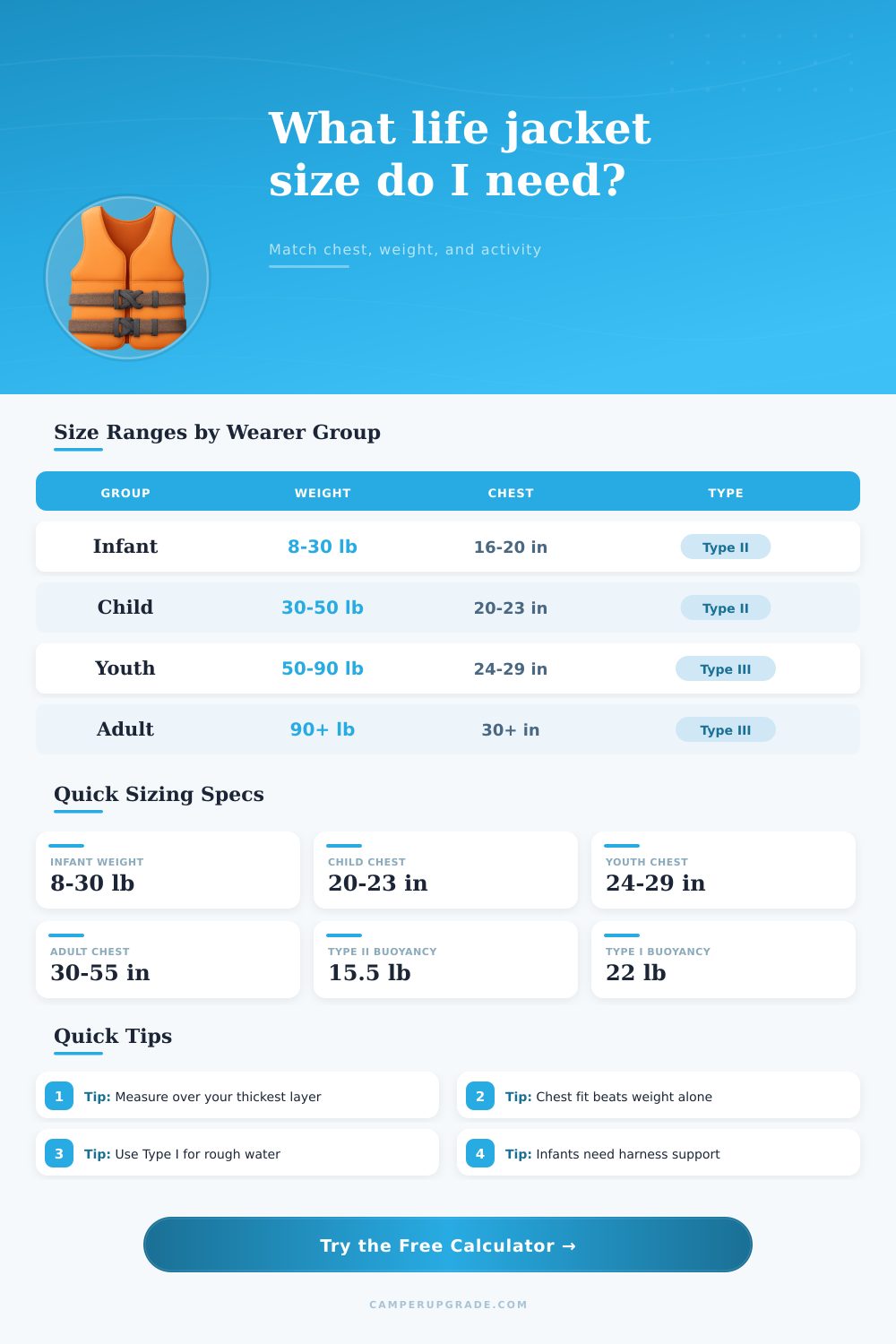
| Size group | Weight | Chest | Best use |
|---|---|---|---|
| Infant | 8-30 lb | 16-20 in | Harnessed support |
| Child | 30-50 lb | 20-23 in | Deck and dock |
| Youth | 50-90 lb | 24-29 in | Paddle and tow |
| Adult | 90+ lb | 30-55 in | Boating and cruise |
| Type | Buoyancy | Use case | Fit note |
|---|---|---|---|
| Type I | 22 lb | Offshore | Bulky, high lift |
| Type II | 15.5 lb | Near shore | Simple profile |
| Type III | 15.5 lb | Paddle use | Easy movement |
| Type V | 22 lb | Special use | Model specific |
| Activity | Type | Motion | Suggested fit |
|---|---|---|---|
| Pontoon | Type II | Low | Balanced |
| Kayak | Type III | High | Mobile |
| Fishing | Type III | Medium | Balanced |
| Offshore | Type I | High | Over gear |
| Check | Where | Target | Why |
|---|---|---|---|
| Chest | Rib cage | Snug | Main size cue |
| Torso | Shoulder to hem | Long enough | Seat comfort |
| Straps | Shoulder gap | Two fingers | Secure hold |
| Lift test | Arm raise | No ride up | Safety check |
A life jacket are a device that allows a person to remains buoyant in the water. A life jacket will only be effective in the event that it correctly fit the individuals that is supposed to wear the life jacket. Should the life jacket be of the wrong size for the individual, the life jacket will not be able to keep that persons head above the water.
Therefore, people should focus on the fit of their life jacket rather then the color and style of the life jacket. To determine the size of the life jacket that an individual need, the person must first measure the chest. The person should place the measuring tape around the ribcage at the fullest part of the ribcage.
How to Find the Right Life Jacket Size
The individual should wear the clothing they will wear while in the water for this measurement. For instance, if the individual wear a thin t-shirt, there will be an additional small measurement of the chest. If the individual wears a heavy rain shell or thermal layers, however, those layers will add to the measurement of the chest.
An individual cannot rely on they weight and height alone to determine the size of their life jacket. The clothing will affect the size of the life jacket that the individual will need. Following the measurement of the chest, the individual must measure the torso length.
The individual should measure from the shoulder to the hips where the life jacket will hit the hips. Individuals with shorter torso will require a life jacket with less coverage than individuals with longer torsos. For instance, if an individual is going to be sitting in a kayak, a longer torso will require more coverage for comfort.
While the weight of the individual may impact the type of life jacket that is available, the chest measurement is the primary measurement that determine the size of the life jacket. The type of activity that the individual will perform while wearing a life jacket will also impact the type of life jacket that they need. For instance, an individual who is to lounge upon a pontoon boat may require a life jacket that is more comfort for that type of activity.
An individual who is to wakeboard or kayak, however, may require a life jacket that is more flexible and allow for mobility of the individual’s limbs. Additionally, an individual who is to perform activities offshore may require a life jacket that can account for the presence of heavy weather gear. In these cases, the life jacket must still fit over the individuals layers of clothing.
There are different types of life jackets available for purchase. Type I life jackets are designed for use offshore and provide high level of buoyancy for the person who wears the life jacket. Because these types of life jackets are bulky, they are designed to turn an unconscious person face-up in deep water.
Type II life jackets are designed for use near the shore and can provide fifteen pounds of buoyancy. These life jackets are effective in calm water but may not be effective in areas that exhibit choppy waters. Type III life jackets are also designed for individuals who exhibit high levels of mobility.
These types of life jackets are thinner than the Type I and Type II life jackets and are, therefore, suitable for paddlers and anglers. Each of these types of life jackets is matched to the type of movement that an individual will exhibit while wearing the life jacket. Many individuals makes mistakes when selecting a life jacket.
For instance, many individuals do not consider the chest measurement of an individual but only consider their weight. For instance, an individual with a large chest may find that a life jacket that is sized for the individual according to their weight is too small. Another mistake that individuals can make is to measure their body with no clothing but then wear their life jacket while wearing their heavy clothing.
The life jacket may be too small for the individual when wearing their clothing. Additionally, many individuals wont remember to perform a lift test for the life jacket. During a lift test, individuals should raise their arms to show that the life jacket will remain in place.
If the life jacket moves up past the individual’s chin, it is too large for that individual. A properly sized life jacket should remain in place and exhibit a gap between the straps of only about two finger across the shoulders. Individuals can also refer to charts that explain the sizes of life jackets according to the weight and chest measurement of the individual.
Additionally, those charts may explain the types of activities that can require each of the life jacket types. Charts can also show the information on how life jackets may wear with time. For instance, the foam that fills the life jacket may compress over time.
In the case of inflatable life jackets, the person should check the CO2 canisters every month to ensure that the life jacket will function when needed. Finally, the individual can consider the different seasons of the year. For instance, during the summer, an individual may wear a light t-shirt under their life jacket.
During the winter, however, the individual may wear heavy gear. Because of the thickness of winter clothing, individuals must consider that their life jacket must account for such thickness. If an individual takes the time to ensure that the life jacket fits the individual according to their chest, their weight, and the type of activity that they will perform while wearing the life jacket, they will experience safety while wearing the life jacket.