Weather Feels Like Temperature Calculator
Blend heat, wind, humidity, cloud cover, sun, and elevation into one practical answer.
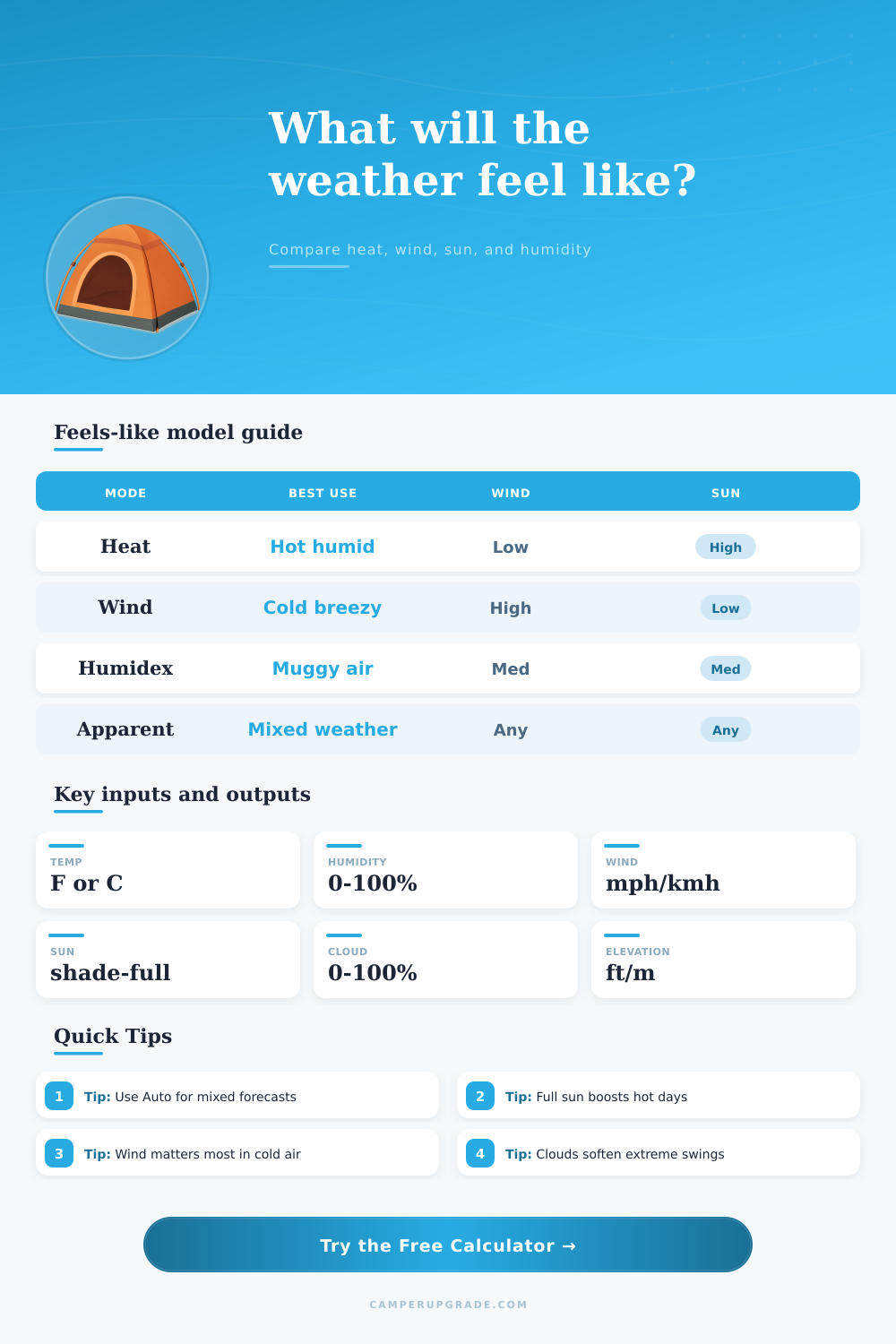
Heat Index
Best for hot, humid afternoons when moisture traps sweat and the air stops helping you cool down.
Wind Chill
Best for cold, breezy conditions where moving air strips heat from skin and exposed surfaces.
Humidex
Best for muggy weather where dew point and moisture create a sticky, harder-to-breathe feel.
Apparent Temp
Best for mixed forecasts because it blends wind, vapor pressure, and air temperature into one view.
| Model | Best When | Core Inputs | Main Bias |
|---|---|---|---|
| Heat Index | Hot and humid | Temp, RH | Feels hotter |
| Wind Chill | Cold and windy | Temp, wind | Feels colder |
| Humidex | Muggy nights | Temp, dew point | Sticky feel |
| Apparent Temp | Mixed air mass | Temp, RH, wind | Best blend |
| Setting | Sun Factor | Cloud Effect | Feels-Like Impact |
|---|---|---|---|
| Shade | 0.20 | Strong softening | Low solar gain |
| Hazy sun | 0.55 | Moderate damp | Small boost |
| Partial sun | 0.80 | Light damp | Clear boost |
| Full sun | 1.00 | Least damp | Peak boost |
| Terrain | Wind x | Sun x | Typical Use |
|---|---|---|---|
| Sheltered | 0.75 | 0.85 | Narrow streets |
| Standard | 1.00 | 1.00 | Typical yard |
| Open field | 1.15 | 1.05 | Little cover |
| Waterfront | 1.25 | 1.10 | Ridge or shore |
| Feels Like | Band | Typical Cue | Why It Matters |
|---|---|---|---|
| Below 32° | Cold | Skin chills fast | Wind matters more |
| 32-59° | Cool | Layering helps | Sun can help |
| 60-84° | Comfort | Easy range | Near neutral |
| 85°+ | Heat stress | Sweat builds | Hydration counts |
High Humidity
When humidity climbs, sweat evaporates slower and the same temperature feels much heavier.
Strong Wind
Wind is most powerful in cold weather, but it can also help hot weather feel slightly cooler.
Clear Sun
Bright direct sun adds a real comfort penalty, especially on pavement, rocks, or open decks.
Elevation
Higher terrain often sharpens sun and cools nights, so altitude can nudge the final feel.
Full sun can push a hot afternoon much higher than the raw thermometer suggests.
Once the temperature drops, even a modest breeze can make the feel change fast.
Use this calculator to compare heat, wind, humidity, sun, cloud cover, and elevation in one place. It highlights the most relevant weather model and shows each step clearly.
Besides the air temperature, which is the measurement of how hot or cold the air is, there is also another temperature: the feels-like temperature. The feels-like temperature is the measurement of how hot or cold the air feel to the person who is exposed to that air. While the person may feel a specific air temperature with a thermometer, the person may feel a different temperature due to factors like humidity, wind, and sun exposure.
Humidity is one of the factor that can make the feels-like temperature different than the air temperature. Because the human body cool itself by the evaporation of its sweat, high humidity levels mean that the body wont be able to cool itself as effectively. As a result, the person will feel hotter than the air temperature suggests.
What is the feels-like temperature
Thus, high humidity levels make the feels-like temperature more hotter than the actual air temperature. Wind is another factor that influence the feels-like temperature. On cold days, high wind exposure will remove the warm air that naturaly surround the human body.
As a result, the person will feel colder than the air temperature suggest. This measurement of how cold the air feels due to high wind exposure is referred to as the wind chill. Thus, the wind chill makes the feels-like temperature lower than the actual air temperature.
Sun exposure is yet another factor that can influence how hot the air feels to a person. The sun emit radiation that adds heat to the human body. Thus, if a person is exposed to the sun directly, their body will heat up, and they will begin to feel hotter than the air temperature suggest.
Conversely, clouds block the suns heat, so more clouds mean that a person will feel more cooler. There are models that attempt to calculate these feels-like temperatures. For instance, the heat index is a model that calculates how humidity can impact the heat of hot climates, and it is used to measure the heat of the air in cases where humidity is high.
Similarly, the wind chill index is used to calculate the impact of the cold in those climates with high winds, and it is used to determine how cold the air feels to those individuals with high exposure to the outdoor climate. Other models include the humidex index and the apparent temperature model. However, the heat index and the wind chill index are the most common models for calculating feels-like temperatures.
In addition to those factors, a person’s clothing and activity levels can impact the feels-like temperature of the air. For instance, dark clothing absorbs more heat from the sun than light clothing. Additionally, if a person is physically active, they will produce more heat than if they are not active.
Finally, a person who is dehydrated will produce less sweat, which allows for the body to cool itself. Thus, a dehydrated person will feel more heat stress than a person with adequate hydration. The terrain in which a person is located can also impact the feels-like temperature of the air.
For instance, a person in a sheltered location may be exposed to less wind than a person that live in an open field. Thus, a person in a sheltered location may feel cooler due to less exposure to the wind. The opposite is true for an open field.
Finally, elevation may also impact the feels-like temperature of the air in that the air is thinner at high elevations, allowing for the suns radiation to be more powerful and the night to be colder in those areas. Finally, understanding how the feels-like temperature of the air is calculated can aid in a person’s safety. For instance, heat stress will occur if a person is exposed to high heat and high humidity for long periods of time.
Heat stress can make a person feel confused. Additionally, hypothermia will occur in those who are exposed to low temperatures for long periods of time, especially with high winds. Hypothermia makes a person feel like they dont have enough energy to perform any activity.
Thus, by understanding the feels-like temperature of the air, a person could of made more better decisions about their clothing and activity levels to ensure that they are safe in there environment.