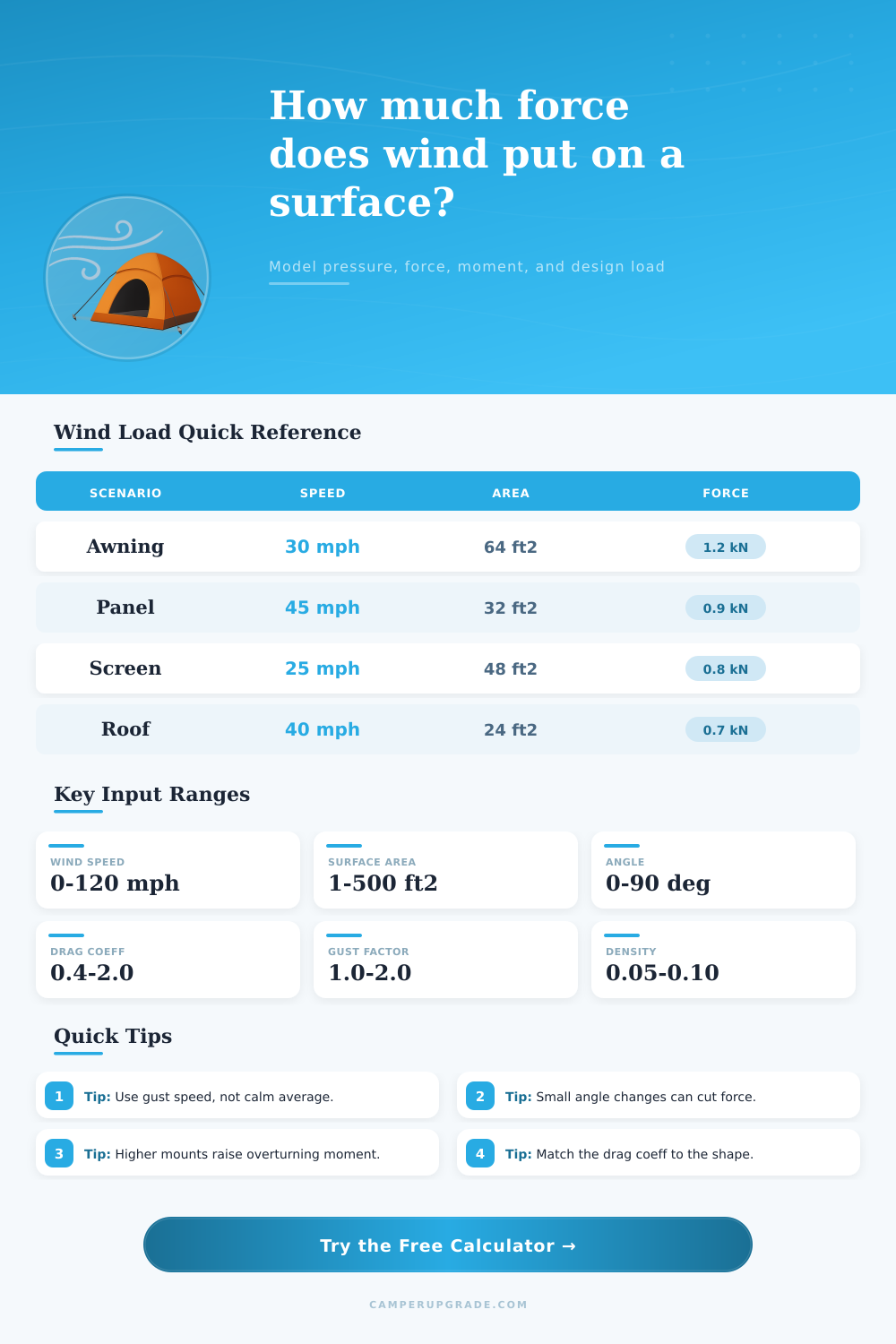
Wind Force Calculator
Estimate pressure, force, and overturning load on awnings, panels, screens, and other exposed camper surfaces.
💨Surface Presets
⚙Wind Load Inputs
📊Surface Spec Grid
📘Wind Load Reference Tables
| Wind Speed | Metric | Pressure | Note |
|---|---|---|---|
| 10 mph | 4.5 m/s | 12.5 Pa | Light steady breeze |
| 20 mph | 8.9 m/s | 50.2 Pa | Useful for calm load checks |
| 30 mph | 13.4 m/s | 112.8 Pa | Strong gust territory |
| 40 mph | 17.9 m/s | 200.7 Pa | Common design trigger |
| Surface Type | Typical Cd | Exposure | Use Case |
|---|---|---|---|
| Solid panel | 1.2 | Open | Flat camper wall or door |
| Awning fabric | 1.8 | Open | Wide, flexible shade panel |
| Perforated screen | 0.8 | Mixed | Privacy mesh with airflow |
| Rounded shell | 0.65 | Sheltered | Curved cover or fairing |
| Angle | Cos Factor | Area Factor | Force Factor |
|---|---|---|---|
| 0 deg | 1.00 | 1.00 | 1.00 |
| 15 deg | 0.97 | 0.97 | 0.93 |
| 30 deg | 0.87 | 0.87 | 0.75 |
| 60 deg | 0.50 | 0.50 | 0.25 |
| Example | Area | Wind | Approx Load |
|---|---|---|---|
| RV awning | 64 ft2 | 30 mph | ~270 lbf |
| Solar rack | 32 ft2 | 40 mph | ~180 lbf |
| Windbreak | 48 ft2 | 25 mph | ~140 lbf |
| Side panel | 24 ft2 | 35 mph | ~150 lbf |
Wind force is a physical phenomenon that can cause damage to components of an RV. The force of the wind cause air molecules to move against the surface of an RV component. The faster that the wind speed increase, the more dynamic pressure of the wind increases at a rate of the squares of the increased wind speed.
Thus, an increase in wind speed will cause the pressure against the RV component to increase at a much more higher rate. Additionally, because wind gusts can occur suddenly and damage the RV components, the impact of wind gusts must be accounted for in the consideration of the damage that the wind can do to those component. The shape of a component will impact the amount of wind force that the component experience.
Wind Damage to RV Parts and How to Protect Them
Flat surfaces will experience more wind force then curved components, as the flat component will experience high drag force against the moving air molecules. An angled component will experience less wind force than a flat component of the same size, as the angle reduce the impact of the wind force on the component. For instance, if a component is angled at 30 degrees, the wind force that it experience will be reduced to approximately three-quarters of the force of the wind.
The size of a component and how high that component is mounted will impact how the wind force impact that component. A component of a larger surface area (such as a 64 square foot awning) will experience more force from the wind than a smaller component. Additionally, if a component is mounted at a higher elevation, the wind will create a moment around the mounting point of the component (the overturning moment).
Because the overturning moment will place a twisting force on the mounting components, the mounting points must be deep or wide enough to resist that force. Air density is a fourth variable that affect the wind pressure against an RV component. Air density change with changes in temperature and elevation.
Hotter air is less dense than colder air. Thus, less dense air will result in less wind pressure against the component compared to more denser air. Additionally, air at sea level is more dense than air at high altitudes.
Thus, higher elevations will experience less wind pressure than air at sea level. Those calculating wind pressure against the components of an RV should consider these variable. Many people makes the mistake of using average wind speeds rather than gust speeds when calculating the impact of the wind on the components of an RV.
Average wind speeds are the sustained speed of the wind over time. Gust speeds are the maximum rate at which the wind can travel in a short period of time. It is the gust speeds of the wind that can damage the RVs component.
Additionally, people should not ignore the effect of wind speed and surface area. Rather, the wind force calculation should use the highest gust speed and the largest areas of the RV. To protect the components of an RV from the damaging effect of the wind force, certain practice should be implemented.
For example, if the wind speed is expected to reach 25 mph or higher, the awning should be retract. In addition, rounded shapes should be used rather than flat components. Any components that are mounted to the RV, such as solar paneling, should be angled to reduce the impact of the wind force.
Finally, the mounting components of an RV should be strong enough to resist the overturning moment create by the wind force acting on those components.