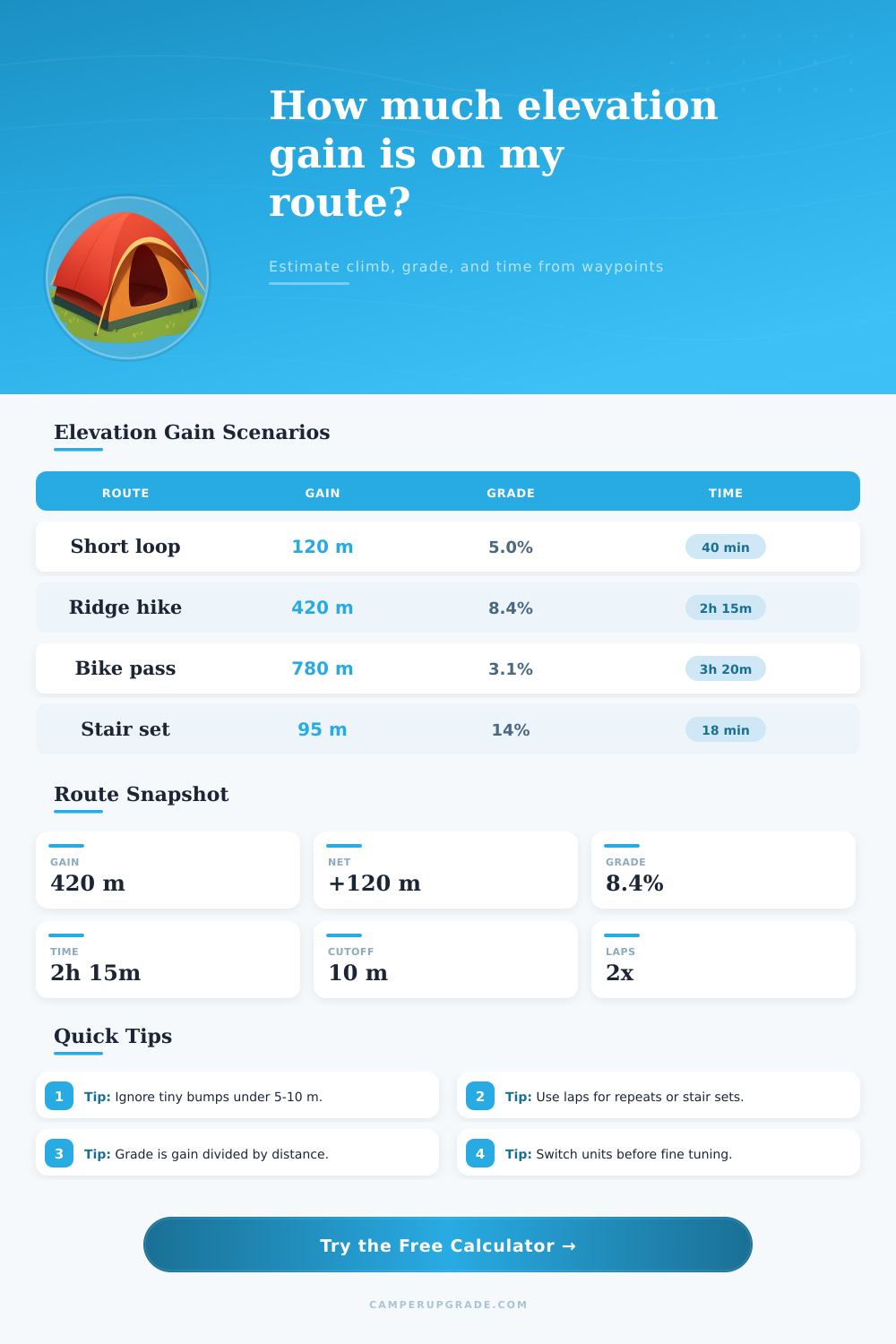
Elevation Gain Calculator
Measure total ascent, net change, and climb-adjusted time from route waypoints.
🏔️Route Presets
⚙️Route Inputs
📊Route Spec Grid
📘Reference Tables
| Activity | Base Speed | Ascent Rate | Best Fit |
|---|---|---|---|
| Day hike | 4.0 km/h | 300 m/h | Steady trail pace |
| Trail run | 9.5 km/h | 500 m/h | Fast mixed terrain |
| Road bike | 24 km/h | 900 m/h | Paved climbing |
| Pack carry | 3.5 km/h | 240 m/h | Loaded trekking |
| Route Style | Time Factor | Gain Logic | Common Use |
|---|---|---|---|
| Linear | 1.00x | Single pass | Point to point |
| Loop | 1.03x | One full circuit | Day hikes |
| Out-and-back | 1.06x | Return on same line | Summit trips |
| Stairs | 1.12x | Repeated steps | Fitness sets |
| Distance | Typical Gain | Grade Band | Route Feel |
|---|---|---|---|
| 2 mi / 3 km | 200-500 ft | 2-5% | Easy to moderate |
| 5 mi / 8 km | 600-1500 ft | 3-6% | Moderate climb |
| 10 mi / 16 km | 1500-4000 ft | 4-8% | Strong outing |
| 20 mi / 32 km | 3000-8000 ft | 5-10% | Big mountain day |
| Unit Pair | Elevation | Distance | Speed |
|---|---|---|---|
| Imperial to metric | 1 ft = 0.3048 m | 1 mi = 1.609 km | 1 mph = 1.609 km/h |
| Metric to imperial | 1 m = 3.281 ft | 1 km = 0.621 mi | 1 km/h = 0.621 mph |
| Vertical rate | 100 m = 328 ft | 1 km gain = 0.62 mi | 300 m/h = 984 ft/h |
| Noise cutoff | 5-15 m | 15-50 ft | Ignore small spikes |
Elevation gains measures the total distance that an individual gain in elevation during a hike or run. This is different than the total distance that an individual hikes because it dont count the distance that an individual move downhill. To calculate the total distance that an individual gains in elevation, the individual must sum the distances of each of the meter or feet that an individual moves uphill during a hike or run.
Such a measurement of elevation gain is important to understand in that it can help to determine the amount of effort and time that an individual will need to complete that route. While many may consider only the distance that an individual must cover, the distance calculation does not factor in the difficulties of the hills along the way. Thus, elevation gain is the most accurate measurement of the difficulty of the route that must be traveled.
How to Measure Elevation Gain
To calculate the elevation gain that an individual will experience during a hike or run, the individual will need to calculate the elevation at various points along the route. These points may include the starting point of the route, several points along the way (waypoints), and the elevation at the finish point of the hike or run. The individual will calculate the elevation gain by adding all of the distance that an individual moves uphill, and discarding any distances that an individual moves downhill.
Furthermore, elevation measurements from GPS devices may contain errors, so the individual may wish to utilize an elevation cutoff to discard any distances that are less than a certain number of meters or feet. For instance, using an elevation cutoff of 10 feet or five meters will cause the GPS device to ignore any gain in elevation of less than those measurements. Through the use of such an elevation cutoff, the individual will ensure the accuracy of the calculations of the individuals total gains in elevation.
The type of activity that an individual performs will have an impact upon the individuals elevation gain. For instance, an individual that is a trail runner will traverse the same distance as an individual that is hiking with a heavy backpack, but the runner will cover the distance at a faster rate. Thus, the individual can calculate the total time that is required for the hike by utilizing a base speed for the hike, as well as an ascent rate for the hike.
The base speed is the rate at which an individual travels on flat areas during the hike, while the ascent rate is the additional time that an individual requires for every hundred meter of elevation gain during the hike. For instance, if an individual is hiking on a loop trail, the distance calculations will require the application of a lap multiplier to account for the fact that the individual will travel the same distance and gain the same elevation gain as the trail during each lap of the hike. If a person is performing hill repeats, a person must multiply the elevation gain of one hill by the number of times a person repeat the hill.
This gives a total elevation gain that a person can use to describe the hills. There are two ways to describe the elevation gain of a set of hills. The first of these is the grade, or the average percentage of hills that are uphill.
This is calculated by dividing the total elevation gain by the total distance of the hills. Grades range from low percentages, such as three percent, which are considered to be easy hills to climb, to high percentages, such as eight percent, which are considered to be difficult hills to climb. The second of these is known as elevation density, which is the elevation gain of hills per mile or per kilometer of travel.
High elevation densities indicate that the hills has high levels of elevation gain over a short distance, which makes them difficult to climb. Each of these numbers can be used to make decisions about which trails or hills to climb based off the fitness of the individual who plans to climb these hills. When many people plan their climbs and calculate the elevation gain that they will experience, they tend to make mistake.
One of the most common is to focus on the net elevation of the hills instead of the cumulative elevation gain. Net elevation is the difference between the starting and finishing point of an area with elevation gain. Cumulative elevation gain is the total of all the elevations that an individual gains while climbing.
For instance, an individual may climb to 400 feet in elevation, descend to sea level, and then climb 500 feet to another destination. In this instance, the net elevation gain is 500 feet, but the cumulative elevation gain is 900 feet. Another common mistake is to ignore the difficulty of the descent in the hills.
While the descent does not add to the cumulative elevation gain, the descent can cause fatigue of the legs of the individual that are descending those hills. Thus, the individual must also account for this factor when planning a trip. Finally, in determining the elevation gain of areas that an individual plans to climb, those measurements are only estimates.
Factors such as the fitness of the individuals, the weather, and the terrain may change the elevation gain that an individual feels while climbing those hills. For instance, headwinds may make an individual feel like the grade of a hill is steeper then it is, and travel on loose soil may make the elevation gain of hills more difficult than if an individual was traveling on firm ground. Thus, an individual should of add some extra time to their plan for these potential variable.
For instance, if an individual calculates that it will take two hours to complete a route with a specific amount of elevation gain, the individual should plan for more than two hours to allow for the additional time needed due to these variables. Thus, if an individual plans their trip using the concept of elevation gain, they will have a more realistic understanding of the time and effort that is needed to climb the hills that they intend to climb.