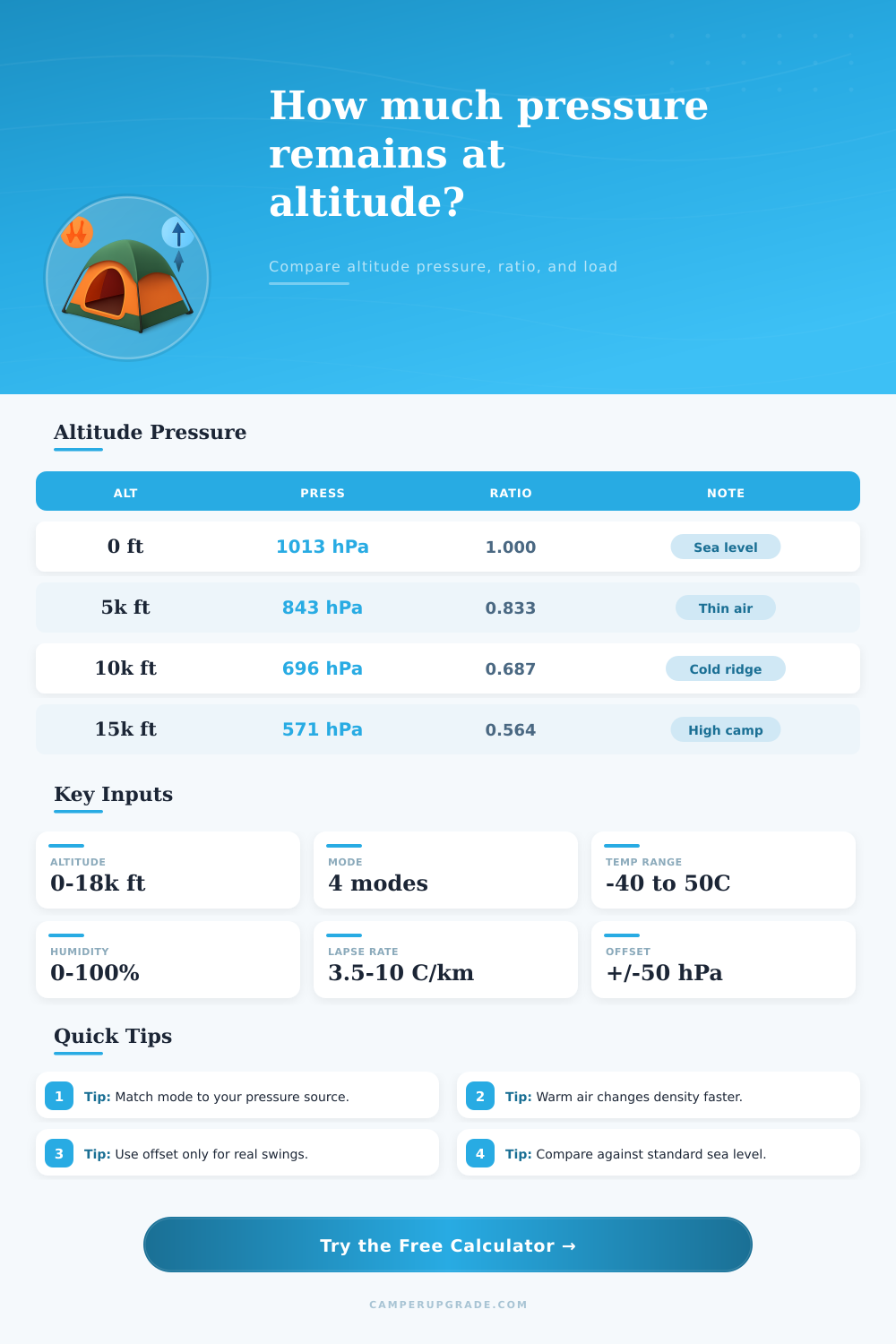
Pressure at Altitude Calculator
Estimate ambient pressure, pressure ratio, and pressure altitude from altitude, weather, humidity, and lapse-rate conditions.
🏔️Altitude Presets
⚙Pressure Inputs
📊Atmosphere Spec Grid
📘Reference Tables
| Altitude | Pressure | Ratio | Load on 1 m2 |
|---|---|---|---|
| 0 ft | 1013.25 hPa | 1.000 | 101.3 kN |
| 5000 ft | 843 hPa | 0.833 | 84.3 kN |
| 10000 ft | 696 hPa | 0.687 | 69.6 kN |
| 15000 ft | 571 hPa | 0.564 | 57.1 kN |
| Unit | Value | Use | Note |
|---|---|---|---|
| 1 inHg | 33.8639 hPa | Altimeters | Weather maps |
| 1 hPa | 0.02953 inHg | METARs | Easy compare |
| 1 kPa | 10 hPa | Metric pressure | Simple scale |
| 1 psi | 68.95 hPa | Surface load | Quick feel |
| Alt Band | Pressure | Ratio | Field Cue |
|---|---|---|---|
| Sea level | 1013 hPa | 1.00 | Baseline |
| 5k ft | 843 hPa | 0.83 | Thin air |
| 10k ft | 696 hPa | 0.69 | Climb loss |
| 15k ft | 571 hPa | 0.56 | Serious drop |
| Pressure | kPa | 1 m2 Load | Note |
|---|---|---|---|
| 1013 hPa | 101.3 | 101.3 kN | Sea level |
| 900 hPa | 90.0 | 90.0 kN | Low ridge |
| 800 hPa | 80.0 | 80.0 kN | High camp |
| 700 hPa | 70.0 | 70.0 kN | Mountain pass |
Atmospheric pressure are the weight of an atmosphere over a specific location. Atmospheric pressure decrease as elevation increase. At sea level the atmosphere weighs a significant amount, but as a person climb towards higher elevation, the air mass over the person decrease.
Thus, there is less atmospheric pressure over a person at high altitude. Furthermore, the decrease of atmospheric pressure dont occur in a linear fashion. The reason that atmospheric pressure is higher at sea level than at high altitude is due to the gravitational pull on the atmosphere for the Earth.
How Air Pressure Changes with Altitude
The gravitational pull on the atmosphere at sea level cause the air molecule to be more denser than they are at high altitude. In addition to these two factor, there are other variable that affect how atmospheric pressure and air density function. For instance, warm air will expand, which cause the air to become less dense.
Thus, warmer temperature will affect how a person feel the air. Another factor in this equation are humidity. Because water vapor is lighter than dry air, humid condition will also make the air less dense.
These two variable can be further affect by the lapse rate, which is the rate at which the temperature of the atmosphere decrease with altitude. These two variable, along with atmospheric pressure, a person who wish to accurately calculate the atmospheric pressure at their location must therefore be consider. The atmosphere is measure in four different mode.
One mode is the standard atmosphere, which measure atmospheric pressure according to the assumptions of a “textbook” atmosphere. Another mode is station pressure, which measure atmospheric pressure according to the raw measurement of a barometer at a specific location. Sea-level reports of atmospheric pressure are common in weather report, but the measurement must be convert to a specific elevation, which use both temperature and height data.
Custom mode allow for atmospheric pressure to be calculate without having to perform the mathematical step necessary to determine the value. However, if a person select the incorrect mode, incorrect data will be display. Thus, if a person choose the wrong mode, the atmospheric pressure measurement will be inaccurate.
The information that atmospheric pressure measurement can provide can have a variety of use for a person. For instance, ambient pressure is the true measurement of the atmospheric pressure at a specific location. The ratio of atmospheric pressure compared to sea level pressure can show a person how significant the effect of altitude stress are.
For example, if the ratio is below 0.7, a person is experience significant altitude stress. Another use of atmospheric pressure is in the measurement of pressure altitude, which is vital for pilot to understand the true altitude of an object in the air. Finally, a person can use the breakdown row for atmospheric pressure to see in what way temperature and humidity affect the density of the atmosphere.
A person can experience a variety of error in relation to atmospheric pressure, especially at high altitude. For instance, a person may look at the atmospheric pressure measurement for sea level, yet fail to understand that the atmosphere pressure will be lower at high elevation. Furthermore, if a person ignore the lapse rate, a person may believe that the temperature measurement will drop at a constant rate with the increase in elevation.
However, the temperature of the atmosphere do not drop at a constant rate. Finally, another potential error is in relation to humidity. A person may feel as if the atmosphere is thicker at high humidity level, yet the atmosphere is actualy less dense due to the presence of water vapor.
Atmospheric pressure can affect a variety of activity and object. For instance, scuba diver must adjust their decompression procedure at high altitude lake due to the effect that the difference in atmospheric pressure have on the rate at which nitrogen leave the body. Additionally, balloons will burst at a lower pressure at high altitude due to the lapse rate.
Finally, another object that atmospheric pressure is affect is carbon dioxide in beverage. When the atmospheric pressure is lower, such as at high altitude, the carbon dioxide will escape more easily from the liquid. Therefore, carbonated beverage will foam more at high altitude.
Finally, another way in which atmospheric pressure can affect a person is through their hydration level at high altitude. Due to the thinness of the air, a person will lose more moisture at high altitude. Thus, a person should of hydrate more frequently when they are at high altitude.
Overall, then, a persons understanding of atmospheric pressure will allow them to navigate high altitude location more effectively.