Solar Panel Angle Calculator
Find the best tilt, azimuth correction, and seasonal setup for fixed, adjustable, portable, and roof-mounted solar arrays.
☀️Angle Presets
⚙Angle Inputs
📊Angle Spec Grid
📘Reference Tables
| Latitude Band | Annual Tilt | Winter Tilt | Summer Tilt |
|---|---|---|---|
| 0-15 deg | 8-18 deg | 20-30 deg | 0-8 deg |
| 15-30 deg | 18-30 deg | 30-45 deg | 5-15 deg |
| 30-45 deg | 28-42 deg | 45-60 deg | 10-25 deg |
| 45-60 deg | 40-55 deg | 55-75 deg | 15-30 deg |
| Azimuth Offset | Approx Output | Loss | Typical Fix |
|---|---|---|---|
| 0 deg | 100% | 0% | Ideal facing |
| 15 deg | 99% | 1% | Minor trim |
| 30 deg | 95% | 5% | Noticeable trim |
| 45 deg | 88% | 12% | Strong correction |
| Mount Style | Tilt Limit | Azimuth Limit | Best Use |
|---|---|---|---|
| Flush Roof | 10 deg | 15 deg | Low-profile RV |
| Tilt-Up Roof | 20 deg | 25 deg | Seasonal roof rigs |
| Ground Rack | 60 deg | 180 deg | Fixed off-grid yard |
| Portable Stand | 75 deg | 180 deg | Trip and camp setup |
| Scenario | Target Tilt | Noon Sun Gap | Setup Note |
|---|---|---|---|
| Year-round | Lat rule | Small gap | Balanced output |
| Winter focus | Lat + 15 | Steeper sun | Best low-sun gain |
| Summer focus | Lat - 15 | Higher sun | Flatter panel |
| Snow shed | Extra steep | Fast runoff | Clear panels faster |
Solar panels captures sunlight to create electrical power. Solar panels work more efficienty when positioned at a correct angle and direction. If the solar panels is positioned at the incorrect angle, the panels will capture less sunlight and produce less electricity.
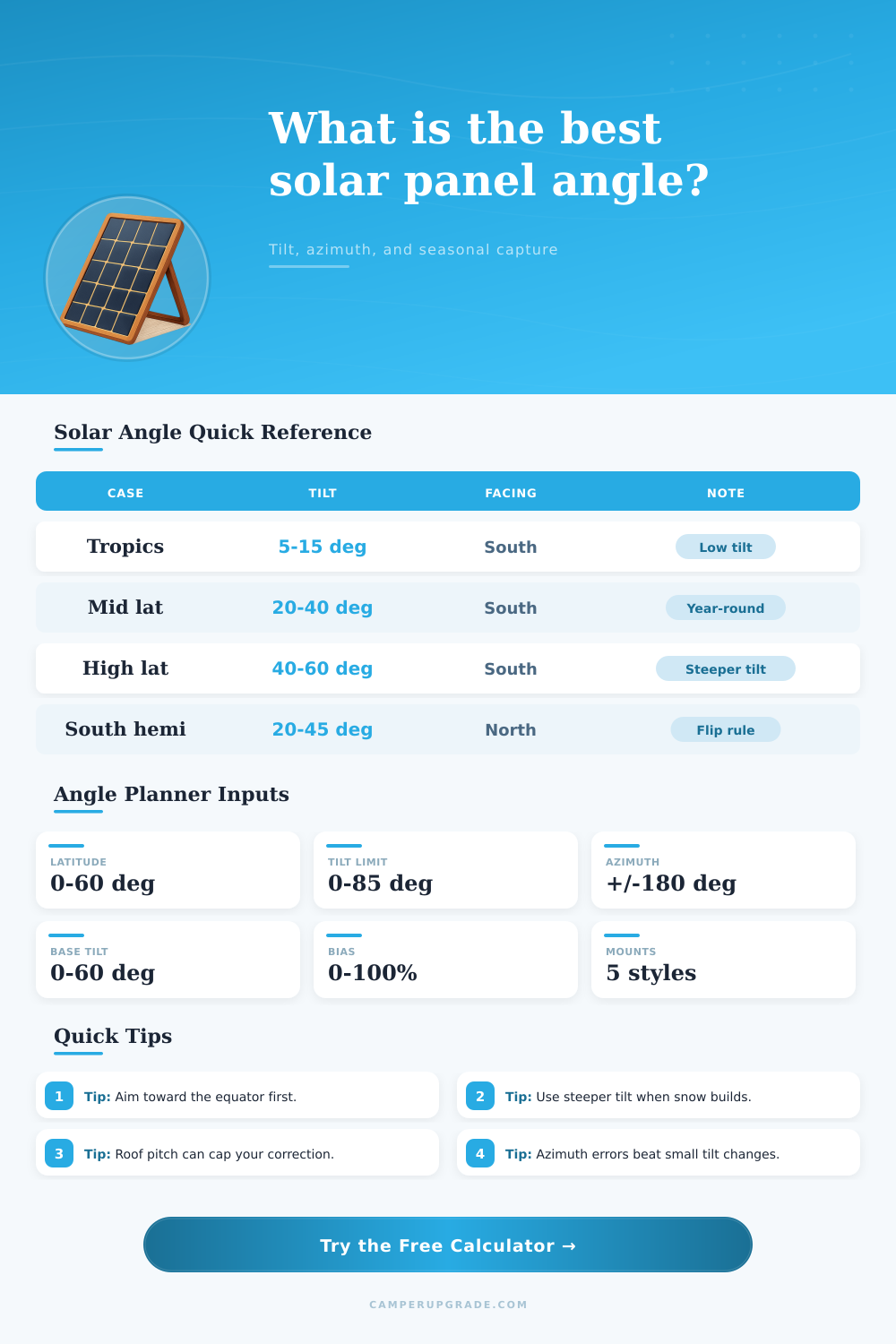
The angle of the solar panel is referred to as the tilt, and the direction of the solar panel is referred to as an azimuth. To capture the most sunlight, the solar panels must be pointing at the equator. In the Northern Hemisphere, solar panels must be pointed south.
How to Aim and Tilt Solar Panels
In the Southern Hemisphere, solar panels must be pointed north. Sunlight will contain the most power if it hits the solar panels perpendicularly because this will allow the panels to capture the maximum amounts of energy from the sunlight falling on them. The tilt of the panels should ideally match the latitude of the location.
However, the tilt of the solar panels must also change with the seasons. During the winter months, the tilt of the panels should be steep. During the summer, when the sun is higher in the sky, the panels should be set to a flatter angle.
Many solar panel installation companies use presets to calculate the best angle and direction for the solar panel. These presets allow the person to set the solar panel to different scenario. For instance, there are presets for winter camping spots and year-round RV spots.
Several different input can affect the preset values of the software. The latitude of the spot will impact the settings. The person can also program the preset to seek more winter power or summer power.
The mount style of the solar panel will also affect the settings. For instance, flush mounts on RV awnings will have fewer settings than a ground mount rack. The person can enter the base tilt of the panels into the software.
This accounts for the slope of the roof. The facing offset will account for the direction the RV is facing. Hardware limits allow the person to input the tilt and azimuth that the solar panel mounting bracket allow.
Horizon obstructions, like trees or mountains, will block the sunlight that the panels can capture. Snow bias will encourage the solar panel manufacturer to include a steeper angle of the panels to allow the snow to slide off of the panels. These solar panel software programs will output several different values for the user.
The ideal tilt is the angle that provides the most power for the spot where the panels will be installed. The final tilt is the angle that the hardware allow the installer to set the panels to. The azimuth adjustment will allow the users to change the direction of the panels.
The relative capture score will show how much power the panels will produce in comparison to if they were ideal positioned. For instance, if the relative capture score reads 95%, the solar panels are performing well. However, if the score is under 80%, then the angle of the solar panels should be adjusted.
Azimuth errors will reduce the amount of power that the solar panels produce. For instance, if the azimuth settings are 30 degree away from pointing true south, the solar panels will lose 5% of their power output. The same is true for tilt mismatch.
The tilt of the solar panel should ideally match the latitude of the spot. If the panels are too flat during the winter months with their tilt, this is another potential problem. A person can use reference tables to find the latitude of their area and use that to find their tilt.
For instance, using the latitude of their spot, they can find the base tilt. Then they can add 15 degrees for winter months or subtract 15 degrees for the summer months. There are different mounting options for solar panel installations, and these have an impact on how the solar panels can be tilted.
If a person chooses flush mounts, they are limited by the pitch of the roof on their RV. Tilt-up mounts allow for more tilting adjustment. Tilt-up mounts allow for the adjustment of the angle of the panels for the winter and summer months.
Pole mounts allow for very high tilts for solar panels. Finally, if a person uses stands for their solar panels, they can change the azimuth and the tilting of the panels no matter where they park their RV. There are a number of ways to improve the performance of their solar panel setups.
For instance, if a person knows that their panels tend to get covered in ice, they can increase the snow bias value. If there are trees or other horizon obstructions between the solar panels and the sunlight, the azimuth value will have to be changed. A person can also use the presets to compare the relative capture scores for different mounting hardware for their solar panel installation.
If a person optimizes the tilt and the azimuth of their solar panel installation, they will produce more electricity during the day.