Solar Panel Calculator
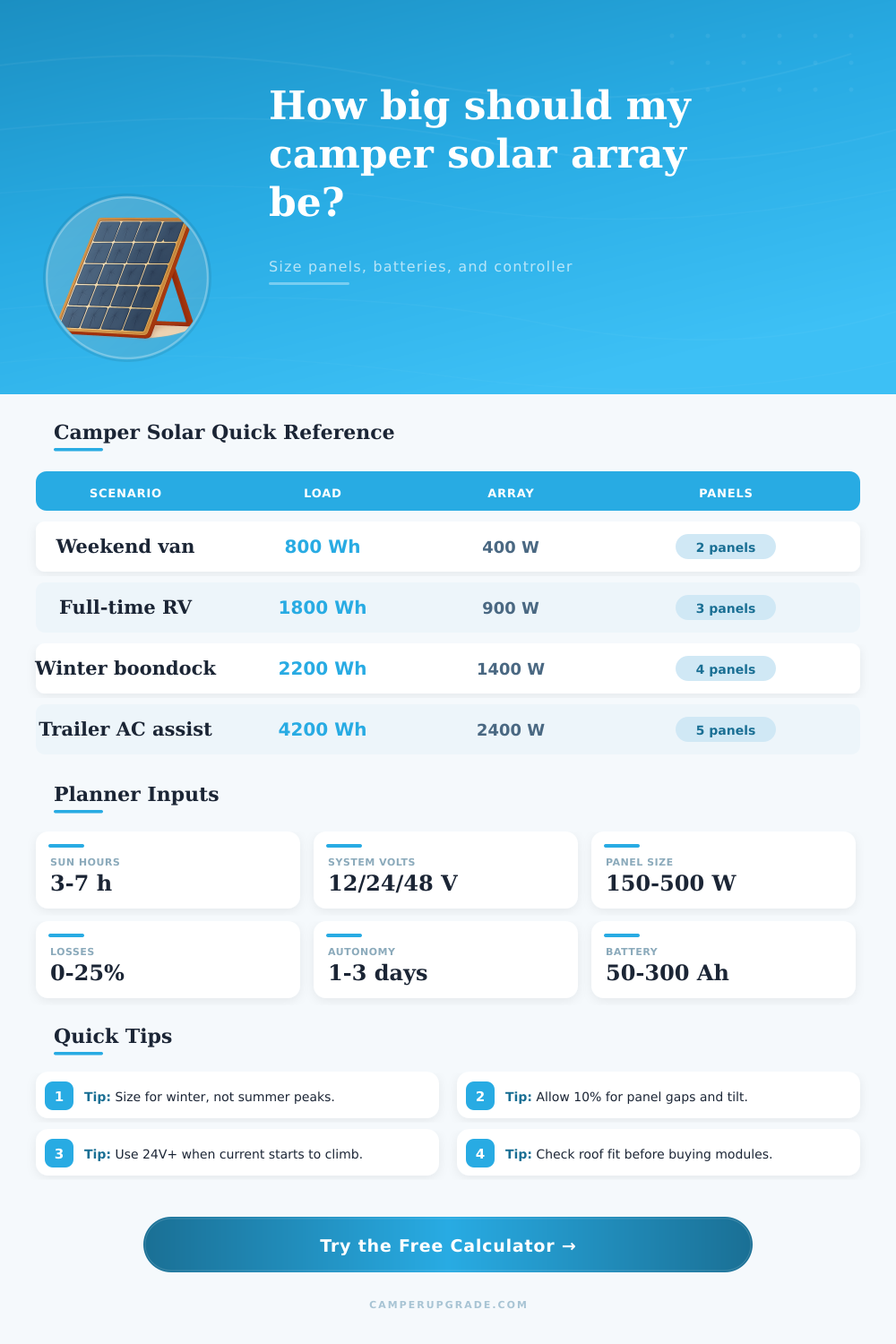
Size a camper solar system with real panel output, battery reserve, controller current, and roof-fit checks.
☀️Scenario Presets
⚙Solar Inputs
📊Panel And System Spec Grid
📘Reference Tables
| Camping Profile | Summer PSH | Winter PSH | Design Note |
|---|---|---|---|
| Coastal mild | 5.6 | 3.4 | Use winter sun for sizing |
| Mountain high | 6.1 | 3.8 | Cold helps panels run cleaner |
| Desert dry | 7.0 | 4.7 | Heat loss rises at midday |
| Humid forest | 5.1 | 2.8 | Shade and haze cut harvest |
| Urban parking | 4.9 | 2.6 | Roof objects can shadow panels |
| Snow country | 5.4 | 2.4 | Steeper tilt helps clear snow |
| Battery Chemistry | Usable DoD | Charge Behavior | Design Note |
|---|---|---|---|
| LiFePO4 | 90% | Fast, flat voltage | Best for daily cycling |
| Lithium-Ion | 85% | Fast, compact | Use careful charge limits |
| AGM | 50% | Moderate taper | Needs more bank size |
| Gel | 55% | Gentle taper | Protect from overcharge |
| Flooded | 50% | Slow top-off | Ventilation matters |
| Load Example | Daily Wh | 12V Array | 24V Array |
|---|---|---|---|
| Weekend lights | 600 | 300-400 W | 200-300 W |
| Fridge and fans | 1200 | 500-700 W | 400-500 W |
| Remote laptop rig | 2000 | 800-1000 W | 600-800 W |
| Winter boondock | 3000 | 1200-1600 W | 900-1200 W |
| Trailer AC assist | 4500 | 2000-2600 W | 1500-2000 W |
| Panel Size | Panel Area | Typical Wattage | Roof Fit Note |
|---|---|---|---|
| 48 x 20 in | 6.7 sq ft | 100-150 W | Portable kits and small roofs |
| 54 x 27 in | 10.1 sq ft | 160-220 W | Compact van roofs |
| 58 x 26 in | 10.5 sq ft | 250-330 W | Common camper roof fit |
| 67 x 39 in | 18.1 sq ft | 350-450 W | Large RV or trailer tops |
| 78 x 42 in | 22.7 sq ft | 450-550 W | Needs a broad flat roof |
When you use a solar power system for off-grid camping, you must size the solar power system according to your specific needs. Solar power systems supplies electricity to camping appliances, like refrigerators and laptops. The solar power system must supply enough electricity to each of these appliances each day, as well as account for any losses of that electricity by the system.
If the system are sized incorrectly, you will quickly run out of power during periods of cloudy weather or during the winter months when there is less sunlight each day. Each of the camping appliance that you use creates the electricity demands of a solar power system. Appliances like a refrigerator use significant amounts of electricity each day; a refrigerator compressor may require between 40 and 60 amp-hours of electricity each day.
How to Size a Solar System for Off-Grid Camping
Appliances like phone chargers also use electricity at a steady rate. In addition to the electric device that you use, the system also loses some of that electricity to the inverter. The inverter creates the alternating current that powers the devices from the direct current of the batteries.
Because the inverter loses some of that electricity to heat while changing from direct to alternating current, you must size the solar power system to allow for the demands of each of these appliances, as well as the loss of electricity to the inverter. The available sunlight for your location will impact the performance of your solar power system. Solar panel ratings show how much energy the panels can create under ideal conditions in the laboratory.
In the wild, solar panels will lose power to haze in the air, dirt on the panels, and the angle of the sun. For example, locations with heavy amounts of fog will receive less sunlight to the panels then deserts in the same area. The sunlight available to your panels should be sized according to the area with the least amount of sunlight during the month with the least amount of sunlight.
This will ensure that your solar power system can handle the demands of your camping location. The batteries that you use in your solar power system will limit the amount of usable electricity that you can recieve from the batteries. For instance, you can use lithium batteries, like LiFePO4 batteries, to their full capacity, but only 90% of that capacity should be used to avoid damaging the batteries.
Lead-acid batteries, like AGM and gel batteries, should only be used to 50% of the capacity of the batteries to avoid damaging them. Because lead-acid batteries can only be used to 50% of their capacity, the amount of lead-acid batteries needed will be twice the amount of lithium batteries needed. The voltage of the system will also impact the efficiency of your solar power system.
12-volt systems are common for small vehicles. 12-volt systems have high amperage requirements to move the electricity. This creates issues in that the high amperage requires thick electrical wires.
If you use 24-volt or 48 volt systems, the amperage requirements will decrease. Using less amperage allows for the use of thinner wires for the system. Using a higher voltage will reduce the cost of creating the solar power system, as well as make it easier to manage the electricity of your solar power system as it expands.
The physical size of the solar panels will limit the amount of power that the panels can create. You must place the solar panels on the roof of your camping vehicle. The amount of available space on the roof might be limited by the skylights and vent openings on the roof.
For example, a single 400-watt solar panel might require ten square feet of roof area. You can calculate the total square feet of your available roof area to determine how many solar panels of this size can be placed on your camping vehicle. You might need to leave gaps between the solar panels to allow for the proper movement of air over the panels.
If the solar panels become too hot during operation, the efficiency of the panels will decrease. You must account for the various losses of electricity in the solar power system. For example, the system will lose some of its electricity to the wiring; for every 100 feet of wiring, the system will lose around 2% of the electricity of the system.
Dirt on the solar panels will reduce the amount of electricity that the panels can create; dirt on the panels will create a loss of around 5% of the system’s potential electricity. If some of the panels are shaded, the system will lose additional electricity; shaded panels will lose 10% of the system’s electricity. You must account for these losses by creating a buffer for these systems within the solar power system.
For example, if your system will experience these losses, it is important to ensure that the charge controllers contain at least 25% extra capacity than the system demands of the appliances to handle these initial surges in the system of electricity. You should plan your solar power system to provide the electricity that your camping vehicles will use. For instance, the high power demands of appliances like refrigerators should only be used when the solar panels are producing the most amount of electricity.
Using the available electricity of the solar panels allows for their high efficiency. The solar power system should not be sized for the sunlight available in the summer months alone; it should be sized for the most difficult conditions of available sunlight. By creating a solar power system that can handle the demands of the most difficult conditions of sunlight, the system will provide you with reliable electricity throughout the camping season.