Battery Amp Hour Calculator
Size camper battery banks in Ah from DC and AC loads, autonomy days, reserve, inverter loss, and chemistry-specific limits.
🔋Scenario Presets
⚙Bank And Load Inputs
📊Chemistry Spec Grid
📘Reference Tables
| Chemistry | Typical DoD | Peukert | Best Fit |
|---|---|---|---|
| LiFePO4 | 80-95% | 1.03-1.08 | Frequent cycling |
| AGM | 45-60% | 1.12-1.18 | Simple sealed bank |
| Gel | 50-65% | 1.08-1.14 | Gentle discharge |
| Flooded | 40-50% | 1.15-1.25 | Ventilated storage |
| System Voltage | 1 kWh Equals | 100 Ah Equals | Why It Helps |
|---|---|---|---|
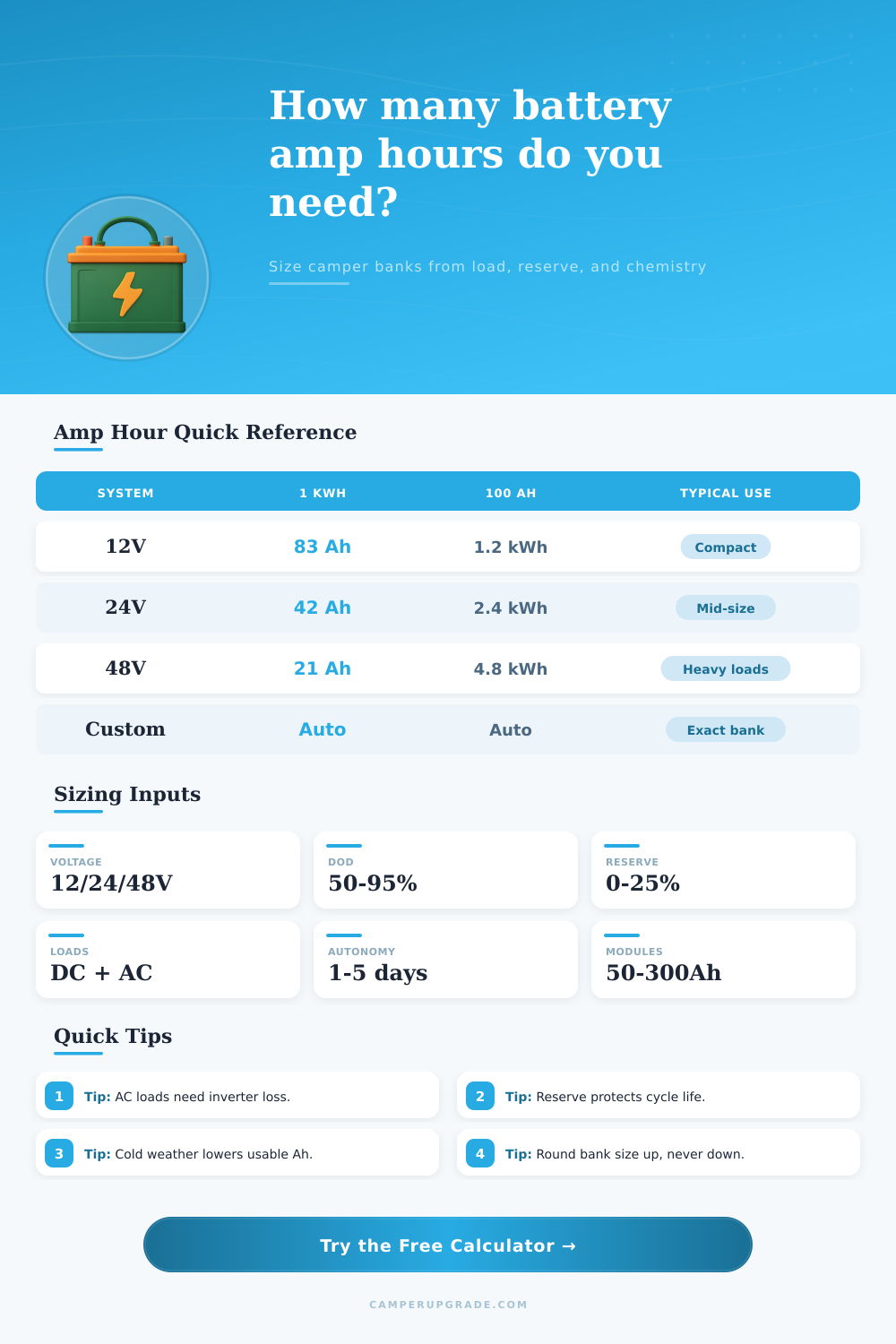
| 12V | 83.3 Ah | 1.20 kWh | Common compact build |
| 24V | 41.7 Ah | 2.40 kWh | Lower current on cables |
| 48V | 20.8 Ah | 4.80 kWh | High power inverter loads |
| Custom | Auto-convert | Auto-convert | Use your exact bank voltage |
| Camper Load | Watts | Hours | Daily Ah at 12V |
|---|---|---|---|
| Roof fan and lights | 60 W | 6 h | 30 Ah |
| 12V fridge cycling | 55 W | 10 h | 46 Ah |
| Laptop and router | 90 W | 5 h | 38 Ah |
| Microwave burst | 1200 W | 0.25 h | 25 Ah |
| Induction breakfast | 1500 W | 0.2 h | 25 Ah |
| Use Case | Daily Load | Target Days | 12V Bank Size |
|---|---|---|---|
| Weekend camper | 500 Wh/day | 2 days | 120 Ah |
| CPAP overnight | 700 Wh/day | 1 night | 100 Ah |
| Work-from-van | 1600 Wh/day | 2 days | 300 Ah |
| Winter furnace | 2400 Wh/day | 2 days | 420 Ah |
| High-load coach | 4200 Wh/day | 1 day | 380 Ah |
To size a battery bank for a camper, you need to calculate the total energy requirement of all appliance. The battery bank has to provide power to the appliances to ensure that they functions properly while camping. A battery bank that is too small will not supply the power that the camper’s appliances need throughout the day and night.
You must account for all appliances that uses power from the battery bank. This includes appliances that provide constant power, such as an refrigerator, as well as those that require burst power, such as a microwave. Additionally, you must consider the energy that is lost due to inverters converting power from direct current to alternating current, as well as the fact that in cold weather, battery bank contain less energy due to their chemical reactions slowing down.
How to Size a Battery Bank for Your Camper
To calculate the energy requirement of your camper’s electrical appliances, you need to calculate the watt-hours that the camper use each day. DC appliances, like fans, use the power of the battery bank without losing any of that power to the conversion from direct to alternating current. However, AC appliances require an inverter that will lose some of the energy in converting the direct current from the battery bank to alternating current that can power the camper’s appliances.
For example, to power a 1200-watt microwave for fifteen minutes will use more than 300 watt-hours of power from the battery bank because of these power losses from the inverter. Thus, it is necesary to calculate the watt-hours that each appliance use and separate those appliances that use direct current from those that use alternating current to calculate the total energy footprint of the camper’s electrical appliances. The chemistry of the battery bank will impact how much energy can be extracted from that battery bank.
For example, lithium iron phosphate (LiFePO4) batteries can deliver up to 80 to 95 percent of the battery’s capacity without damaging them over time. Thus, if the camper uses the battery bank every night while camping, these batteries will be the most efficient in meeting the camper’s need. Lead-acid batteries, such as AGM or gel batteries, cannot deliver 100 percent of their capacity without damaging them over time.
Instead, they can only deliver 50 percent of their capacity without damaging them. If lead-acid batteries are deeply discharged, the lead will sulfate, and that sulfate will permanently reduce the capacity of those batteries. Additionally, if there are heavy power draw from the battery bank, the Peukert effect will reduce the number of amp hours that the battery bank delivers to the camper’s appliances.
The autonomy of a battery bank is the number of days that the battery bank can provide power to the camper’s appliances without being recharged. The greater the number of days that the camper would like the battery bank to provide power, the more greater the size of the battery bank that is required. For example, if the camper’s daily power needs are 150 amp hours at 12 volts, the size of the battery bank will need to be increased if the camper wants to provide power for two or three days.
In that example, double or triple the size of the battery bank will be required. It is also necesary to include a buffer into the calculations to provide for 15 to 25 percent of extra power for situations like cloudy weather that may prevent the use of solar panel to recharge the battery bank. Additionally, the weather affects the battery banks chemical reaction; below-freezing temperatures may reduce the usable capacity of the battery bank by 10 to 20 percent.
Another consideration when sizing a battery bank for a camper is the voltage of that battery bank. Many campers use 12-volt battery banks. Other campers with more extensive camping systems use 24-volt or 48-volt battery banks.
Using 24 volts rather than 12 volts will decrease the current that is used to power the camper’s appliances. Because power is equal to voltage multiplied by current, reducing the current will reduce the power loss in the wiring from the battery bank to the camper’s appliances. Similarly, 48 volt battery banks are efficient because they allow for large inverters that use thinner wires with less heat created when moving the power from the battery to the camper’s appliances.
Using a 48 volt battery bank for camping, however, requires that the camper use battery bank chargers that is matched to the 48 volt system. Many people make mistakes when sizing their battery bank for camping. Some people choose battery banks that are too small because they do not account for the energy lost to the inverter when changing from direct to alternating current or to the Peukert effect that occur with deep battery discharges.
Other people do not account for the power that solar panel chargers or alternators can provide while camping. Thus, if people forget to include these power offsets, they will calculate the energy that their appliances use incorrect. Finally, the calculated size of the battery bank should never be rounded down; it should be rounded up to ensure that there is enough energy for the camper’s appliances.
You should of checked your math twice.