Battery Capacity Calculator
Size camper battery banks in Ah, kWh, module count, and backup time from daily loads, autonomy days, and chemistry limits.
⚡Quick Presets
⚙Bank Inputs
📊Battery Chemistry Spec Grid
📘Reference Tables
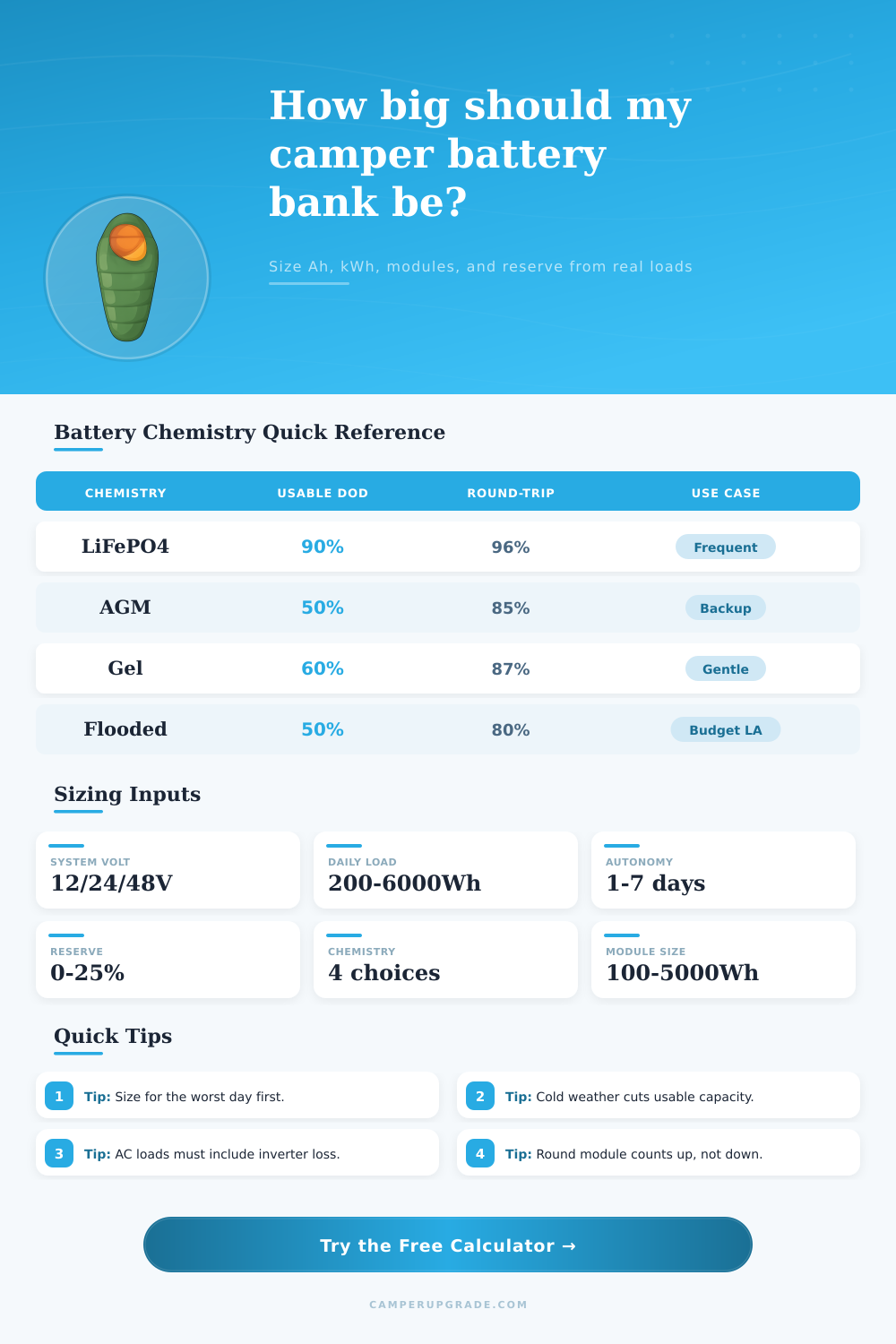
| Chemistry | Usable DoD | Round-Trip | Best Fit |
|---|---|---|---|
| LiFePO4 | 80-90% | 94-97% | Daily camper use |
| AGM | 40-50% | 80-88% | Simple sealed bank |
| Gel | 50-60% | 82-90% | Slow, steady loads |
| Flooded | 40-50% | 75-84% | Ventilated storage bay |
| System Voltage | 1 kWh At Voltage | 100 Ah Bank | Why It Matters |
|---|---|---|---|
| 12V | 83.3 Ah | 1.2 kWh | Common in compact campers |
| 24V | 41.7 Ah | 2.4 kWh | Lower current for mid-size builds |
| 48V | 20.8 Ah | 4.8 kWh | Best for high inverter loads |
| Custom | Auto-convert | Auto-convert | Use the exact bank voltage |
| DoD Limit | Usable From 100Ah | Usable At 12V | Cycle Pressure |
|---|---|---|---|
| 50% | 50 Ah | 0.6 kWh | Very low |
| 60% | 60 Ah | 0.72 kWh | Moderate |
| 80% | 80 Ah | 0.96 kWh | Higher |
| 90% | 90 Ah | 1.08 kWh | High but acceptable |
| Typical Camper Load | Wh Per Day | 12V Ah Per Day | Comment |
|---|---|---|---|
| Roof fan and lights | 300 Wh | 25 Ah | Small weekend use |
| 12V fridge cycling | 600 Wh | 50 Ah | Moderate daily draw |
| Laptop and router | 400 Wh | 33 Ah | Light remote work |
| Microwave and coffee | 1200 Wh | 100 Ah | Short but heavy AC load |
A battery bank is a system that stores energy in the camper. Additionally, it is a critical component for those who would like to live off an grid. The battery bank must be of the correct size for the camper.
If the battery bank is too small for the campers need, the camper will reach power depletion too soon. To calculate the size of the battery bank that is required for the camper, that individual must determine there energy draws, weather patterns, and the number of day that they will be off the power grid. To calculate the number of battery banks that will be required for the camper, the camper must first determine the electrical loads that will be drawing energy from the camper.
How to Size a Battery Bank for a Camper
Some electrical loads will be DC loads, which include LED lights, water pumps, and USB charger. These devices will draw power directly from the battery bank and will waste little energy. Other electrical loads will be AC loads, such as microwave and hair dryers.
These appliances will require an inverter to convert the energy from the battery bank to the electrical energy that the appliances use. In doing so, the inverter will use 5 to 20 percent of the energy that the appliances draw. Additionally, the solar panels will subtract the energy provided from the total energy need of the camper, as the solar panels will provide some of the energy to the battery bank.
Another number that can be used to determine the size of the battery bank is the number of “autonomy” days that will be required of the battery bank. Autonomy days are the number of days that the battery bank will provide power to the camper without being recharged. If the camper plans to travel to locations with limited sunlight, more autonomy days will be required.
Thus, a battery bank with more autonomy days will be required for these locations. The capacity of the battery bank can also be affected by the temperatures at which the battery bank will be exposed. Battery bank capacities can be reduced by 20% or more in temperatures where the electrolyte within the battery thicken.
Thus, battery bank size should of been calculated according to the coldest temperatures that the camper will encounter. Another consideration in the sizing of the battery bank is the chemistry of the batteries that are to be used. For instance, lithium iron phosphate (LiFePO4) batteries permit for the use of 90% of the battery’s capacity before the lifespan of the battery is diminish.
Lead-acid batteries, such as AGM and flooded lead-acid batteries, should not have their capacity depleted to more than 50% of the total capacity. Additionally, LiFePO4 batteries has a high rate of return of the energy that is placed into the battery; they can return 96% of the energy that is put into them. In contrast, flooded lead-acid batteries may waste a significant portion of the energy that is placed into the battery.
Another consideration for those who are calculating the size of their battery bank is the voltage that will be used by the camper. For instance, 12-volt systems are common for trailers; however, 12-volt systems require thicker electrical cables to handle the amount of current that the electrical loads in the trailer require. 48-volt systems require less current to power the electrical devices in the trailer and, therefore, allow for the use of thinner wires.
Additionally, higher voltages are generally used to power large appliance like air conditioners; however, all components in the camper must be able to handle the voltage that the battery bank provides. In addition to the factors discussed above, an individual should provide for a reserve margin in the battery bank. A reserve margin is established as an extra amount of energy to compensate for any difference between the estimated and actual capacity of the battery bank’s cells over time.
A reserve margin of 10 to 20% of the total calculated energy needs of the camper should be provided; without this reserve margin, the battery bank will reach 0% capacity at a faster rate than estimated as its cells age. Many individuals make mistake when sizing their battery bank. For instance, some individuals may underestimate the energy requirements of their AC appliances and, thus, do not account for the energy that the inverter uses.
Other individuals may not account for the effect of cold temperature on the batteries capacity to store energy. Finally, some individuals may round down the number of battery modules that they calculate are required for their camping trailer. Any rounding down of the number of modules in a battery bank will result in a battery bank that does not have enough energy to meet the electrical needs of the camper.
Thus, any number of battery modules that is calculated will be rounded up to ensure that the camper has enough energy from the battery bank. Beyond calculating the number of battery bank modules that is required for a camper according to their energy needs, there are also environmental considerations of the travels of the camper that can help to determine battery chemistry. For instance, if the travels of the camper may occur on rough road, sealed batteries are better than flooded lead-acid batteries.
Additionally, if the camper use solar panels to provide energy to the trailer, the use of LiFePO4 batteries is beneficial because they can handle the high charging currents from the solar panels more efficiently than lead-acid batteries. Thus, each of these factors will play a role in the decision of the battery chemistry that is to be used in the campers trailer. Overall, to size the battery bank for the camper, it is important to calculate the electrical loads that the camper will use, to choose a battery chemistry, and to add in the reserve margin for the battery bank’s cells.