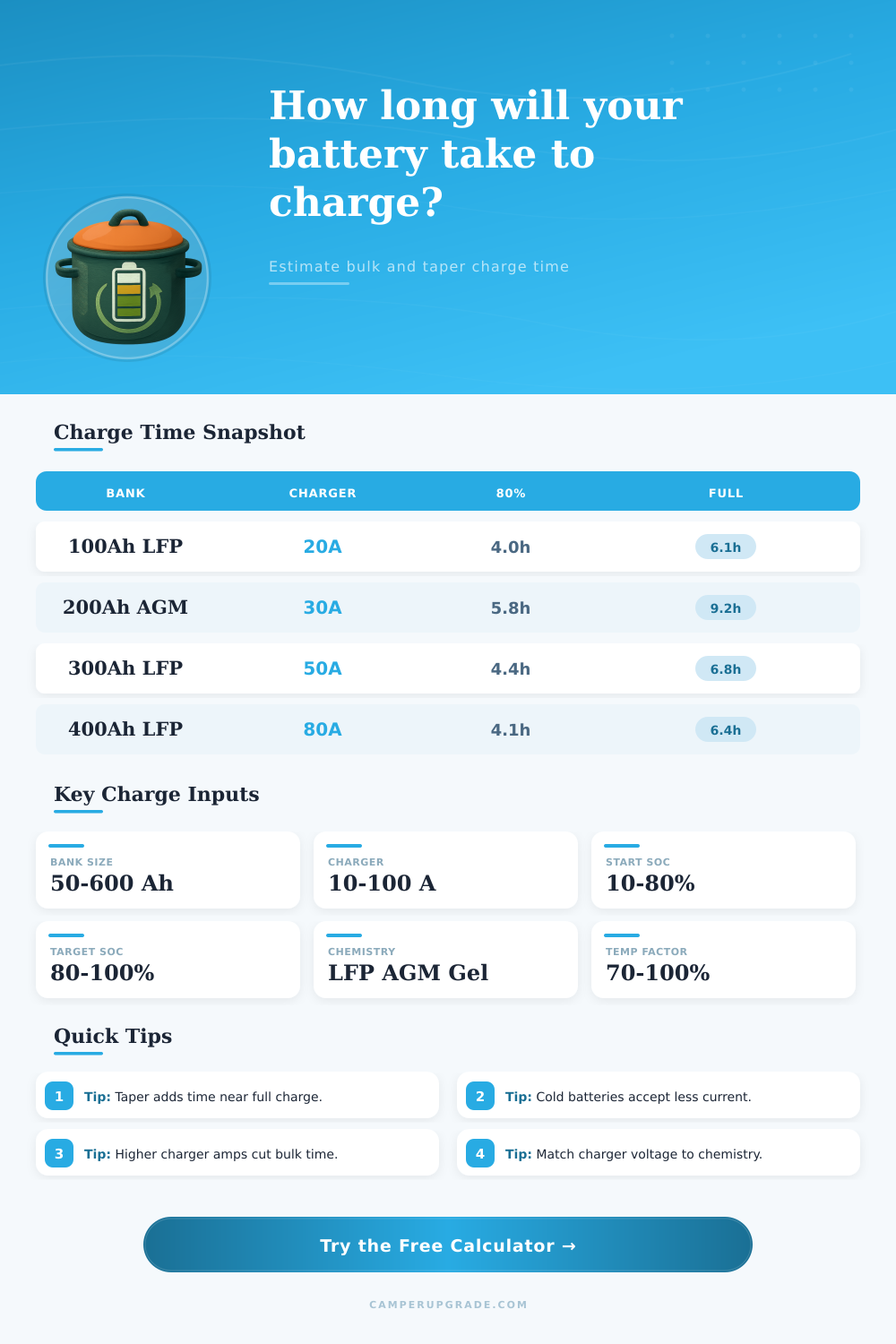
Battery Charge Time Calculator
Estimate how long an RV battery bank needs to reach a target state of charge with bulk, absorption, and loss factors included.
💡Charge Scenarios
⚙Battery and Charger Inputs
📈Charge Chemistry Comparison Grid
📘Reference Tables
| Stage | Typical Goal | What Happens | Time Share |
|---|---|---|---|
| Bulk | 0-80% | Max current, fastest refill | 60-80% |
| Absorption | 80-95% | Voltage holds, current tapers | 15-35% |
| Finish | 95-100% | Final top-off is slowest | 5-20% |
| Float | 100% | Maintenance only | Hold mode |
| Charger Size | 100Ah Bank | 200Ah Bank | 400Ah Bank |
|---|---|---|---|
| 10A | 8-10h | 16-20h | 32-40h |
| 20A | 4-5h | 8-10h | 16-20h |
| 40A | 2-3h | 4-5h | 8-10h |
| 80A | 1-2h | 2-3h | 4-5h |
| Bank | Start to 80% | 80 to 100% | Note |
|---|---|---|---|
| 100Ah LFP | 3-4h | 1-2h | Short taper |
| 200Ah AGM | 5-7h | 2-4h | Longer finish |
| 300Ah LFP | 4-6h | 1-3h | High acceptance |
| 600Ah LFP | 7-10h | 2-5h | Dual charger helps |
| Efficiency Factor | Charge Current | Practical Effect | Use Case |
|---|---|---|---|
| 100% | Full rating | Fastest result | Ideal temp |
| 95% | Near rating | Small real loss | Most installs |
| 90% | Reduced | Notable slowdown | Warm wiring |
| 80% | Limited | Longer charge window | Cold weather |
| Preset | Bank | Charger | Target |
|---|---|---|---|
| Shore top-up | 100Ah | 20A | 90% |
| Weekend return | 200Ah | 30A | 95% |
| Alternator assist | 280Ah | 60A | 85% |
| Large bank fast | 400Ah | 80A | 90% |
When you use an RV battery systems, you must have an understanding of how battery charging work. Battery charging takes a specific amount of time and follows specific stage. You must be able to calculate how much time you need to charging your batteries so that you can prepare for your next drive.
Battery charging does not occur in a single process but instead goes through different phase of battery charging. The first phase of battery charging includes the bulk phase of charging. During this phase, the charger will provide the most current to the battery.
How RV Batteries Get Charged and How Long It Takes
This phase is responsible for the majority of the charging of the battery. During this phase, the battery will have charged seventy to eighty percent of the total amount of charge it will receive during charging. The second phase are the absorption phase of battery charging.
This occurs after the bulk phase. During this stage, the battery voltage will remain the same, but the current that the charger provides to the battery will start to wane as the battery fill the remaining charge in its cells. This phase takes more time than the bulk phase.
In some instances, it can take as long as double amount of time it takes to complete the bulk phase to fully charge the battery. Battery chemistry will play a key role in how long it takes to charge the battery. The chemistry of the battery will determine how it respond to the charging battery.
Lead acid batteries will take longer during the absorption phase than a lithium battery will. Lithium batteries does not have an extensive absorption phase. For these reason, they will charge at a faster rate than lead acid batteries.
The voltage of the charger must be matched to the chemistry of the battery. For instance, lithium batteries will require fourteen point four volts. AGM batteries will require a slightly higher voltage.
Using a shore power connection that does not account for the chemistry of the batteries will prevent them from being able to charge correct. The temperature of the batteries will play a key role in how much current the batteries can accept. At ninety-five degrees Fahrenheit, batteries can accept the full current required to charge them.
At freezing temperature, though, they may only be able to take in eighty percent of the current that is provided to them. Lithium batteries are not impacted much by the temperatures around them. Gel batteries, though, may have difficulty charging if the temperatures drops below seventy degrees.
In these cases, you might have to warm the batteries to provide the proper current to fully charge the batteries. Another thing to consider is the efficiency of the battery charging system. Some system lose power due to the resistance in the wiring system and at the battery connections.
Using electrical wiring that is too small for the power that must be provided to the battery may cause a drop in the voltage provided to the battery. A drop in the voltage will make it seem as if the battery is not providing as much amperage as it should. Using connections that may contain resistance due to dirt or other substances will also play a key role in the amperage provided to the battery.
Any resistance will reduce the amount of amperage that is provided to the battery. The efficiency of the converter that the battery is connected to may also play a role in how much power is delivered to the battery. For example, if the converter is only ninety-two percent efficient, it will not be able to deliver one hundred percent of the power that it is rated to provide to the battery.
The type of power that you use to charge the batteries will also affect how fast that battery fills up its cell. The different power sources and how much time you have will play a role in the power source that you choose for your battery system. For example, solar panels will allow the batteries to charge while in use but only during the daylight hours.
The solar power fluctuate with the presence of clouds and the angle of the sun in respect to the panels. Another power source is the DC-DC charger which will allow the alternator of the RV to be connected directly to the battery bank. Using this power source, the alternator can provide power to the battery while the RV is in motion.
Shore power is another power source that may be used to charge batteries while the RV is parked at its campground and sleeping quarters. When you prepare your RV to travel, calculate how many amp-hours of power you will need to provide to the battery to fully replace the power that the RV used. For example, a two hundred amp-hour lithium battery will need to be charged with specific amperage for four hours to provide the necessary charge.
In this case, eighty to ninety percent of the batterys charge may be targeted rather than a one hundred percent charge to the battery. By understanding how the two relate, you can plan your trips and ensure that your batteries are in proper condition and ready to use.