Distance Calculator
Measure point-to-point distance, road expansion, and stop-adjusted trip time for camper route planning.
🛣️Route Presets
⚙Distance Inputs
📊Measurement Spec Grid
📘Distance Reference Tables
| Terrain | Multiplier | Best Use | Route Effect |
|---|---|---|---|
| Open Highway | 1.05 | Paved links | Low detour |
| Coastal Roads | 1.08 | Scenic bends | Moderate |
| Forest Access | 1.12 | Camp roads | Extra turns |
| Mountain Pass | 1.22 | Steep grades | Switchbacks |
| Distance | Miles | Kilometers | Comment |
|---|---|---|---|
| 1 mi | 1.00 | 1.61 | Short hop |
| 10 mi | 10.00 | 16.09 | Local run |
| 50 mi | 50.00 | 80.47 | Half day |
| 100 mi | 100.00 | 160.93 | Full run |
| Route Band | Stops | Rest Time | Use Case |
|---|---|---|---|
| Under 50 mi | 0-1 | 0-12 min | Quick hop |
| 50-150 mi | 1-2 | 12-24 min | Day travel |
| 150-300 mi | 2-3 | 24-36 min | Camp move |
| 300+ mi | 3+ | 36+ min | Long haul |
| Preset Type | Straight | Route | Detail |
|---|---|---|---|
| Desert Loop | 34 mi | 43 mi | Warm, open roads |
| Mountain Pass | 58 mi | 79 mi | Steep and slow |
| Coastal Hop | 92 mi | 121 mi | Bends and pullouts |
| Forest Spur | 46 mi | 58 mi | Gravel connectors |
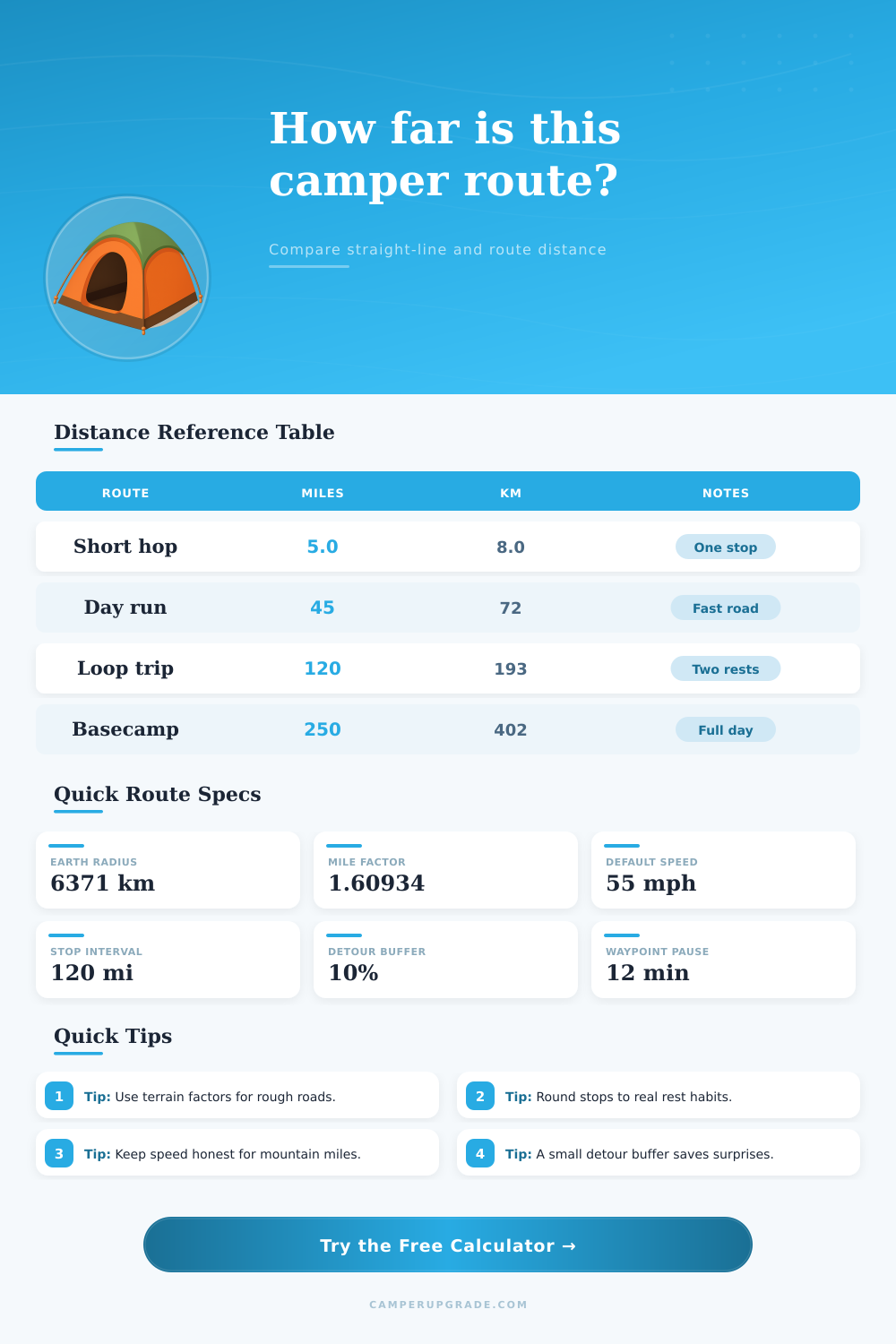
When you are planning a route for a camper, you must consider the difference between the distance on the map and the actual distance of the road. The distance on the map from one point to another is the straight line distance between the two points. However, the actual distance that the camper will travel are always going to be more, as roads often wind around canyons or around boulders.
Thus, the actual distance of the road will always be more than the straight-line distance on the map. This actual distance must be considered because this is the distance that the camper will travel, so it will determine the time that the camper will spend driving. The terrain that a camper will travel will impact both the distance and the speeds at which the camper travels.
How to Plan Camper Travel Time
For example, many mountain passes has very steep gradients as well as numerous hairpin turns that make it take more time to travel those passes compared to flat areas. In these cases, the trip will have to recalibrate the speed of the camper to account for these mountains. One way of doing this is by using terrain multipliers.
Highways have a terrain multiplier of 1.05, for instance, but roads such as forest roads have a terrain multiplier of 1.12 because there is more turns in these roads. These multipliers can help to ensure that the trip accounts for the extra distance required by the terrain. The average speed that is planned for a camper must also be realistic.
Many people may think that the camper can reach the same speeds as a car on the highway. However, campers tend to travel at a slower rate because of the weight of the camper. Additionally, there may be different surface for the camper to travel on that require slower speeds.
Finally, it is also necessary to include a detour buffer in the trip. A detour buffer will account for unexpected events on the road. A detour buffer may be anywhere from 8 to 14 percent of the total travel time for the camper.
Another important factor to consider is the stops that the camper will make. Stops must be included in the plan for the camper because the person who are traveling will need to take breaks during such a long trip. Twelve minutes at every interval for a break, for example, will add up to a significant amount of time for the camper to travel.
Additionally, if there are any waypoints that the trip will visit during the trip, those stops will also add to the total amount of time that the camper will require. If these stops are not included in the travel time calculation, the estimate for the travel time will be inaccurate. Finally, another factor that will impact the travel time for a camper is the weather and the weight of the camper.
For example, if the weather is particularly windy during the trip, the camper will experience friction with the wind, making it difficult for the camper to maintain its desired travel speed. Similarly, if there is rain or thick fog along the route, the visibility will be lessened, forcing the camper to travel at a more slow speed. Additionally, if the camper is fully loaded with gear and water, it will travel at a slower rate up hills than if it was lighter in weight.
Thus, it is a good idea to test the speed of the camper on roads that are similar to the area that are to be traveled. Testing the speed of the camper will allow the camper to understand how its weight may impact the travel time. Finally, if there are different routes that you can take to the same destination, it is a good idea to compare each route to determine which may be the most best for travel.
Each route should use the same speeds and stop distances to compare the routes. Additionally, using buffers in the time estimate will account for any surprises that may occur when the camper is on the road. Thus, by using buffers, realistic speeds, and terrain multipliers, you can ensure that the estimate for the trip will match the reality of the camper when on the road.
When you are planning a route for a camper, you must consider the difference between the distance on the map and the actual distance of the road. The distance on the map from one point to another is the straight line distance between the two points. However, the actual distance that the camper will travel are always going to be more, as roads often wind around canyons or around boulders.
Thus, the actual distance of the road will always be more than the straight-line distance on the map. This actual distance must be considered because this is the distance that the camper will travel, so it will determine the time that the camper will spend driving. The terrain that a camper will travel will impact both the distance and the speeds at which the camper travels.
For example, many mountain passes has very steep gradients as well as numerous hairpin turns that make it take more time to travel those passes compared to flat areas. In these cases, the trip will have to recalibrate the speed of the camper to account for these mountains. One way of doing this is by using terrain multipliers.
Highways have a terrain multiplier of 1.05, for instance, but roads such as forest roads have a terrain multiplier of 1.12 because there is more turns in these roads. These multipliers can help to ensure that the trip accounts for the extra distance required by the terrain. The average speed that is planned for a camper must also be realistic.
Many people may think that the camper can reach the same speeds as a car on the highway. However, campers tend to travel at a slower rate because of the weight of the camper. Additionally, there may be different surface for the camper to travel on that require slower speeds.
Finally, it is also necessary to include a detour buffer in the trip. A detour buffer will account for unexpected events on the road. A detour buffer may be anywhere from 8 to 14 percent of the total travel time for the camper.
Another important factor to consider is the stops that the camper will make. Stops must be included in the plan for the camper because the person who are traveling will need to take breaks during such a long trip. Twelve minutes at every interval for a break, for example, will add up to a significant amount of time for the camper to travel.
Additionally, if there are any waypoints that the trip will visit during the trip, those stops will also add to the total amount of time that the camper will require. If these stops are not included in the travel time calculation, the estimate for the travel time will be inaccurate. Finally, another factor that will impact the travel time for a camper is the weather and the weight of the camper.
For example, if the weather is particularly windy during the trip, the camper will experience friction with the wind, making it difficult for the camper to maintain its desired travel speed. Similarly, if there is rain or thick fog along the route, the visibility will be lessened, forcing the camper to travel at a more slow speed. Additionally, if the camper is fully loaded with gear and water, it will travel at a slower rate up hills than if it was lighter in weight.
Thus, it is a good idea to test the speed of the camper on roads that are similar to the area that are to be traveled. Testing the speed of the camper will allow the camper to understand how its weight may impact the travel time. Finally, if there are different routes that you can take to the same destination, it is a good idea to compare each route to determine which may be the most best for travel.
Each route should use the same speeds and stop distances to compare the routes. Additionally, using buffers in the time estimate will account for any surprises that may occur when the camper is on the road. Thus, by using buffers, realistic speeds, and terrain multipliers, you can ensure that the estimate for the trip will match the reality of the camper when on the road.
***
When you are planning a route for a camper, you must consider the difference between the distance on the map and the actual distance of the road. The distance on the map from one point to another is the straight line distance between the two points. However, the actual distance that the camper will travel are always going to be more, as roads often wind around canyons or around boulders.
Thus, the actual distance of the road will always be more than the straight-line distance on the map. This actual distance must be considered because this is the distance that the camper will travel, so it will determine the time that the camper will spend driving. The terrain that a camper will travel will impact both the distance and the speeds at which the camper travels.
For example, many mountain passes has very steep gradients as well as numerous hairpin turns that make it take more time to travel those passes compared to flat areas. In these cases, the trip will have to recalibrate the speed of the camper to account for these mountains. One way of doing this is by using terrain multipliers.
Highways have a terrain multiplier of 1.05, for instance, but roads such as forest roads have a terrain multiplier of 1.12 because there is more turns in these roads. These multipliers can help to ensure that the trip accounts for the extra distance required by the terrain. The average speed that is planned for a camper must also be realistic.
Many people may think that the camper can reach the same speeds as a car on the highway. However, campers tend to travel at a slower rate because of the weight of the camper. Additionally, there may be different surface for the camper to travel on that require slower speeds.
Finally, it is also necessary to include a detour buffer in the trip. A detour buffer will account for unexpected events on the road. A detour buffer may be anywhere from 8 to 14 percent of the total travel time for the camper.
Another important factor to consider is the stops that the camper will make. Stops must be included in the plan for the camper because the person who are traveling will need to take breaks during such a long trip. Twelve minutes at every interval for a break, for example, will add up to a significant amount of time for the camper to travel.
Additionally, if there are any waypoints that the trip will visit during the trip, those stops will also add to the total amount of time that the camper will require. If these stops are not included in the travel time calculation, the estimate for the travel time will be inaccurate. Finally, another factor that will impact the travel time for a camper is the weather and the weight of the camper.
For example, if the weather is particularly windy during the trip, the camper will experience friction with the wind, making it difficult for the camper to maintain its desired travel speed. Similarly, if there is rain or thick fog along the route, the visibility will be lessened, forcing the camper to travel at a more slow speed. Additionally, if the camper is fully loaded with gear and water, it will travel at a slower rate up hills than if it was lighter in weight.
Thus, it is a good idea to test the speed of the camper on roads that are similar to the area that are to be traveled. Testing the speed of the camper will allow the camper to understand how its weight may impact the travel time. Finally, if there are different routes that you can take to the same destination, it is a good idea to compare each route to determine which may be the most best for travel.
Each route should use the same speeds and stop distances to compare the routes. Additionally, using buffers in the time estimate will account for any surprises that may occur when the camper is on the road. Thus, by using buffers, realistic speeds, and terrain multipliers, you can ensure that the estimate for the trip will match the reality of the camper when on the road.
***
When you are planning a route for a camper, you must consider the difference between the distance on the map and the actual distance of the road. The distance on the map from one point to another is the straight line distance between the two points. However, the actual distance that the camper will travel are always going to be more, as roads often wind around canyons or around boulders.
Thus, the actual distance of the road will always be more than the straight-line distance on the map. This actual distance must be considered because this is the distance that the camper will travel, so it will determine the time that the camper will spend driving. The terrain that a camper will travel will impact both the distance and the speeds at which the camper travels.
For example, many mountain passes has very steep gradients as well as numerous hairpin turns that make it take more time to travel those passes compared to flat areas. In these cases, the trip will have to recalibrate the speed of the camper to account for these mountains. One way of doing this is by using terrain multipliers.
Highways have a terrain multiplier of 1.05, for instance, but roads such as forest roads have a terrain multiplier of 1.12 because there is more turns in these roads. These multipliers can help to ensure that the trip accounts for the extra distance required by the terrain. The average speed that is planned for a camper must also be realistic.
Many people may think that the camper can reach the same speeds as a car on the highway. However, campers tend to travel at a slower rate because of the weight of the camper. Additionally, there may be different surface for the camper to travel on that require slower speeds.
Finally, it is also necessary to include a detour buffer in the trip. A detour buffer will account for unexpected events on the road. A detour buffer may be anywhere from 8 to 14 percent of the total travel time for the camper.
Another important factor to consider is the stops that the camper will make. Stops must be included in the plan for the camper because the person who are traveling will need to take breaks during such a long trip. Twelve minutes at every interval for a break, for example, will add up to a significant amount of time for the camper to travel.
Additionally, if there are any waypoints that the trip will visit during the trip, those stops will also add to the total amount of time that the camper will require. If these stops are not included in the travel time calculation, the estimate for the travel time will be inaccurate. Finally, another factor that will impact the travel time for a camper is the weather and the weight of the camper.
For example, if the weather is particularly windy during the trip, the camper will experience friction with the wind, making it difficult for the camper to maintain its desired travel speed. Similarly, if there is rain or thick fog along the route, the visibility will be lessened, forcing the camper to travel at a more slow speed. Additionally, if the camper is fully loaded with gear and water, it will travel at a slower rate up hills than if it was lighter in weight.
Thus, it is a good idea to test the speed of the camper on roads that are similar to the area that are to be traveled. Testing the speed of the camper will allow the camper to understand how its weight may impact the travel time. Finally, if there are different routes that you can take to the same destination, it is a good idea to compare each route to determine which may be the most best for travel.
Each route should use the same speeds and stop distances to compare the routes. Additionally, using buffers in the time estimate will account for any surprises that may occur when the camper is on the road. Thus, by using buffers, realistic speeds, and terrain multipliers, you can ensure that the estimate for the trip will match the reality of the camper when on the road.
***
When you are planning a route for a camper, you must consider the difference between the distance on the map and the actual distance of the road. The distance on the map from one point to another is the straight line distance between the two points. However, the actual distance that the camper will travel are always going to be more, as roads often wind around canyons or around boulders.
Thus, the actual distance of the road will always be more than the straight-line distance on the map. This actual distance must be considered because this is the distance that the camper will travel, so it will determine the time that the camper will spend driving. The terrain that a camper will travel will impact both the distance and the speeds at which the camper travels.
For example, many mountain passes has very steep gradients as well as numerous hairpin turns that make it take more time to travel those passes compared to flat areas. In these cases, the trip will have to recalibrate the speed of the camper to account for these mountains. One way of doing this is by using terrain multipliers.
Highways have a terrain multiplier of 1.05, for instance, but roads such as forest roads have a terrain multiplier of 1.12 because there is more turns in these roads. These multipliers can help to ensure that the trip accounts for the extra distance required by the terrain. The average speed that is planned for a camper must also be realistic.
Many people may think that the camper can reach the same speeds as a car on the highway. However, campers tend to travel at a slower rate because of the weight of the camper. Additionally, there may be different surface for the camper to travel on that require slower speeds.
Finally, it is also necessary to include a detour buffer in the trip. A detour buffer will account for unexpected events on the road. A detour buffer may be anywhere from 8 to 14 percent of the total travel time for the camper.
Another important factor to consider is the stops that the camper will make. Stops must be included in the plan for the camper because the person who are traveling will need to take breaks during such a long trip. Twelve minutes at every interval for a break, for example, will add up to a significant amount of time for the camper to travel.
Additionally, if there are any waypoints that the trip will visit during the trip, those stops will also add to the total amount of time that the camper will require. If these stops are not included in the travel time calculation, the estimate for the travel time will be inaccurate. Finally, another factor that will impact the travel time for a camper is the weather and the weight of the camper.
For example, if the weather is particularly windy during the trip, the camper will experience friction with the wind, making it difficult for the camper to maintain its desired travel speed. Similarly, if there is rain or thick fog along the route, the visibility will be lessened, forcing the camper to travel at a more slow speed. Additionally, if the camper is fully loaded with gear and water, it will travel at a slower rate up hills than if it was lighter in weight.
Thus, it is a good idea to test the speed of the camper on roads that are similar to the area that are to be traveled. Testing the speed of the camper will allow the camper to understand how its weight may impact the travel time. Finally, if there are different routes that you can take to the same destination, it is a good idea to compare each route to determine which may be the most best for travel.
Each route should use the same speeds and stop distances to compare the routes. Additionally, using buffers in the time estimate will account for any surprises that may occur when the camper is on the road. Thus, by using buffers, realistic speeds, and terrain multipliers, you can ensure that the estimate for the trip will match the reality of the camper when on the road.
***
When you are planning a route for a camper, you must consider the difference between the distance on the map and the actual distance of the road. The distance on the map from one point to another is the straight line distance between the two points. However, the actual distance that the camper will travel are always going to be more, as roads often wind around canyons or around boulders.
Thus, the actual distance of the road will always be more than the straight-line distance on the map. This actual distance must be considered because this is the distance that the camper will travel, so it will determine the time that the camper will spend driving. The terrain that a camper will travel will impact both the distance and the speeds at which the camper travels.
For example, many mountain passes has very steep gradients as well as numerous hairpin turns that make it take more time to travel those passes compared to flat areas. In these cases, the trip will have to recalibrate the speed of the camper to account for these mountains. One way of doing this is by using terrain multipliers.
Highways have a terrain multiplier of 1.05, for instance, but roads such as forest roads have a terrain multiplier of 1.12 because there is more turns in these roads. These multipliers can help to ensure that the trip accounts for the extra distance required by the terrain. The average speed that is planned for a camper must also be realistic.
Many people may think that the camper can reach the same speeds as a car on the highway. However, campers tend to travel at a slower rate because of the weight of the camper. Additionally, there may be different surface for the camper to travel on that require slower speeds.
Finally, it is also necessary to include a detour buffer in the trip. A detour buffer will account for unexpected events on the road. A detour buffer may be anywhere from 8 to 14 percent of the total travel time for the camper.
Another important factor to consider is the stops that the camper will make. Stops must be included in the plan for the camper because the person who are traveling will need to take breaks during such a long trip. Twelve minutes at every interval for a break, for example, will add up to a significant amount of time for the camper to travel.
Additionally, if there are any waypoints that the trip will visit during the trip, those stops will also add to the total amount of time that the camper will require. If these stops are not included in the travel time calculation, the estimate for the travel time will be inaccurate. Finally, another factor that will impact the travel time for a camper is the weather and the weight of the camper.
For example, if the weather is particularly windy during the trip, the camper will experience friction with the wind, making it difficult for the camper to maintain its desired travel speed. Similarly, if there is rain or thick fog along the route, the visibility will be lessened, forcing the camper to travel at a more slow speed. Additionally, if the camper is fully loaded with gear and water, it will travel at a slower rate up hills than if it was lighter in weight.
Thus, it is a good idea to test the speed of the camper on roads that are similar to the area that are to be traveled. Testing the speed of the camper will allow the camper to understand how its weight may impact the travel time. Finally, if there are different routes that you can take to the same destination, it is a good idea to compare each route to determine which may be the most best for travel.
Each route should use the same speeds and stop distances to compare the routes. Additionally, using buffers in the time estimate will account for any surprises that may occur when the camper is on the road. Thus, by using buffers, realistic speeds, and terrain multipliers, you can ensure that the estimate for the trip will match the reality of the camper when on the road.
***
When you are planning a route for a camper, you must consider the difference between the distance on the map and the actual distance of the road. The distance on the map from one point to another is the straight line distance between the two points. However, the actual distance that the camper will travel are always going to be more, as roads often wind around canyons or around boulders.
Thus, the actual distance of the road will always be more than the straight-line distance on the map. This actual distance must be considered because this is the distance that the camper will travel, so it will determine the time that the camper will spend driving. The terrain that a camper will travel will impact both the distance and the speeds at which the camper travels.
For example, many mountain passes has very steep gradients as well as numerous hairpin turns that make it take more time to travel those passes compared to flat areas. In these cases, the trip will have to recalibrate the speed of the camper to account for these mountains. One way of doing this is by using terrain multipliers.
Highways have a terrain multiplier of 1.05, for instance, but roads such as forest roads have a terrain multiplier of 1.12 because there is more turns in these roads. These multipliers can help to ensure that the trip accounts for the extra distance required by the terrain. The average speed that is planned for a camper must also be realistic.
Many people may think that the camper can reach the same speeds as a car on the highway. However, campers tend to travel at a slower rate because of the weight of the camper. Additionally, there may be different surface for the camper to travel on that require slower speeds.
Finally, it is also necessary to include a detour buffer in the trip. A detour buffer will account for unexpected events on the road. A detour buffer may be anywhere from 8 to 14 percent of the total travel time for the camper.
Another important factor to consider is the stops that the camper will make. Stops must be included in the plan for the camper because the person who are traveling will need to take breaks during such a long trip. Twelve minutes at every interval for a break, for example, will add up to a significant amount of time for the camper to travel.
Additionally, if there are any waypoints that the trip will visit during the trip, those stops will also add to the total amount of time that the camper will require. If these stops are not included in the travel time calculation, the estimate for the travel time will be inaccurate. Finally, another factor that will impact the travel time for a camper is the weather and the weight of the camper.
For example, if the weather is particularly windy during the trip, the camper will experience friction with the wind, making it difficult for the camper to maintain its desired travel speed. Similarly, if there is rain or thick fog along the route, the visibility will be lessened, forcing the camper to travel at a more slow speed. Additionally, if the camper is fully loaded with gear and water, it will travel at a slower rate up hills than if it was lighter in weight.
Thus, it is a good idea to test the speed of the camper on roads that are similar to the area that are to be traveled. Testing the speed of the camper will allow the camper to understand how its weight may impact the travel time. Finally, if there are different routes that you can take to the same destination, it is a good idea to compare each route to determine which may be the most best for travel.
Each route should use the same speeds and stop distances to compare the routes. Additionally, using buffers in the time estimate will account for any surprises that may occur when the camper is on the road. Thus, by using buffers, realistic speeds, and terrain multipliers, you can ensure that the estimate for the trip will match the reality of the camper when on the road.
***
When you are planning a route for a camper, you must consider the difference between the distance on the map and the actual distance of the road. The distance on the map from one point to another is the straight line distance between the two points. However, the actual distance that the camper will travel are always going to be more, as roads often wind around canyons or around boulders.
Thus, the actual distance of the road will always be more than the straight-line distance on the map. This actual distance must be considered because this is the distance that the camper will travel, so it will determine the time that the camper will spend driving. The terrain that a camper will travel will impact both the distance and the speeds at which the camper travels.
For example, many mountain passes has very steep gradients as well as numerous hairpin turns that make it take more time to travel those passes compared to flat areas. In these cases, the trip will have to recalibrate the speed of the camper to account for these mountains. One way of doing this is by using terrain multipliers.
Highways have a terrain multiplier of 1.05, for instance, but roads such as forest roads have a terrain multiplier of 1.12 because there is more turns in these roads. These multipliers can help to ensure that the trip accounts for the extra distance required by the terrain. The average speed that is planned for a camper must also be realistic.
Many people may think that the camper can reach the same speeds as a car on the highway. However, campers tend to travel at a slower rate because of the weight of the camper. Additionally, there may be different surface for the camper to travel on that require slower speeds.
Finally, it is also necessary to include a detour buffer in the trip. A detour buffer will account for unexpected events on the road. A detour buffer may be anywhere from 8 to 14 percent of the total travel time for the camper.
Another important factor to consider is the stops that the camper will make. Stops must be included in the plan for the camper because the person who are traveling will need to take breaks during such a long trip. Twelve minutes at every interval for a break, for example, will add up to a significant amount of time for the camper to travel.
Additionally, if there are any waypoints that the trip will visit during the trip, those stops will also add to the total amount of time that the camper will require. If these stops are not included in the travel time calculation, the estimate for the travel time will be inaccurate. Finally, another factor that will impact the travel time for a camper is the weather and the weight of the camper.
For example, if the weather is particularly windy during the trip, the camper will experience friction with the wind, making it difficult for the camper to maintain its desired travel speed. Similarly, if there is rain or thick fog along the route, the visibility will be lessened, forcing the camper to travel at a more slow speed. Additionally, if the camper is fully loaded with gear and water, it will travel at a slower rate up hills than if it was lighter in weight.
Thus, it is a good idea to test the speed of the camper on roads that are similar to the area that are to be traveled. Testing the speed of the camper will allow the camper to understand how its weight may impact the travel time. Finally, if there are different routes that you can take to the same destination, it is a good idea to compare each route to determine which may be the most best for travel.
Each route should use the same speeds and stop distances to compare the routes. Additionally, using buffers in the time estimate will account for any surprises that may occur when the camper is on the road. Thus, by using buffers, realistic speeds, and terrain multipliers, you can ensure that the estimate for the trip will match the reality of the camper when on the road.
***
When you are planning a route for a camper, you must consider the difference between the distance on the map and the actual distance of the road. The distance on the map from one point to another is the straight line distance between the two points. However, the actual distance that the camper will travel are always going to be more, as roads often wind around canyons or around boulders.
Thus, the actual distance of the road will always be more than the straight-line distance on the map. This actual distance must be considered because this is the distance that the camper will travel, so it will determine the time that the camper will spend driving. The terrain that a camper will travel will impact both the distance and the speeds at which the camper travels.
For example, many mountain passes has very steep gradients as well as numerous hairpin turns that make it take more time to travel those passes compared to flat areas. In these cases, the trip will have to recalibrate the speed of the camper to account for these mountains. One way of doing this is by using terrain multipliers.
Highways have a terrain multiplier of 1.05, for instance, but roads such as forest roads have a terrain multiplier of 1.12 because there is more turns in these roads. These multipliers can help to ensure that the trip accounts for the extra distance required by the terrain. The average speed that is planned for a camper must also be realistic.
Many people may think that the camper can reach the same speeds as a car on the highway. However, campers tend to travel at a slower rate because of the weight of the camper. Additionally, there may be different surface for the camper to travel on that require slower speeds.
Finally, it is also necessary to include a detour buffer in the trip. A detour buffer will account for unexpected events on the road. A detour buffer may be anywhere from 8 to 14 percent of the total travel time for the camper.
Another important factor to consider is the stops that the camper will make. Stops must be included in the plan for the camper because the person who are traveling will need to take breaks during such a long trip. Twelve minutes at every interval for a break, for example, will add up to a significant amount of time for the camper to travel.
Additionally, if there are any waypoints that the trip will visit during the trip, those stops will also add to the total amount of time that the camper will require. If these stops are not included in the travel time calculation, the estimate for the travel time will be inaccurate. Finally, another factor that will impact the travel time for a camper is the weather and the weight of the camper.
For example, if the weather is particularly windy during the trip, the camper will experience friction with the wind, making it difficult for the camper to maintain its desired travel speed. Similarly, if there is rain or thick fog along the route, the visibility will be lessened, forcing the camper to travel at a more slow speed. Additionally, if the camper is fully loaded with gear and water, it will travel at a slower rate up hills than if it was lighter in weight.
Thus, it is a good idea to test the speed of the camper on roads that are similar to the area that are to be traveled. Testing the speed of the camper will allow the camper to understand how its weight may impact the travel time. Finally, if there are different routes that you can take to the same destination, it is a good idea to compare each route to determine which may be the most best for travel.
Each route should use the same speeds and stop distances to compare the routes. Additionally, using buffers in the time estimate will account for any surprises that may occur when the camper is on the road. Thus, by using buffers, realistic speeds, and terrain multipliers, you can ensure that the estimate for the trip will match the reality of the camper when on the road.
***
When you are planning a route for a camper, you must consider the difference between the distance on the map and the actual distance of the road. The distance on the map from one point to another is the straight line distance between the two points. However, the actual distance that the camper will travel are always going to be more, as roads often wind around canyons or around boulders.
Thus, the actual distance of the road will always be more than the straight-line distance on the map. This actual distance must be considered because this is the distance that the camper will travel, so it will determine the time that the camper will spend driving. The terrain that a camper will travel will impact both the distance and the speeds at which the camper travels.
For example, many mountain passes has very steep gradients as well as numerous hairpin turns that make it take more time to travel those passes compared to flat areas. In these cases, the trip will have to recalibrate the speed of the camper to account for these mountains. One way of doing this is by using terrain multipliers.
Highways have a terrain multiplier of 1.05, for instance, but roads such as forest roads have a terrain multiplier of 1.12 because there is more turns in these roads. These multipliers can help to ensure that the trip accounts for the extra distance required by the terrain. The average speed that is planned for a camper must also be realistic.
Many people may think that the camper can reach the same speeds as a car on the highway. However, campers tend to travel at a slower rate because of the weight of the camper. Additionally, there may be different surface for the camper to travel on that require slower speeds.
Finally, it is also necessary to include a detour buffer in the trip. A detour buffer will account for unexpected events on the road. A detour buffer may be anywhere from 8 to 14 percent of the total travel time for the camper.
Another important factor to consider is the stops that the camper will make. Stops must be included in the plan for the camper because the person who are traveling will need to take breaks during such a long trip. Twelve minutes at every interval for a break, for example, will add up to a significant amount of time for the camper to travel.
Additionally, if there are any waypoints that the trip will visit during the trip, those stops will also add to the total amount of time that the camper will require. If these stops are not included in the travel time calculation, the estimate for the travel time will be inaccurate. Finally, another factor that will impact the travel time for a camper is the weather and the weight of the camper.
For example, if the weather is particularly windy during the trip, the camper will experience friction with the wind, making it difficult for the camper to maintain its desired travel speed. Similarly, if there is rain or thick fog along the route, the visibility will be lessened, forcing the camper to travel at a more slow speed. Additionally, if the camper is fully loaded with gear and water, it will travel at a slower rate up hills than if it was lighter in weight.
Thus, it is a good idea to test the speed of the camper on roads that are similar to the area that are to be traveled. Testing the speed of the camper will allow the camper to understand how its weight may impact the travel time. Finally, if there are different routes that you can take to the same destination, it is a good idea to compare each route to determine which may be the most best for travel.
Each route should use the same speeds and stop distances to compare the routes. Additionally, using buffers in the time estimate will account for any surprises that may occur when the camper is on the road. Thus, by using buffers, realistic speeds, and terrain multipliers, you can ensure that the estimate for the trip will match the reality of the camper when on the road.
***
When you are planning a route for a camper, you must consider the difference between the distance on the map and the actual distance of the road. The distance on the map from one point to another is the straight line distance between the two points. However, the actual distance that the camper will travel are always going to be more, as roads often wind around canyons or around boulders.
Thus, the actual distance of the road will always be more than the straight-line distance on the map. This actual distance must be considered because this is the distance that the camper will travel, so it will determine the time that the camper will spend driving. The terrain that a camper will travel will impact both the distance and the speeds at which the camper travels.
For example, many mountain passes has very steep gradients as well as numerous hairpin turns that make it take more time to travel those passes compared to flat areas. In these cases, the trip will have to recalibrate the speed of the camper to account for these mountains. One way of doing this is by using terrain multipliers.
Highways have a terrain multiplier of 1.05, for instance, but roads such as forest roads have a terrain multiplier of 1.12 because there is more turns in these roads. These multipliers can help to ensure that the trip accounts for the extra distance required by the terrain. The average speed that is planned for a camper must also be realistic.
Many people may think that the camper can reach the same speeds as a car on the highway. However, campers tend to travel at a slower rate because of the weight of the camper. Additionally, there may be different surface for the camper to travel on that require slower speeds.
Finally, it is also necessary to include a detour buffer in the trip. A detour buffer will account for unexpected events on the road. A detour buffer may be anywhere from 8 to 14 percent of the total travel time for the camper.
Another important factor to consider is the stops that the camper will make. Stops must be included in the plan for the camper because the person who are traveling will need to take breaks during such a long trip. Twelve minutes at every interval for a break, for example, will add up to a significant amount of time for the camper to travel.
Additionally, if there are any waypoints that the trip will visit during the trip, those stops will also add to the total amount of time that the camper will require. If these stops are not included in the travel time calculation, the estimate for the travel time will be inaccurate. Finally, another factor that will impact the travel time for a camper is the weather and the weight of the camper.
For example, if the weather is particularly windy during the trip, the camper will experience friction with the wind, making it difficult for the camper to maintain its desired travel speed. Similarly, if there is rain or thick fog along the route, the visibility will be lessened, forcing the camper to travel at a more slow speed. Additionally, if the camper is fully loaded with gear and water, it will travel at a slower rate up hills than if it was lighter in weight.
Thus, it is a good idea to test the speed of the camper on roads that are similar to the area that are to be traveled. Testing the speed of the camper will allow the camper to understand how its weight may impact the travel time. Finally, if there are different routes that you can take to the same destination, it is a good idea to compare each route to determine which may be the most best for travel.
Each route should use the same speeds and stop distances to compare the routes. Additionally, using buffers in the time estimate will account for any surprises that may occur when the camper is on the road. Thus, by using buffers, realistic speeds, and terrain multipliers, you can ensure that the estimate for the trip will match the reality of the camper when on the road.
***
When you are planning a route for a camper, you must consider the difference between the distance on the map and the actual distance of the road. The distance on the map from one point to another is the straight line distance between the two points. However, the actual distance that the camper will travel are always going to be more, as roads often wind around canyons or around boulders.
Thus, the actual distance of the road will always be more than the straight-line distance on the map. This actual distance must be considered because this is the distance that the camper will travel, so it will determine the time that the camper will spend driving. The terrain that a camper will travel will impact both the distance and the speeds at which the camper travels.
For example, many mountain passes has very steep gradients as well as numerous hairpin turns that make it take more time to travel those passes compared to flat areas. In these cases, the trip will have to recalibrate the speed of the camper to account for these mountains. One way of doing this is by using terrain multipliers.
Highways have a terrain multiplier of 1.05, for instance, but roads such as forest roads have a terrain multiplier of 1.12 because there is more turns in these roads. These multipliers can help to ensure that the trip accounts for the extra distance required by the terrain. The average speed that is planned for a camper must also be realistic.
Many people may think that the camper can reach the same speeds as a car on the highway. However, campers tend to travel at a slower rate because of the weight of the camper. Additionally, there may be different surface for the camper to travel on that require slower speeds.
Finally, it is also necessary to include a detour buffer in the trip. A detour buffer will account for unexpected events on the road. A detour buffer may be anywhere from 8 to 14 percent of the total travel time for the camper.
Another important factor to consider is the stops that the camper will make. Stops must be included in the plan for the camper because the person who are traveling will need to take breaks during such a long trip. Twelve minutes at every interval for a break, for example, will add up to a significant amount of time for the camper to travel.
Additionally, if there are any waypoints that the trip will visit during the trip, those stops will also add to the total amount of time that the camper will require. If these stops are not included in the travel time calculation, the estimate for the travel time will be inaccurate. Finally, another factor that will impact the travel time for a camper is the weather and the weight of the camper.
For example, if the weather is particularly windy during the trip, the camper will experience friction with the wind, making it difficult for the camper to maintain its desired travel speed. Similarly, if there is rain or thick fog along the route, the visibility will be lessened, forcing the camper to travel at a more slow speed. Additionally, if the camper is fully loaded with gear and water, it will travel at a slower rate up hills than if it was lighter in weight.
Thus, it is a good idea to test the speed of the camper on roads that are similar to the area that are to be traveled. Testing the speed of the camper will allow the camper to understand how its weight may impact the travel time. Finally, if there are different routes that you can take to the same destination, it is a good idea to compare each route to determine which may be the most best for travel.
Each route should use the same speeds and stop distances to compare the routes. Additionally, using buffers in the time estimate will account for any surprises that may occur when the camper is on the road. Thus, by using buffers, realistic speeds, and terrain multipliers, you can ensure that the estimate for the trip will match the reality of the camper when on the road.
***
When you are planning a route for a camper, you must consider the difference between the distance on the map and the actual distance of the road. The distance on the map from one point to another is the straight line distance between the two points. However, the actual distance that the camper will travel are always going to be more, as roads often wind around canyons or around boulders.
Thus, the actual distance of the road will always be more than the straight-line distance on the map. This actual distance must be considered because this is the distance that the camper will travel, so it will determine the time that the camper will spend driving. The terrain that a camper will travel will impact both the distance and the speeds at which the camper travels.
For example, many mountain passes has very steep gradients as well as numerous hairpin turns that make it take more time to travel those passes compared to flat areas. In these cases, the trip will have to recalibrate the speed of the camper to account for these mountains. One way of doing this is by using terrain multipliers.
Highways have a terrain multiplier of 1.05, for instance, but roads such as forest roads have a terrain multiplier of 1.12 because there is more turns in these roads. These multipliers can help to ensure that the trip accounts for the extra distance required by the terrain. The average speed that is planned for a camper must also be realistic.
Many people may think that the camper can reach the same speeds as a car on the highway. However, campers tend to travel at a slower rate because of the weight of the camper. Additionally, there may be different surface for the camper to travel on that require slower speeds.
Finally, it is also necessary to include a detour buffer in the trip. A detour buffer will account for unexpected events on the road. A detour buffer may be anywhere from 8 to 14 percent of the total travel time for the camper.
Another important factor to consider is the stops that the camper will make. Stops must be included in the plan for the camper because the person who are traveling will need to take breaks during such a long trip. Twelve minutes at every interval for a break, for example, will add up to a significant amount of time for the camper to travel.
Additionally, if there are any waypoints that the trip will visit during the trip, those stops will also add to the total amount of time that the camper will require. If these stops are not included in the travel time calculation, the estimate for the travel time will be inaccurate. Finally, another factor that will impact the travel time for a camper is the weather and the weight of the camper.
For example, if the weather is particularly windy during the trip, the camper will experience friction with the wind, making it difficult for the camper to maintain its desired travel speed. Similarly, if there is rain or thick fog along the route, the visibility will be lessened, forcing the camper to travel at a more slow speed. Additionally, if the camper is fully loaded with gear and water, it will travel at a slower rate up hills than if it was lighter in weight.
Thus, it is a good idea to test the speed of the camper on roads that are similar to the area that are to be traveled. Testing the speed of the camper will allow the camper to understand how its weight may impact the travel time. Finally, if there are different routes that you can take to the same destination, it is a good idea to compare each route to determine which may be the most best for travel.
Each route should use the same speeds and stop distances to compare the routes. Additionally, using buffers in the time estimate will account for any surprises that may occur when the camper is on the road. Thus, by using buffers, realistic speeds, and terrain multipliers, you can ensure that the estimate for the trip will match the reality of the camper when on the road.
***
When you are planning a route for a camper, you must consider the difference between the distance on the map and the actual distance of the road. The distance on the map from one point to another is the straight line distance between the two points. However, the actual distance that the camper will travel are always going to be more, as roads often wind around canyons or around boulders.
Thus, the actual distance of the road will always be more than the straight-line distance on the map. This actual distance must be considered because this is the distance that the camper will travel, so it will determine the time that the camper will spend driving. The terrain that a camper will travel will impact both the distance and the speeds at which the camper travels.
For example, many mountain passes has very steep gradients as well as numerous hairpin turns that make it take more time to travel those passes compared to flat areas. In these cases, the trip will have to recalibrate the speed of the camper to account for these mountains. One way of doing this is by using terrain multipliers.
Highways have a terrain multiplier of 1.05, for instance, but roads such as forest roads have a terrain multiplier of 1.12 because there is more turns in these roads. These multipliers can help to ensure that the trip accounts for the extra distance required by the terrain. The average speed that is planned for a camper must also be realistic.
Many people may think that the camper can reach the same speeds as a car on the highway. However, campers tend to travel at a slower rate because of the weight of the camper. Additionally, there may be different surface for the camper to travel on that require slower speeds.
Finally, it is also necessary to include a detour buffer in the trip. A detour buffer will account for unexpected events on the road. A detour buffer may be anywhere from 8 to 14 percent of the total travel time for the camper.
Another important factor to consider is the stops that the camper will make. Stops must be included in the plan for the camper because the person who are traveling will need to take breaks during such a long trip. Twelve minutes at every interval for a break, for example, will add up to a significant amount of time for the camper to travel.
Additionally, if there are any waypoints that the trip will visit during the trip, those stops will also add to the total amount of time that the camper will require. If these stops are not included in the travel time calculation, the estimate for the travel time will be inaccurate. Finally, another factor that will impact the travel time for a camper is the weather and the weight of the camper.
For example, if the weather is particularly windy during the trip, the camper will experience friction with the wind, making it difficult for the camper to maintain its desired travel speed. Similarly, if there is rain or thick fog along the route, the visibility will be lessened, forcing the camper to travel at a more slow speed. Additionally, if the camper is fully loaded with gear and water, it will travel at a slower rate up hills than if it was lighter in weight.
Thus, it is a good idea to test the speed of the camper on roads that are similar to the area that are to be traveled. Testing the speed of the camper will allow the camper to understand how its weight may impact the travel time. Finally, if there are different routes that you can take to the same destination, it is a good idea to compare each route to determine which may be the most best for travel.
Each route should use the same speeds and stop distances to compare the routes. Additionally, using buffers in the time estimate will account for any surprises that may occur when the camper is on the road. Thus, by using buffers, realistic speeds, and terrain multipliers, you can ensure that the estimate for the trip will match the reality of the camper when on the road.
***
When you are planning a route for a camper, you must consider the difference between the distance on the map and the actual distance of the road. The distance on the map from one point to another is the straight line distance between the two points. However, the actual distance that the camper will travel are always going to be more, as roads often wind around canyons or around boulders.
Thus, the actual distance of the road will always be more than the straight-line distance on the map. This actual distance must be considered because this is the distance that the camper will travel, so it will determine the time that the camper will spend driving. The terrain that a camper will travel will impact both the distance and the speeds at which the camper travels.
For example, many mountain passes has very steep gradients as well as numerous hairpin turns that make it take more time to travel those passes compared to flat areas. In these cases, the trip will have to recalibrate the speed of the camper to account for these mountains. One way of doing this is by using terrain multipliers.
Highways have a terrain multiplier of 1.05, for instance, but roads such as forest roads have a terrain multiplier of 1.12 because there is more turns in these roads. These multipliers can help to ensure that the trip accounts for the extra distance required by the terrain. The average speed that is planned for a camper must also be realistic.
Many people may think that the camper can reach the same speeds as a car on the highway. However, campers tend to travel at a slower rate because of the weight of the camper. Additionally, there may be different surface for the camper to travel on that require slower speeds.
Finally, it is also necessary to include a detour buffer in the trip. A detour buffer will account for unexpected events on the road. A detour buffer may be anywhere from 8 to 14 percent of the total travel time for the camper.
Another important factor to consider is the stops that the camper will make. Stops must be included in the plan for the camper because the person who are traveling will need to take breaks during such a long trip. Twelve minutes at every interval for a break, for example, will add up to a significant amount of time for the camper to travel.
Additionally, if there are any waypoints that the trip will visit during the trip, those stops will also add to the total amount of time that the camper will require. If these stops are not included in the travel time calculation, the estimate for the travel time will be inaccurate. Finally, another factor that will impact the travel time for a camper is the weather and the weight of the camper.
For example, if the weather is particularly windy during the trip, the camper will experience friction with the wind, making it difficult for the camper to maintain its desired travel speed. Similarly, if there is rain or thick fog along the route, the visibility will be lessened, forcing the camper to travel at a more slow speed. Additionally, if the camper is fully loaded with gear and water, it will travel at a slower rate up hills than if it was lighter in weight.
Thus, it is a good idea to test the speed of the camper on roads that are similar to the area that are to be traveled. Testing the speed of the camper will allow the camper to understand how its weight may impact the travel time. Finally, if there are different routes that you can take to the same destination, it is a good idea to compare each route to determine which may be the most best for travel.
Each route should use the same speeds and stop distances to compare the routes. Additionally, using buffers in the time estimate will account for any surprises that may occur when the camper is on the road. Thus, by using buffers, realistic speeds, and terrain multipliers, you can ensure that the estimate for the trip will match the reality of the camper when on the road.
***
When you are planning a route for a camper, you must consider the difference between the distance on the map and the actual distance of the road. The distance on the map from one point to another is the straight line distance between the two points. However, the actual distance that the camper will travel are always going to be more, as roads often wind around canyons or around boulders.
Thus, the actual distance of the road will always be more than the straight-line distance on the map. This actual distance must be considered because this is the distance that the camper will travel, so it will determine the time that the camper will spend driving. The terrain that a camper will travel will impact both the distance and the speeds at which the camper travels.
For example, many mountain passes has very steep gradients as well as numerous hairpin turns that make it take more time to travel those passes compared to flat areas. In these cases, the trip will have to recalibrate the speed of the camper to account for these mountains. One way of doing this is by using terrain multipliers.
Highways have a terrain multiplier of 1.05, for instance, but roads such as forest roads have a terrain multiplier of 1.12 because there is more turns in these roads. These multipliers can help to ensure that the trip accounts for the extra distance required by the terrain. The average speed that is planned for a camper must also be realistic.
Many people may think that the camper can reach the same speeds as a car on the highway. However, campers tend to travel at a slower rate because of the weight of the camper. Additionally, there may be different surface for the camper to travel on that require slower speeds.
Finally, it is also necessary to include a detour buffer in the trip. A detour buffer will account for unexpected events on the road. A detour buffer may be anywhere from 8 to 14 percent of the total travel time for the camper.
Another important factor to consider is the stops that the camper will make. Stops must be included in the plan for the camper because the person who are traveling will need to take breaks during such a long trip. Twelve minutes at every interval for a break, for example, will add up to a significant amount of time for the camper to travel.
Additionally, if there are any waypoints that the trip will visit during the trip, those stops will also add to the total amount of time that the camper will require. If these stops are not included in the travel time calculation, the estimate for the travel time will be inaccurate. Finally, another factor that will impact the travel time for a camper is the weather and the weight of the camper.
For example, if the weather is particularly windy during the trip, the camper will experience friction with the wind, making it difficult for the camper to maintain its desired travel speed. Similarly, if there is rain or thick fog along the route, the visibility will be lessened, forcing the camper to travel at a more slow speed. Additionally, if the camper is fully loaded with gear and water, it will travel at a slower rate up hills than if it was lighter in weight.
Thus, it is a good idea to test the speed of the camper on roads that are similar to the area that are to be traveled. Testing the speed of the camper will allow the camper to understand how its weight may impact the travel time. Finally, if there are different routes that you can take to the same destination, it is a good idea to compare each route to determine which may be the most best for travel.
Each route should use the same speeds and stop distances to compare the routes. Additionally, using buffers in the time estimate will account for any surprises that may occur when the camper is on the road. Thus, by using buffers, realistic speeds, and terrain multipliers, you can ensure that the estimate for the trip will match the reality of the camper when on the road.
***
When you are planning a route for a camper, you must consider the difference between the distance on the map and the actual distance of the road. The distance on the map from one point to another is the straight line distance between the two points. However, the actual distance that the camper will travel are always going to be more, as roads often wind around canyons or around boulders.
Thus, the actual distance of the road will always be more than the straight-line distance on the map. This actual distance must be considered because this is the distance that the camper will travel, so it will determine the time that the camper will spend driving. The terrain that a camper will travel will impact both the distance and the speeds at which the camper travels.
For example, many mountain passes has very steep gradients as well as numerous hairpin turns that make it take more time to travel those passes compared to flat areas. In these cases, the trip will have to recalibrate the speed of the camper to account for these mountains. One way of doing this is by using terrain multipliers.
Highways have a terrain multiplier of 1.05, for instance, but roads such as forest roads have a terrain multiplier of 1.12 because there is more turns in these roads. These multipliers can help to ensure that the trip accounts for the extra distance required by the terrain. The average speed that is planned for a camper must also be realistic.
Many people may think that the camper can reach the same speeds as a car on the highway. However, campers tend to travel at a slower rate because of the weight of the camper. Additionally, there may be different surface for the camper to travel on that require slower speeds.
Finally, it is also necessary to include a detour buffer in the trip. A detour buffer will account for unexpected events on the road. A detour buffer may be anywhere from 8 to 14 percent of the total travel time for the camper.
Another important factor to consider is the stops that the camper will make. Stops must be included in the plan for the camper because the person who are traveling will need to take breaks during such a long trip. Twelve minutes at every interval for a break, for example, will add up to a significant amount of time for the camper to travel.
Additionally, if there are any waypoints that the trip will visit during the trip, those stops will also add to the total amount of time that the camper will require. If these stops are not included in the travel time calculation, the estimate for the travel time will be inaccurate. Finally, another factor that will impact the travel time for a camper is the weather and the weight of the camper.
For example, if the weather is particularly windy during the trip, the camper will experience friction with the wind, making it difficult for the camper to maintain its desired travel speed. Similarly, if there is rain or thick fog along the route, the visibility will be lessened, forcing the camper to travel at a more slow speed. Additionally, if the camper is fully loaded with gear and water, it will travel at a slower rate up hills than if it was lighter in weight.
Thus, it is a good idea to test the speed of the camper on roads that are similar to the area that are to be traveled. Testing the speed of the camper will allow the camper to understand how its weight may impact the travel time. Finally, if there are different routes that you can take to the same destination, it is a good idea to compare each route to determine which may be the most best for travel.
Each route should use the same speeds and stop distances to compare the routes. Additionally, using buffers in the time estimate will account for any surprises that may occur when the camper is on the road. Thus, by using buffers, realistic speeds, and terrain multipliers, you can ensure that the estimate for the trip will match the reality of the camper when on the road.
***
When you are planning a route for a camper, you must consider the difference between the distance on the map and the actual distance of the road. The distance on the map from one point to another is the straight line distance between the two points. However, the actual distance that the camper will travel are always going to be more, as roads often wind around canyons or around boulders.
Thus, the actual distance of the road will always be more than the straight-line distance on the map. This actual distance must be considered because this is the distance that the camper will travel, so it will determine the time that the camper will spend driving. The terrain that a camper will travel will impact both the distance and the speeds at which the camper travels.
For example, many mountain passes has very steep gradients as well as numerous hairpin turns that make it take more time to travel those passes compared to flat areas. In these cases, the trip will have to recalibrate the speed of the camper to account for these mountains. One way of doing this is by using terrain multipliers.
Highways have a terrain multiplier of 1.05, for instance, but roads such as forest roads have a terrain multiplier of 1.12 because there is more turns in these roads. These multipliers can help to ensure that the trip accounts for the extra distance required by the terrain. The average speed that is planned for a camper must also be realistic.
Many people may think that the camper can reach the same speeds as a car on the highway. However, campers tend to travel at a slower rate because of the weight of the camper. Additionally, there may be different surface for the camper to travel on that require slower speeds.
Finally, it is also necessary to include a detour buffer in the trip. A detour buffer will account for unexpected events on the road. A detour buffer may be anywhere from 8 to 14 percent of the total travel time for the camper.
Another important factor to consider is the stops that the camper will make. Stops must be included in the plan for the camper because the person who are traveling will need to take breaks during such a long trip. Twelve minutes at every interval for a break, for example, will add up to a significant amount of time for the camper to travel.
Additionally, if there are any waypoints that the trip will visit during the trip, those stops will also add to the total amount of time that the camper will require. If these stops are not included in the travel time calculation, the estimate for the travel time will be inaccurate. Finally, another factor that will impact the travel time for a camper is the weather and the weight of the camper.
For example, if the weather is particularly windy during the trip, the camper will experience friction with the wind, making it difficult for the camper to maintain its desired travel speed. Similarly, if there is rain or thick fog along the route, the visibility will be lessened, forcing the camper to travel at a more slow speed. Additionally, if the camper is fully loaded with gear and water, it will travel at a slower rate up hills than if it was lighter in weight.
Thus, it is a good idea to test the speed of the camper on roads that are similar to the area that are to be traveled. Testing the speed of the camper will allow the camper to understand how its weight may impact the travel time. Finally, if there are different routes that you can take to the same destination, it is a good idea to compare each route to determine which may be the most best for travel.
Each route should use the same speeds and stop distances to compare the routes. Additionally, using buffers in the time estimate will account for any surprises that may occur when the camper is on the road. Thus, by using buffers, realistic speeds, and terrain multipliers, you can ensure that the estimate for the trip will match the reality of the camper when on the road.
***
When you are planning a route for a camper, you must consider the difference between the distance on the map and the actual distance of the road. The distance on the map from one point to another is the straight line distance between the two points. However, the actual distance that the camper will travel are always going to be more, as roads often wind around canyons or around boulders.
Thus, the actual distance of the road will always be more than the straight-line distance on the map. This actual distance must be considered because this is the distance that the camper will travel, so it will determine the time that the camper will spend driving. The terrain that a camper will travel will impact both the distance and the speeds at which the camper travels.
For example, many mountain passes has very steep gradients as well as numerous hairpin turns that make it take more time to travel those passes compared to flat areas. In these cases, the trip will have to recalibrate the speed of the camper to account for these mountains. One way of doing this is by using terrain multipliers.
Highways have a terrain multiplier of 1.05, for instance, but roads such as forest roads have a terrain multiplier of 1.12 because there is more turns in these roads. These multipliers can help to ensure that the trip accounts for the extra distance required by the terrain. The average speed that is planned for a camper must also be realistic.
Many people may think that the camper can reach the same speeds as a car on the highway. However, campers tend to travel at a slower rate because of the weight of the camper. Additionally, there may be different surface for the camper to travel on that require slower speeds.
Finally, it is also necessary to include a detour buffer in the trip. A detour buffer will account for unexpected events on the road. A detour buffer may be anywhere from 8 to 14 percent of the total travel time for the camper.
Another important factor to consider is the stops that the camper will make. Stops must be included in the plan for the camper because the person who are traveling will need to take breaks during such a long trip. Twelve minutes at every interval for a break, for example, will add up to a significant amount of time for the camper to travel.
Additionally, if there are any waypoints that the trip will visit during the trip, those stops will also add to the total amount of time that the camper will require. If these stops are not included in the travel time calculation, the estimate for the travel time will be inaccurate. Finally, another factor that will impact the travel time for a camper is the weather and the weight of the camper.
For example, if the weather is particularly windy during the trip, the camper will experience friction with the wind, making it difficult for the camper to maintain its desired travel speed. Similarly, if there is rain or thick fog along the route, the visibility will be lessened, forcing the camper to travel at a more slow speed. Additionally, if the camper is fully loaded with gear and water, it will travel at a slower rate up hills than if it was lighter in weight.
Thus, it is a good idea to test the speed of the camper on roads that are similar to the area that are to be traveled. Testing the speed of the camper will allow the camper to understand how its weight may impact the travel time. Finally, if there are different routes that you can take to the same destination, it is a good idea to compare each route to determine which may be the most best for travel.
Each route should use the same speeds and stop distances to compare the routes. Additionally, using buffers in the time estimate will account for any surprises that may occur when the camper is on the road. Thus, by using buffers, realistic speeds, and terrain multipliers, you can ensure that the estimate for the trip will match the reality of the camper when on the road.
***
When you are planning a route for a camper, you must consider the difference between the distance on the map and the actual distance of the road. The distance on the map from one point to another is the straight line distance between the two points. However, the actual distance that the camper will travel are always going to be more, as roads often wind around canyons or around boulders.
Thus, the actual distance of the road will always be more than the straight-line distance on the map. This actual distance must be considered because this is the distance that the camper will travel, so it will determine the time that the camper will spend driving. The terrain that a camper will travel will impact both the distance and the speeds at which the camper travels.
For example, many mountain passes has very steep gradients as well as numerous hairpin turns that make it take more time to travel those passes compared to flat areas. In these cases, the trip will have to recalibrate the speed of the camper to account for these mountains. One way of doing this is by using terrain multipliers.
Highways have a terrain multiplier of 1.05, for instance, but roads such as forest roads have a terrain multiplier of 1.12 because there is more turns in these roads. These multipliers can help to ensure that the trip accounts for the extra distance required by the terrain. The average speed that is planned for a camper must also be realistic.
Many people may think that the camper can reach the same speeds as a car on the highway. However, campers tend to travel at a slower rate because of the weight of the camper. Additionally, there may be different surface for the camper to travel on that require slower speeds.
Finally, it is also necessary to include a detour buffer in the trip. A detour buffer will account for unexpected events on the road. A detour buffer may be anywhere from 8 to 14 percent of the total travel time for the camper.
Another important factor to consider is the stops that the camper will make. Stops must be included in the plan for the camper because the person who are traveling will need to take breaks during such a long trip. Twelve minutes at every interval for a break, for example, will add up to a significant amount of time for the camper to travel.
Additionally, if there are any waypoints that the trip will visit during the trip, those stops will also add to the total amount of time that the camper will require. If these stops are not included in the travel time calculation, the estimate for the travel time will be inaccurate. Finally, another factor that will impact the travel time for a camper is the weather and the weight of the camper.
For example, if the weather is particularly windy during the trip, the camper will experience friction with the wind, making it difficult for the camper to maintain its desired travel speed. Similarly, if there is rain or thick fog along the route, the visibility will be lessened, forcing the camper to travel at a more slow speed. Additionally, if the camper is fully loaded with gear and water, it will travel at a slower rate up hills than if it was lighter in weight.
Thus, it is a good idea to test the speed of the camper on roads that are similar to the area that are to be traveled. Testing the speed of the camper will allow the camper to understand how its weight may impact the travel time. Finally, if there are different routes that you can take to the same destination, it is a good idea to compare each route to determine which may be the most best for travel.
Each route should use the same speeds and stop distances to compare the routes. Additionally, using buffers in the time estimate will account for any surprises that may occur when the camper is on the road. Thus, by using buffers, realistic speeds, and terrain multipliers, you can ensure that the estimate for the trip will match the reality of the camper when on the road.
***
When you are planning a route for a camper, you must consider the difference between the distance on the map and the actual distance of the road. The distance on the map from one point to another is the straight line distance between the two points. However, the actual distance that the camper will travel are always going to be more, as roads often wind around canyons or around boulders.
Thus, the actual distance of the road will always be more than the straight-line distance on the map. This actual distance must be considered because this is the distance that the camper will travel, so it will determine the time that the camper will spend driving. The terrain that a camper will travel will impact both the distance and the speeds at which the camper travels.
For example, many mountain passes has very steep gradients as well as numerous hairpin turns that make it take more time to travel those passes compared to flat areas. In these cases, the trip will have to recalibrate the speed of the camper to account for these mountains. One way of doing this is by using terrain multipliers.
Highways have a terrain multiplier of 1.05, for instance, but roads such as forest roads have a terrain multiplier of 1.12 because there is more turns in these roads. These multipliers can help to ensure that the trip accounts for the extra distance required by the terrain. The average speed that is planned for a camper must also be realistic.
Many people may think that the camper can reach the same speeds as a car on the highway. However, campers tend to travel at a slower rate because of the weight of the camper. Additionally, there may be different surface for the camper to travel on that require slower speeds.
Finally, it is also necessary to include a detour buffer in the trip. A detour buffer will account for unexpected events on the road. A detour buffer may be anywhere from 8 to 14 percent of the total travel time for the camper.
Another important factor to consider is the stops that the camper will