Fuel Economy Calculator
Model camper-trip mpg, range, idle burn, terrain drag, and reserve fuel in one conversion-safe calculator.
🛣Trip Presets
⚙Fuel Economy Inputs
📊Fuel Economy Spec Grid
📘Fuel Economy Reference Tables
| Unit | Direct Rule | Better When | Best Use |
|---|---|---|---|
| mpg US | 235.2 / rate | Higher | US trip logs |
| mpg Imp | 282.5 / rate | Higher | UK fleet data |
| km/L | 100 / rate | Higher | Metric routes |
| L/100 km | Direct input | Lower | Fuel planning |
| Condition | Terrain | Speed Band | Multiplier |
|---|---|---|---|
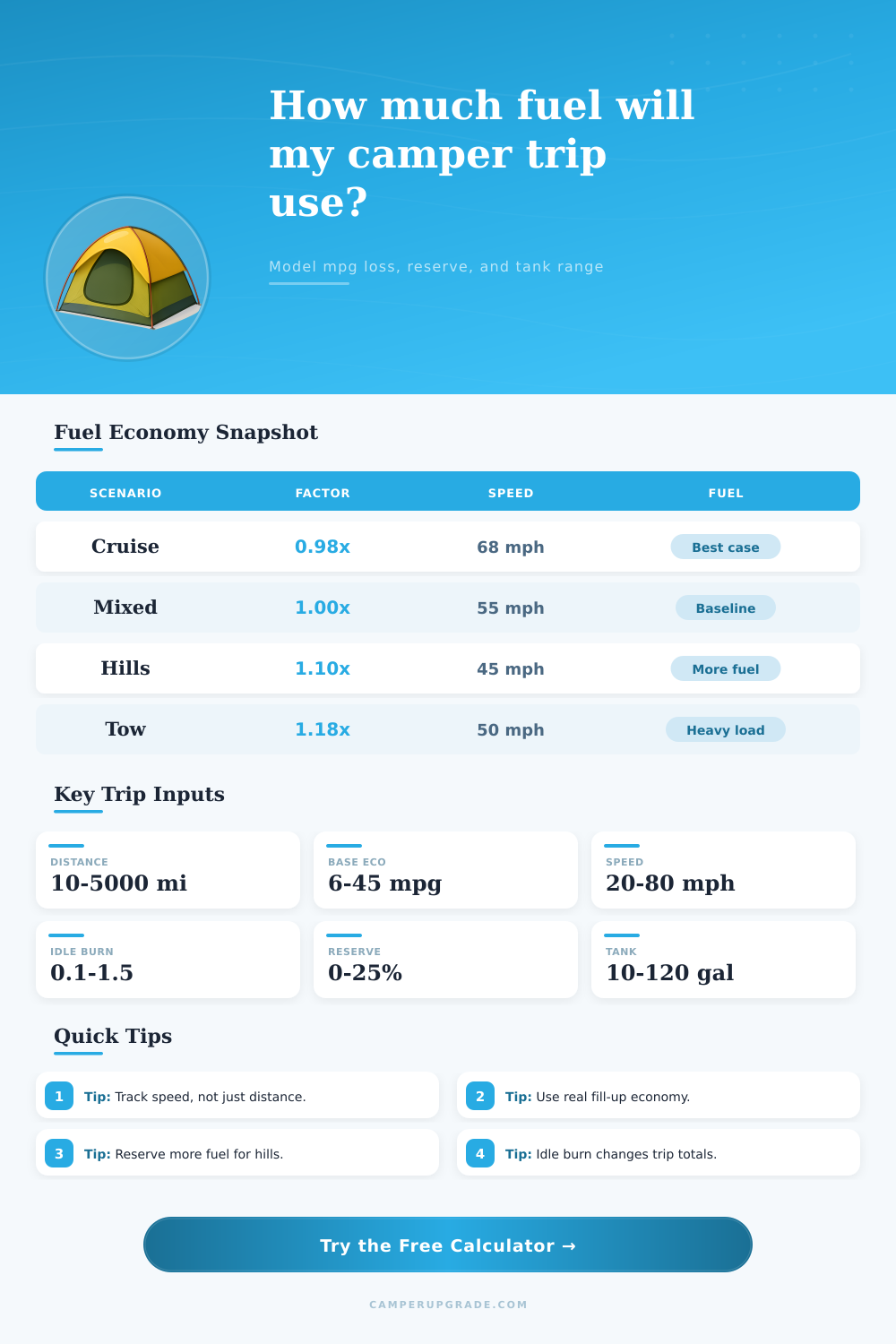
| Highway cruise | Flat | 60-90 | 0.98x |
| Mixed route | Rolling | 45-80 | 1.00x |
| Hill country | Grades | 35-70 | 1.10x |
| Mountain tow | Steep | 30-60 | 1.18x |
| Tank Size | At 12 mpg | At 18 mpg | At 28 mpg |
|---|---|---|---|
| 16 gal | 192 mi | 288 mi | 448 mi |
| 24 gal | 288 mi | 432 mi | 672 mi |
| 30 gal | 360 mi | 540 mi | 840 mi |
| 40 gal | 480 mi | 720 mi | 1120 mi |
| Trip Pattern | Distance | Expected Load | Fuel Signal |
|---|---|---|---|
| Shoreline loop | 220 mi | Light | Near baseline |
| Ferry queue | 90 mi | Idle heavy | Extra burn |
| Mountain pass | 140 mi | Heavy | High draw |
| Cross-country | 600 mi | Steady | Best range |
Fuel economy for a camper are a critical measurement in determining whether or not a camper will reach they destination or if they will run out of fuel prior to arriving at the destination. Many individuals may believe that the fuel economy that is displayed on the vehicle’s dashboard is an accurate indication of the fuel economy of the camper trailer. However, fuel economy displays on the dashboard is often inaccurate measurements of the actual fuel economy of the camper trailer.
Instead, an individual can track the fuel economy by noting the amount of fuel that is pour into the camper trailer’s fuel tank during each fill-up of the tank. From this starting point, an individual can establish a true baseline of the fuel economy of their camper trailer. From this starting point, an individual can apply various factor that may impact the fuel economy of the camper trailer.
How to Measure and Plan Your Camper’s Fuel Use
One of the main factor that will impact fuel economy is the terrain that the camper trailer travels. Terrain will impact the fuel economy of the camper trailer because different types of ground require different amount of power to be delivered to the trailer’s engine. For instance, traveling on hills will require the camper trailer to use more fuel than if the camper trailer was traveling on flat terrain.
Additionally, another factor that will impact the fuel economy of the trailer is the presence of wind. The presence of wind will impact the fuel economy of the camper trailer because the wind will create resistance against the camper trailer. Thus, when the camper trailer is traveling against the wind (headwinds), it will use more fuel to travel at the same rate as if it was traveling in calm air.
Another factor that will impact the fuel economy of a camper trailer is the speed at which it is driven. The speed at which the trailer is driven will impact fuel economy because the faster that the camper trailer moves, the more fuel that will be used to power the trailer. If the camper trailer is driven at high speeds, it will use more fuel than if it was driven at a moderate speed.
In addition to the speed of the camper trailer, another factor that may impact the fuel economy of the trailer is the weight of the camper trailer. The weight of the camper trailer will impact fuel economy because if the camper trailer is loaded with heavy items, it will use more fuel than if the camper trailer was lighter in weight. This additional fuel are required to move the additional weight of the camper trailer.
Another factor that may impact the fuel economy of a camper trailer is the tire pressure of the trailer. The tire pressure of the camper trailer will impact fuel economy because if the camper trailer’s tires are too soft or underinflated, the tires will create more resistance against the ground in which the trailer is moving. This additional resistance will require the camper trailer to use more fuel to move forward.
Furthermore, another factor that may impact fuel economy is the idling of the camper trailer. Idling will impact fuel economy because the idling of the trailer’s engine requires that fuel is continuous burned in the engine to keep the engine running. For instance, idling while waiting in line for a task will consume fuel but not move the camper trailer forward.
Each of these factor has the potential to impact fuel economy, but many individuals dont consider the composite effect of these factors. For instance, each factor considered individually may seem significant to the fuel economy of the camper trailer, but if combined with another factor having the same impact, the impact on fuel economy may have a very significant impact on the range of the camper trailer. For instance, a five percent impact on fuel economy from an additional load on the camper trailer may combine with a ten percent impact on fuel economy from wind to create a total percentage impact on fuel economy that is much greater than ten percent.
Therefore, an individual must plan for a much larger reduction in fuel economy than that created by any single factor. An additional consideration that should of been made in planning the range of the camper trailer is to include a fuel reserve. An individual should include a fuel reserve in the planning of the camper trailer’s range for fuel because there may be unexpected conditions during the range of the camper trailer.
These unexpected conditions may include bad weather, detours, and even traffic patterns in the area that are much heavy than those expected. These conditions may lead to a reduction of the range of the camper trailer, and the fuel that is used by the camper trailer. Therefore, it is a common practice to include a fuel reserve of ten to twenty percent of the total fuel calculations for range.
This ensures that the camper trailer has enough fuel to reach the destination and the nearest gas station, even if fuel economy is reduced due to unexpected conditions. Finally, it is also possible to create mathematical models of the fuel economy of the camper trailer. Many individuals may have a fuel log for their camper trailer that calculates the fuel economy in miles per gallon (mpg).
However, liters per 100 kilometers (L/100 km) is a more precise fuel economy for planning. By calculating the fuel economy of the camper trailer under adjusted conditions, with idle fuel usage, and with total fuel need for the trip with a fuel reserve, an individual can determine the true range of the camper trailer. By calculating the fuel economy of the camper trailer in this way, it is possible to determine if the camper trailer has enough fuel to make the journey.
If the calculations indicate a positive amount of the fuel that remains in the camper trailer, it is safe to state that the camper trailer has enough fuel to make the journey. However, if the calculations reveal a negative amount of fuel for the camper trailer, the camper trailer will need to plan to stop for fuel at an earlier time than it had original plan.