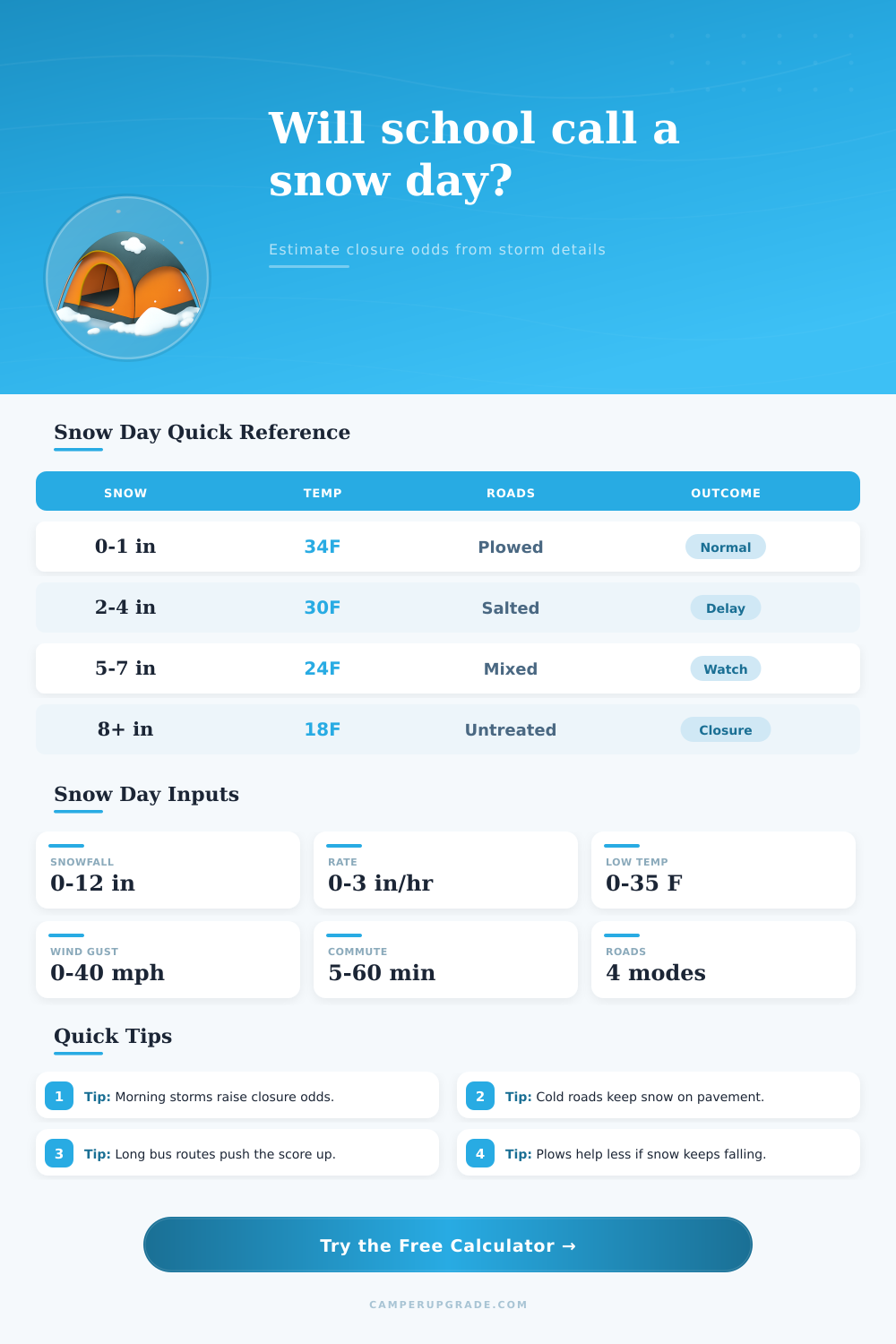
Snow Day Calculator
Estimate school closure odds from snowfall, road treatment, temperature, wind, commute length, and storm timing.
🌨Scenario Presets
⚙Storm Inputs
📊District Comparison Grid
📐Reference Tables
| Snow Band | Road Impact | Likely Call | Score Bias |
|---|---|---|---|
| 0 to 1 in | Light cleanup | Normal start | Low |
| 2 to 4 in | Patchy lanes | Delay watch | Mid |
| 5 to 7 in | Slow routes | Delay or close | High |
| 8+ in | Major drift | Closure likely | Very high |
| Temp Band | Roads | Effect | Notes |
|---|---|---|---|
| Above 32F | Melting | Lower risk | Cleanup improves |
| 25-32F | Slushy | Mixed risk | Refreeze is key |
| 15-24F | Icy | Higher risk | Salt works slowly |
| Below 15F | Frozen | Very high | Black ice hangs on |
| Road Prep | Modifier | Recovery | Best Use |
|---|---|---|---|
| Salted and plowed | 0.78x | Fast | Urban core |
| Plowed only | 0.95x | Moderate | Mixed routes |
| Partial service | 1.08x | Slow | Side roads |
| Untreated roads | 1.22x | Very slow | Rural routes |
| Storm Timing | Modifier | Cleanup Window | Closure Bias |
|---|---|---|---|
| Overnight | 1.10x | Short | Higher |
| Early morning | 1.20x | Very short | Highest |
| Midday | 0.80x | Long | Lower |
| Evening | 0.92x | Medium | Moderate |
💡Key Threshold Guide
💭Practical Tips
School district must make a decision about whether to close school during snowstorm. Many different factor must be considered when making this decision. One of the factor that a school district must consider is the safety of the students versus the loss of instructional time for the school.
One of the factor that a school district considers when deciding whether to close school is the total snowfall. However, total snowfall isnt the only factor that a school district consider when making this decision. Other factor include the rate of snowfall, the temperature, the wind speed, and the length of the bus commutes that the driver will have to travel to transport the student to school.
How to decide if school should close in a snowstorm
A snow day calculator will help a person understand all of the factor that a school district must consider when making the decision about school closing. These calculator take into account the factor described above and give a score that indicate the chance of school closings occurring. A snow day calculator will ask a person to input the total amount of snowfall that has fallen during the storm, the rate at which the snow fell, the temperature outside, and the wind speed during the snowfall.
Based off these variable, the calculator will calculate a score for the school district. A low score indicate that the school district is likely to remain open, while a high score indicate that the school district is likely to close it’s school. Additionally, the calculator will calculate a travel stress score for the area that indicate how difficult it will be for bus driver to navigate the roads in the area.
People often make mistake when trying to determine the number of snow day that will fall in there area. Many people only consider the total amount of snow that fell during the storm. For example, five inch of snow may make people think that the school will be closed, but they may not think about the fact that the temperature during the snowfall may have been warm, or the snow may have been falling slow.
Additionally, individual may not consider that individual who live in areas that have long bus commutes may experience more dangerous driving condition during snowstorm than individual that live in urban area. In order to avoid such error, individual can use a snow day calculator to determine the number of snow day that will fall in their area. The calculator will take into consideration all of the variable mentioned above.
A snow day calculator help individual to systematically consider all of the variable regarding the weather. However, it cannot replace the decision making abilities of the school superintendent. School superintendent often consider the data obtained from the snow day calculator as well as their experience in making school closing and opening decision.
For instance, a superintendent may use the high score from the calculator to indicate that the school should be closed, but may make an exception for certain school that have clear road and snow removal crew. However, a superintendent may also use the calculator and the score that is provide to help them to make their decision. Thus, while the calculator is a helpful tool for school district, it isnt a replacement for the school superintendent.