Perfect Fit Harness Size Calculator
Match chest, neck, and back length to the right harness style for a cleaner, safer fit.
🐕Quick Fit Presets
⚙Measurement Inputs
📊Harness Style Comparison Grid
📘Reference Tables
| Size | Chest Range | Neck Max | Typical Build |
|---|---|---|---|
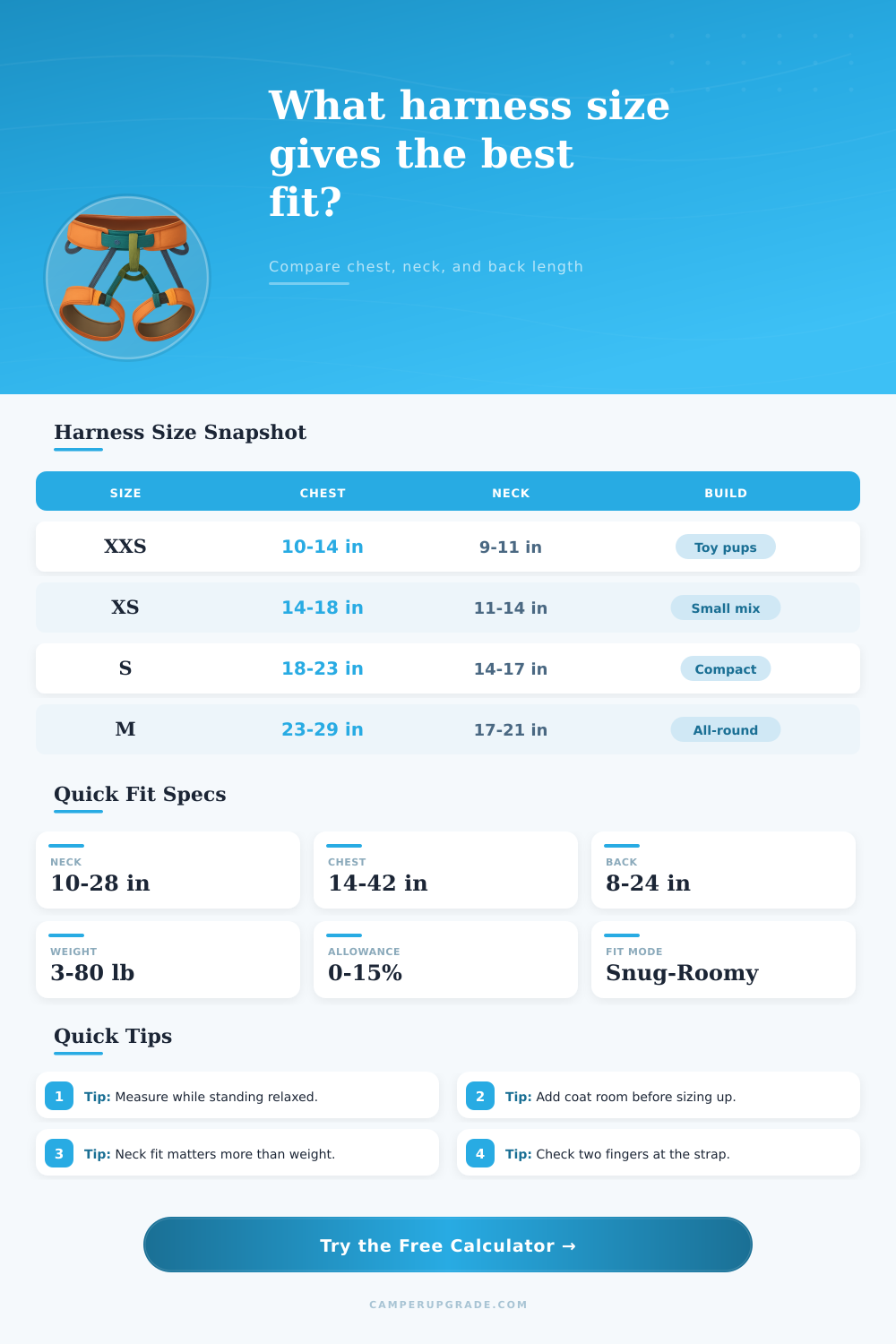
| XXS | 10-14 in | 9-11 in | Toy pups |
| XS | 14-18 in | 11-14 in | Small mix |
| S | 18-23 in | 14-17 in | Compact |
| M | 23-29 in | 17-21 in | All-round |
| L | 29-35 in | 21-26 in | Deep chest |
| XL | 35-42 in | 26-31 in | Large frame |
| XXL | 42-50 in | 31-36 in | Giant build |
| Measure | Tape Path | Posture | Common Miss |
|---|---|---|---|
| Neck | Low collar line | Stand relaxed | Too high |
| Chest | Widest rib point | Weight even | Behind elbows |
| Back | Withers to base | Head neutral | Curved tape |
| Weight | Scale check | Fully standing | Breed guess |
| Fit Mode | Chest Buffer | Neck Room | Best Use |
|---|---|---|---|
| Snug | 3-5% | 1.0 in | Fast runs |
| Balanced | 5-8% | 1.5 in | Daily wear |
| Roomy | 8-12% | 2.0 in | Coats |
| Layered | 10-15% | 2.5 in | Winter gear |
| Build Type | Chest Trait | Size Bias | Notes |
|---|---|---|---|
| Barrel chest | Wide rib | Up one | Watch neck |
| Deep chest | Long front | Style match | Check back |
| Narrow frame | Lean torso | Down fit | Less bulk |
| Growing pup | Rapid change | Roomy | Recheck soon |
A harness must fit a dog correctly for the harness to be comfortable for the dog and for the harness to be safe for the dog. Harnesses is often preferred to collars because a harness provide even pressure on a dogs chest. However, the harness will only provide safety for the dog if the harness is the correct size for the dogs physical build.
If the harness is too small for the dog, the dog will develop friction in there skin. However, if the harness is too large for the dog, the dog will be able to slip out of the harness. In either case, measurements will help to ensure that the harness fits the dog correctly.
Measure Your Dog for a Harness
The most important measurement of a dogs body for determining the size of the harness is there chest girth. To determine the chest girth, you must find the widest part of the dogs ribcage. You will find the widest part of the dogs ribcage behind the dogs front legs.
You must take the chest girth at this part of the dogs body as their harness will buckle at this part of their body. You should also measure the dogs neck. You should measure the neck low around the dogs base of the neck as if you were placing a collar around the dogs neck.
Many people tend to make the mistake of taking the measurement of the dogs neck too high around the dogs jaw. When people take the measurement of the dogs neck too high, they will obtain a measurement that is too small for the dog. Using this too-small measurement will force the buyer to purchase a harness that is too small for the dogs physical build.
Additionally, measuring the back length of the dog can be another measurement that is taken to determine the size of the harness. When measuring a dogs back length, ensure that the dog is standing in a relaxed position with all of its legs on the ground. If the dog is slouching or tilting its head, the measurement will be inaccuratly.
Another factor that will affect how a harness fits a dog is the thickness of there coat. For instance, dogs with thick coats, like huskies, will require more space within their harness for comfort since there thick coat will compress against the harness when wearing it. Puppies and dogs that are still growing require extra space within the harness due to the changes in there body.
The activity level of the dog will also affect the fit of the harness. For example, if a dog is highly active, the harness should be relatively snug so that the harness will not shift while the dog is in motion. There is also different styles of harnesses that will impact the measurements.
For instance, a Y-front harness will allow the dog more freedom in its shoulders while a vest-style harness will allow for even more even distribution of the dogs weight. A vest-style harness will be useful for dogs with barrel-shaped bodies like corgis so that the harness will provide more even coverage over the dogs body. To find the best balance between a harness that is too snug and one that is too roomy, ensure that you can fit two fingers under every strap of the harness.
If you can fit two fingers under each of the harness straps, there is enough room for the dog to breathe and to turn its body. A snug harness is useful for dogs that will be performing high-velocity activities because it will allow the dog to feel your cues without the harness causing chafing on its skin. A roomier harness is useful for dogs with thick fur or who wear clothing because it will prevent the development of pressure points on the dog.
You should not use the weight of the dog to determine the size of the harness for the dog. Dogs of the same weight may have very different body frames. For instance, a dog of the same weight as a greyhound may have the frame of a bulldog.
In these cases, you will need to use chest measurements to determine the size of the harness that will best fit the dog. Common mistakes when fitting a harness to a dog include using a harness that is too small for dogs with barrel chests. These dogs have wide ribs but may have a smaller neck measurement that allows for the harness to be too loose.
Great Danes have deep chests and a smaller chest girth measurement, meaning that the harness should have sufficient length along the back of the dog. Dogs with narrow frames may find that standard harness sizes are too bulky for there bodies. It is recommended to walk the dog in the harness to test how it fits.
It is possible for the owner to miss the proper fitting of the harness when putting it on the dog, but the owner will notice if it is binding the dogs shoulders after walking for a period of time. The accuracy of the harness fitting relies upon the measurements of the dogs body. The most important measurement is the chest girth, which will determine a large portion of the size of the harness.
The second most important measurement is the dogs neck measurement, back length, and its weight. Other measurements can be used to fill in the gaps created by the neck and chest measurements. For instance, if the dogs measurements do not align well with the harness sizes, you may need to choose a larger size for the harness.
It is important to measure your dog each month due to the rapid rate at which puppies grow. Additionally, the harness should remain in place when the dog is engaged in play or on a walk. A correctly fitted harness will prevent the dog from escaping with the harness and will prevent the harness from rubbing against the dogs skin.