Pace Count Calculator
Calibrate your personal pace rate, apply terrain and fatigue factors, and estimate route checkpoints for reliable land navigation planning.
🧭Field Scenario Presets
⚙Pace Calibration And Route Inputs
📊Adjustment Factor Snapshot
📘Pace Count Reference Tables
| Terrain Type | Factor | Typical Effect | When To Use |
|---|---|---|---|
| Open Trail | 1.03 | Small cadence change | Packed paths with clean footing |
| Forest Path | 1.08 | Stride shortens modestly | Roots, turns, and uneven tread |
| Rocky Ground | 1.12 | Frequent foot placement checks | Scree, slab steps, loose stone |
| Dense Brush | 1.22 | Cadence interruption is high | Route finding through thick growth |
| Sand Or Snow | 1.18 | Higher leg sink and slip | Dunes, soft beach, shallow snow |
| Wet Or Swampy | 1.27 | Step security dominates pace | Mud flats, marsh edge, wetland |
| Grade Profile | 0 to 5% | 6 to 12% | 13 to 25% |
|---|---|---|---|
| Mostly Uphill | 1.02x to 1.06x | 1.07x to 1.15x | 1.16x to 1.30x |
| Mixed Rollers | 1.01x to 1.03x | 1.04x to 1.09x | 1.10x to 1.18x |
| Mostly Downhill | 0.99x to 0.96x | 0.95x to 1.00x | 1.01x to 1.16x |
| Planning Note | Low impact | Moderate correction | High correction and caution |
| Checkpoint Interval | At 60/100m | At 75/100m | At 90/100m |
|---|---|---|---|
| 50 m | 30 paces | 38 paces | 45 paces |
| 100 m | 60 paces | 75 paces | 90 paces |
| 200 m | 120 paces | 150 paces | 180 paces |
| 500 m | 300 paces | 375 paces | 450 paces |
| Distance Conversion | Meters | Feet | Practical Cue |
|---|---|---|---|
| 100 m | 100 | 328 | Standard pace block |
| 100 yd | 91 | 300 | Quick imperial check |
| 0.5 mi | 805 | 2640 | Route segment planning |
| 1.0 mi | 1609 | 5280 | Leg-level total estimate |
Pace counting are a method used for land navigation. Pace counting is a method that allow a person to measure the distance that they travel by counting the number of step that the person takes. A person use this method if they dont have access to electronic tools like GPS device.
The movement of the persons body correlate to the measurement of distance, which help the person to remain on the correct path. If a person miss a checkpoint during a land navigation exercise, they may end up walking away from the correct direction, which will require the person to walk many kilometer to correct there path. In order to use pace counting effective, a person must learn how to perform the task correctly.
How to Do Pace Counting
Most people will find that attempting to count every single step that the person takes is both exhausting and difficult to maintain if the person has to travel long distance. When a person performs pace counting, that person will use a method known as double pacing. With this method, the person will count one full stride of the persons body as one single count.
This method is considered to be more efficient than try to count every single step that the person makes. When a person is using double-pacing, they do not have to continually look at the persons foot in order to count their steps. Instead, they can focus on the terrain that the person is traveling over.
To begin pace counting, the person has to perform what is known as a calibration walk. During a calibration walk, the person will walk a known distance on flat terrain and calculate the number of paces that the person take to travel that distance. This number will serve as the persons baseline for their pace count.
Each person will have a different baseline for the number of paces that they take over a set distance. This number will depend on the height of the person, their level of physical fitness, and the way that they grip their shoe. The terrain that a person walks over will impact the number of paces that a person take.
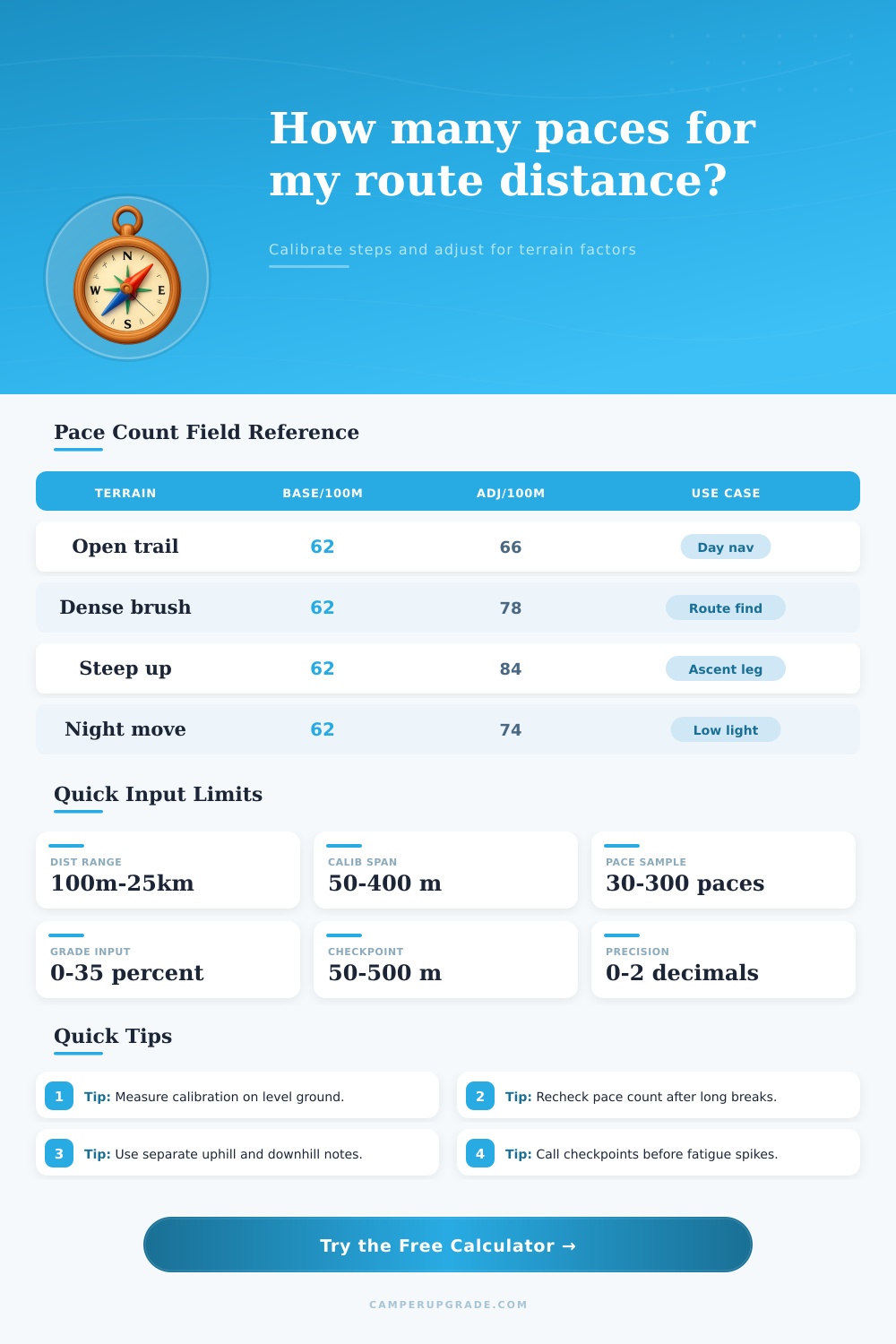
On open trail, a person is able to take longer strides than on other types of terrain. In the opposite situation, where there is dense brush, it will be more difficult for the person to move forward due to the thorns and roots in the ground. Therefore, the person will take more steps to travel over the same distance as when they are on even ground.
On rocky ground, a person may have to place their feet in a different way than on even ground to avoid falling off the terrain. In these situation, a person will have to adjust the way that they pace their steps. In addition, other types of terrain like snow, sand, or swamps will make it more difficult for a person to walk at their typical pace.
A person must account for these variable in order to not get lost during there journey. The slope of the land will also impact a persons pace count. On hill, a person will have to change the way that they use their leg when they walk.
On hills with an uphill slope, a person will take shorter steps so as to conserve there energy. On hills with a downhill slope, a person may have to take more steps in order to avoid falling off the hill. A persons load will also impact their pace count.
If a person is transporting heavy item in a pack, it will impact the way that they take their strides. With a heavy pack, a person will have to shift their body in a different way, which may impact the length of their stride. Therefore, a person may have to take more steps with a heavy load.
Other factor that will impact the pace count of a person include fatigue and visibility. If a person is very tired, their legs may become tired while they are walking, which will impact the length of their stride. Similarly, if a person cannot see the terrain in which they are to walk, they will have to take more tentative step.
A person should use this form of counting to plan the location of the checkpoint that they will use during there journey. A person will be able to break up there journey into section. Using there baseline for pace counting, a person will be able to calculate how many paces will equal a distance in meter.
For instance, if a person calculates that they take sixty paces for every one hundred meters, then they will know that sixty paces will equal fifty meter, and that three hundred paces will equal five hundred meters. Using this information, a person will be able to reach each checkpoint. If a person miss a checkpoint, they may become less confident in the direction that they are traveling.
A person who loses confidence in their direction may lose their azimuth, which is the direction that they aim their compass to point to. A person should never treat there pace count as a fixed number. A person can calibrate there pace count if they are on even ground and without any load.
After taking a break during there journey or when they reach a hill that they climbed, they should also recheck there pace count. After adjusting the load that they are transporting, they should also recheck there pace count. A person should keep separate note of the number of paces that they take on uphill terrain, on downhill terrain, during the daytime, and during the nighttime.
Many people will fail in there attempt to navigate the terrain if they treat there pace count as if it is a constant number. A person who make errors in there pace count will experience incorrect navigation of the terrain. Some of the most common error are pacing too quickly at the start of there journey, ignoring the movement of the persons pack while descending hills, and forgetting the impact of low visibility on the way that a person walks.
Finally, a person should never use the pace count that belongs to another person. A persons stride will never be the same as another persons. A person has to use their own pace count to ensure that they are traveling the correct distance.
When a person is using pace counting, they are connecting the map to the land that they are traveling over. Thus, pace counting allow a person to travel over the terrain in a more accurate manner.