Dutch Oven Coal Calculator
Estimate lid and base briquettes, refill timing, and total fuel load for dutch oven cooks in changing wind, temperature, and altitude.
🏕️Camp Cooking Presets
⚙Coal Planning Inputs
📊Fuel Profile Grid
📘Dutch Oven Coal Reference Tables
| Oven Diameter | 350 F Base Load | Baking Split | Typical Capacity |
|---|---|---|---|
| 8 inch | 16 coals | 10 top / 6 bottom | 2 qt oven |
| 10 inch | 21 coals | 14 top / 7 bottom | 4 qt oven |
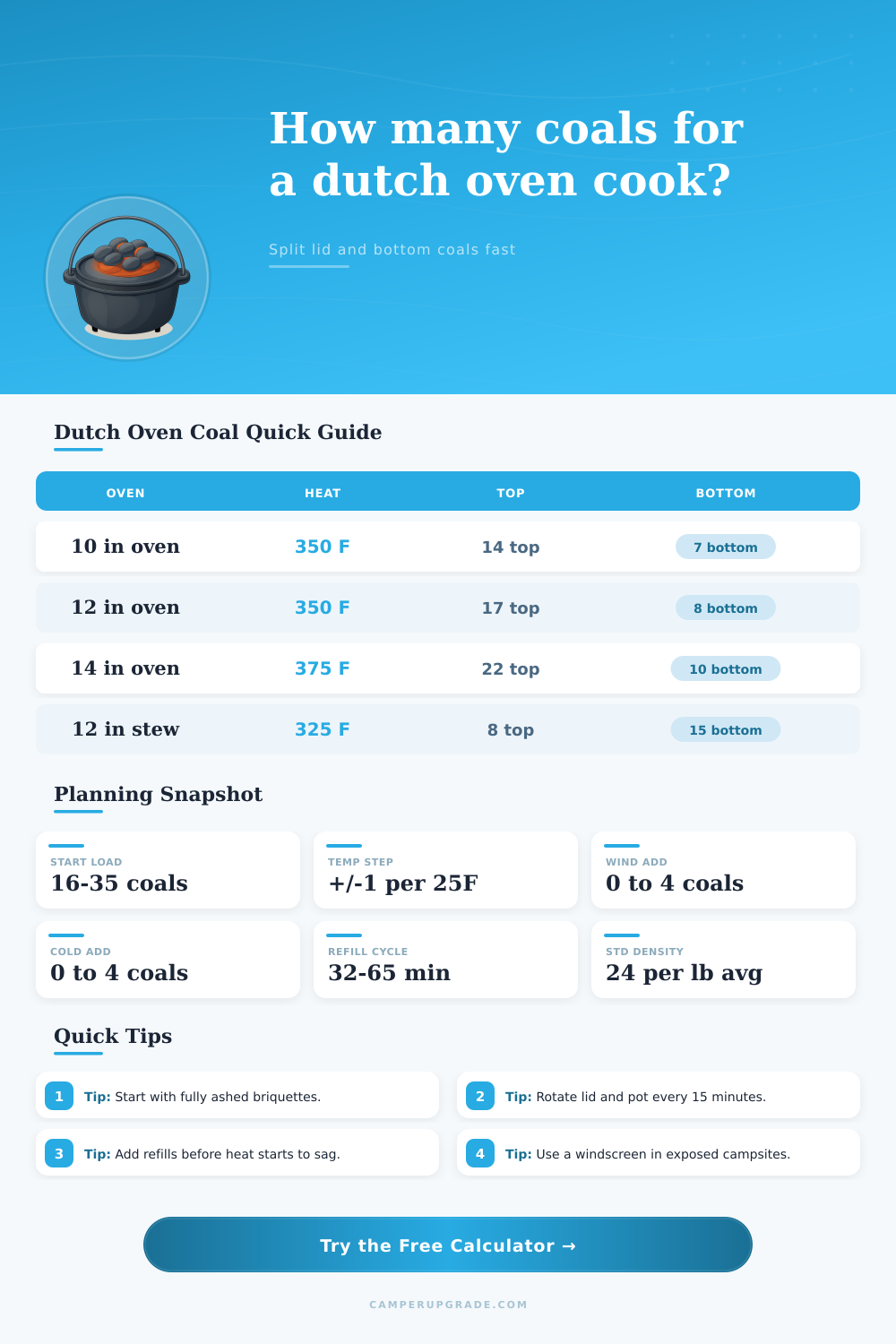
| 12 inch | 25 coals | 17 top / 8 bottom | 6 qt oven |
| 14 inch | 30 coals | 20 top / 10 bottom | 8 qt oven |
| 16 inch | 35 coals | 23 top / 12 bottom | 12 qt oven |
| Target Heat | Delta Vs 350 F | Coal Adjustment | Planning Note |
|---|---|---|---|
| 250 F | -100 F | -4 coals | Low braise or gentle simmer |
| 300 F | -50 F | -2 coals | Slow stew or beans |
| 325 F | -25 F | -1 coal | Soft bake zone |
| 350 F | Baseline | 0 | General baking target |
| 375 F | +25 F | +1 coal | Browning and crust |
| 400 F | +50 F | +2 coals | Roast and crisp |
| 425 F | +75 F | +3 coals | High heat finish |
| Method | Top Share | Bottom Share | Best Use |
|---|---|---|---|
| Baking | 67% | 33% | Bread, biscuits, cobbler |
| Roasting | 55% | 45% | Chicken, mixed vegetables |
| Stew or Braise | 35% | 65% | Stews and braises |
| Long Simmer | 20% | 80% | Chili, beans, sauces |
| Fry or Boil | 0% | 100% | Frying and high-bottom heat |
| Fuel Type | Sheltered | Moderate Wind | Strong Wind |
|---|---|---|---|
| Standard briquette | 50 min | 44 min | 38 min |
| Hardwood briquette | 55 min | 49 min | 43 min |
| Coconut briquette | 65 min | 59 min | 53 min |
| Mini briquette | 38 min | 32 min | 26 min |
| Quick light | 32 min | 26 min | 25 min |
Dutch oven cooking require the management of heat within the Dutch oven; controlling the number of coal that are used within the cooking process achieves the management of heat within the Dutch oven. Each of the coals will act as a thermostat for the Dutch oven; the more coals that is added to the Dutch oven, the hotter the Dutch oven will become. Each charcoal briquette will burn at a steady rate; however, the burn rate of the briquette can change if the weather is windy or if the air is coldy.
Additionally, the size of the Dutch oven will impact the number of coals that are required to heat the Dutch oven to the desired temperature; the larger the Dutch oven lid, the more coals that are required to even heat the Dutch oven. The number of coals that are used within the Dutch oven should be planned according to both the diameter of the Dutch oven and the cooking style that is to be used within the Dutch oven. For baking recipes, for instance, the amount of heat that is required to be provide to the top of the Dutch oven determines that two-third of the coals should be placed on the lid of the Dutch oven.
How Many Coals to Use and Where to Put Them in a Dutch Oven
In recipes that require more heat to be provided to the bottom of the Dutch oven, such as stews, the cook should place more coals underneath the Dutch oven to allow for the food to simmer within the Dutch oven. Additionally, the wind can remove heat from the coals that are within the Dutch oven; thus, additional coals will be required for cooking in a windy area. A twelve-inch Dutch oven will reach a temperature of 350 degrees if seventeen coals are used on the lid of the Dutch oven and eight coals are placed underneath the Dutch oven.
If the recipe that is to be prepared requires the Dutch oven to reach a temperature of 400 degrees, however, more coals will be required. If the recipe that is to be prepared requires the Dutch oven to reach a temperature of 300 degrees, on the other hand, the cook should decrease the number of coals that are within the Dutch oven. Each twenty-five degree change in the temperature within the Dutch oven will require the addition or removal of one coal from the total number of coals that are within the Dutch oven when the cooking process begins.
Many cooks may guess the number of coals that are required for a recipe; however, the guess work may lead to some food within the Dutch oven experiencing hot spots while other spots of the food experience cold temperatures within the Dutch oven. The number of coals that are within the Dutch oven should also be adjusted for cold temperatures and high altitude; cold temperatures and high altitudes will require the addition of more coals to the Dutch oven in order to reach the target temperature for the food that is to be cooked within the Dutch oven. The type of fuel that is used within the Dutch oven will change the way in which the coals within the Dutch oven burn.
For instance, standard charcoal briquettes contain twenty-four briquettes per pound of charcoal, and the standard briquettes will burn at a steady rate. Coconut shell coals will burn for longer periods of time and reach higher temperatures then standard briquettes; thus, coconut shell briquettes are often used for slow cooking recipes. Small charcoal briquettes will burn out faster than large briquettes; however, small briquettes will allow for more precise control of the temperature within the Dutch oven.
Quick-light briquettes will start the fire within the Dutch oven more quick; however, quick-light briquettes will fade more quickly if there is wind within the cooking area. Additionally, the number of times that the lid of the Dutch oven can be lifted will impact the number of coals that are required within the Dutch oven; lifting the lid of the Dutch oven will allow for some of the heat that is created by the burning coals to escape from the Dutch oven. Coals will need to be added to the Dutch oven every thirty to sixty-five minutes; the replacement coals for the burned coals should be prep in advance so that the replacement coals are fully ashed prior to adding them to the Dutch oven.
The environmental conditions within which the Dutch oven is cooked will impact the number of coals that are required within the Dutch oven. For instance, cooking within a ridge where there are strong gusts of wind will shorten the burn time of the coals that are within the Dutch oven; thus, more coals will be required in such an environment. If cooking is to occur during the winter months, or if the Dutch oven is removed from the kitchen and cooked in an area of high altitude, the metal of the Dutch oven will become cold and draw heat away from the food that is cooking within the Dutch oven; thus, more coals will be required within the Dutch oven in these scenarios.
If the ambient temperature is below freezing, for instance, three extra coals will need to be added to the Dutch oven to ensure that the food reaches the baseline temperature that is required for the recipe. Additionally, the Dutch ovens lid can be rotated ninety degrees from its initial position and the Dutch oven’s contents can be rotated forty-five degrees every fifteen minutes to maintain the temperature of the contents of the Dutch oven. Using a windscreen will help to prevent the Dutch oven from losing heat to the surrounding environment and will allow the Dutch oven to maintain its temperature without the need to use extra coal within the cooking process.
Many cooks, however, may make mistake within the Dutch oven that lead to the ruin of the food that is cooking within the Dutch oven. For instance, if the coals that are used within the Dutch oven are not fully ashed prior to the start of the cooking process, the Dutch oven will become too hot too quickly for the food to cook properly. If too many coals are placed on the bottom of the Dutch oven, the food will steam within the Dutch oven instead of properly baking.
If the cook within the Dutch oven does not remember to add more coals during a cooking process that lasts for more than thirty minutes, the Dutch oven may drop to a temperature that is too low for the food to cook properly. A two-hour baking process for food may require thirty coals to start the process and two additional refill of coals to ensure that the Dutch oven maintains its temperature; however, the same cooking process in a windy area may require double the amount of coals to be added. The cooking method that is used within the Dutch oven will impact the method in which the coals are distributed within the Dutch oven.
For cooking methods like baking bread or cobbler, for instance, more coals should be placed on the top of the Dutch oven in order to allow for the food to rise and brown. For cooking methods like pot roasts, the food should be cooked with an even distribution of coals within the Dutch oven; coals will be placed on both the top and bottom of the Dutch oven. For braising recipes, the coals should be distributed to ensure that the food is cooked more even on the bottom of the Dutch oven; thus, more coals will be placed on the bottom of the Dutch oven.
For frying recipes, no coals will be placed on the lid of the Dutch oven. Heat within the Dutch oven will rise; thus, coals will be placed on the lid of the Dutch oven to control the temperature within the Dutch oven, while the coals that are placed on the bottom of the Dutch oven will prevent the food from burning. Longer cooking times will require the Dutch oven to be refilled with coals more frequently.
For instance, a ninety-minute cooking process may require only one refill of coals within the Dutch oven; however, a four-hour cooking process for food like chili may require three or four refills of coals within the Dutch oven. The chimney starter should be started in advance of the start of the cooking process so that the coals will be glowing when the coals that are currently within the Dutch oven begin to fade in brightness and burn out. The lid of the Dutch oven should be avoided from being opened too often during the cooking process; opening the lid of the Dutch oven will allow for heat to escape from the Dutch oven, and will cost the cook time and effort to re-heat the Dutch oven to the temperature that are required for the food that is cooking within the Dutch oven.
Finally, one or two extra coals should be included within the Dutch oven to provide for instances where the temperature within the Dutch oven may change unexpectedly; thus, including a safety buffer of extra coals will ensure that the food will not cook in a Dutch oven that drops in temperature.