Portable Power Station Calculator
Estimate usable energy, runtime, recharge speed, and safe headroom for real camper and backup loads.
🚙Scenario Presets
⚙Load and Capacity Inputs
🔋Recharge Inputs
Model uses usable battery window, health, temperature derating, reserve holdback, inverter losses, and recharge taper near high SOC for a practical field estimate.
| Typical Camper Load | Running Watts | Duty / Usage | Daily Wh |
|---|---|---|---|
| 12V Compressor Fridge | 45 W | 40% | 432 Wh |
| CPAP (No Humidifier) | 35 W | 8 h | 280 Wh |
| Laptop + Router | 90 W | 5 h | 450 Wh |
| LED Camp Lighting | 18 W | 6 h | 108 Wh |
| Portable Fan | 32 W | 8 h | 256 Wh |
| Induction Burner | 1200 W | 0.3 h | 360 Wh |
| Recharge Method | Input Power | Best For | Notes |
|---|---|---|---|
| Wall AC Fast Charge | 700-1800 W | Quick turnaround | Watch circuit limits |
| Vehicle DC Charge | 100-400 W | Drive days | Output varies by alternator |
| Portable Solar Array | 120-800 W | Camp recharge | Depends on season and shade |
| Generator + AC | 600-1500 W | Cloudy backup | Fuel and noise trade-off |
| Nightly Energy Need | Suggested Station | Runtime Range | Common Setup |
|---|---|---|---|
| 250-450 Wh | 500-700 Wh | 1-2 nights | Lights + fan + phones |
| 450-800 Wh | 900-1200 Wh | 1 night reserve | CPAP + fridge support |
| 800-1400 Wh | 1500-2200 Wh | Heavy overnight | Laptop work + cooling |
| 1400-2200 Wh | 2500-3600 Wh | High demand | Cooking + tools + backup |
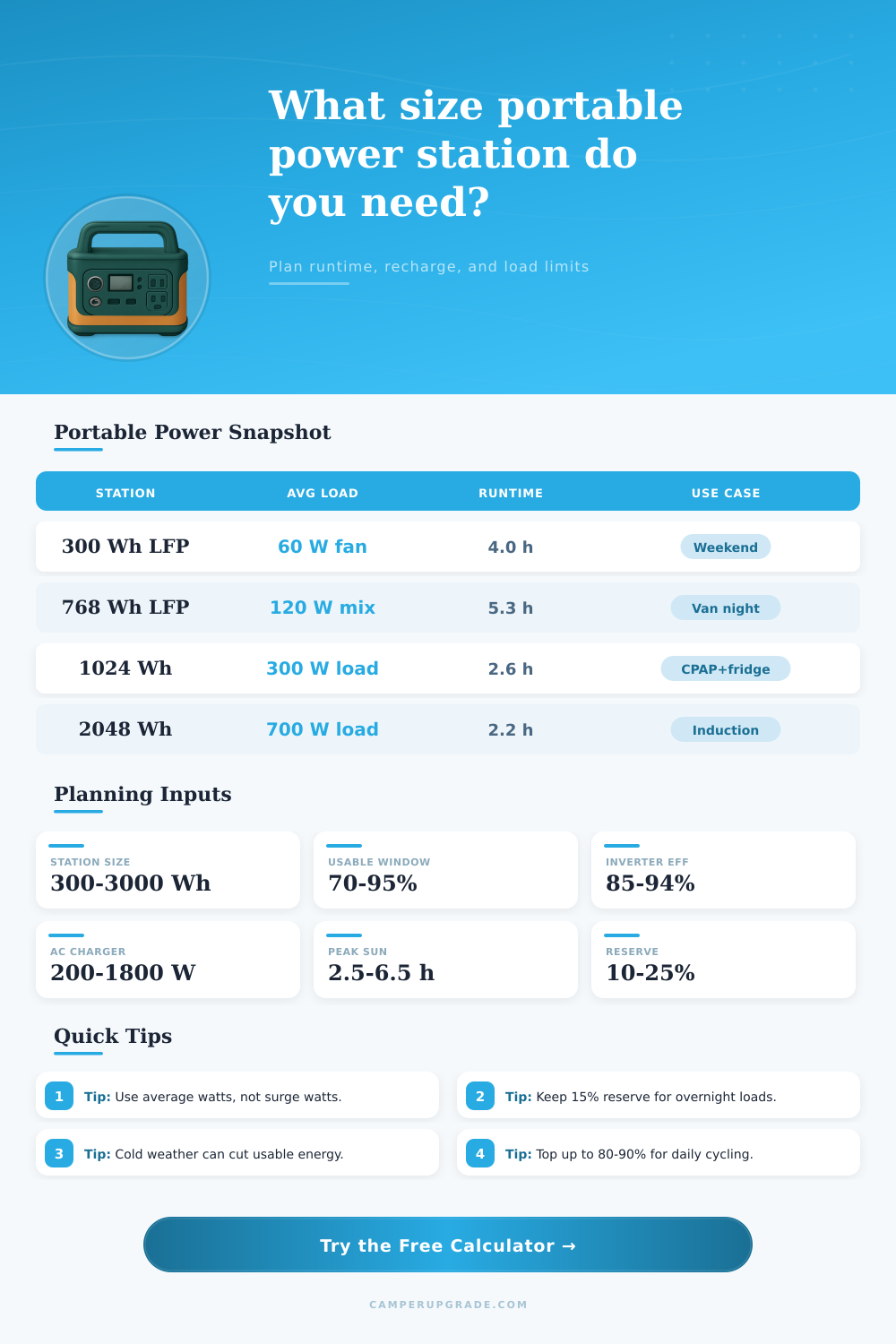
When selecting an portable power station, it is important to understand the difference between peak power and average power draw. Many individuals looks at the maximum wattage that an appliance can produce, but the maximum wattage isnt the same as the average or continuous energy consumption rate of that appliances. In order to determine the energy needs of the appliances that you wish to power with your portable power station, you must calculate the average power draw of those appliances.
Portable power stations draw there energy from a battery. The battery has a capacity in watt-hours. In order to ensure that the power station can supply the energy for your appliances, you must calculate the average wattage that they use; otherwise, you may end up with a power station that is either too small or too large for your needs.
How to Choose a Portable Power Station
You must also consider the duty cycle of each appliance that you will use. The duty cycle is a measurement of the amount of time that an appliance actualy runs compared to the total amount of time that pass. For instance, a compressor fridge will not run constantly; it will cycle on and off in relation to the temperature within the fridge.
Thus, a compressor fridge will have a lower average wattage than a fridge with no compressor. Appliances that requires you to calculate the average wattage may have an energy draw of, for instance, 45 watt. Other appliances may run at a wattage of 35 watts for tasks that take eight hours, or a laptop may require 90 watts for specific tasks.
By calculating the average wattage of each appliance, you can understand the total watt-hours that the power station will draw each hour. In addition to the power draw from the appliances, you must also factor in the energy loss from the power station from both temperature and inverter losses. Portable power stations tend to use lithium iron phosphate batteries.
However, these batteries dont provide the same amount of energy when compared to the rated watt-hours of the battery when exposed to different temperatures. At temperatures of 100 degrees F., the batteries may only provide 10% of the energy compared to when the batteries are at room temperature. At temperatures of 0 degrees F., the batteries may lose 20% of their efficiency.
Additionally, the power station also loses energy due to the inverter. Energy is lost when the inverter within the power station converts the direct current (DC) power from the batteries to the alternating current (AC) power that the appliances require. The inverter will lose approximately 10% of the energy that it converts.
Thus, a power station with 1000 watt-hours of energy may only provide 600-700 usable watt-hours to the appliances. The next factor to consider is how you will recharge the power station. You can recharge portable power stations with electricity from a wall outlet, a solar panel, or a vehicle alternator.
Electric companies provides fast recharging of the power station through outlets that provide high wattage. Solar panels are slow in comparison because the wattage that they provide is variable; it depends upon the available sunlight. Clouds, the positioning of the solar panel, and the fact that the power station will require more time to recharge as the battery nears a full charge may limit the available sunlight.
It is also a good idea to maintain a reserve of energy within the power station. By leaving the battery at a consistant 15% charge, you will have extra power to accommodate appliances that may require longer periods of operation than you have accounted for. By following a few simple steps, you can avoid the mistakes and ensure that the power station you purchase can provide the power requirements for the appliances that you would like to use.
First, determine the appliances that you plan to use. Second, calculate the average wattage of each appliance by considering its duty cycle. Third, calculate the total wattage that the appliances require each hour.
Fourth, calculate how many watt-hours is required for the number of hours that you require the power station to provide power. Finally, increase that number to account for the power losses due to temperature and the inverter, as well as to account for the 15% energy reserve. By following these steps, you will ensure that you will purchase a power station with the apropiate amount of capacity to supply your energy needs.
You should of checked the weight too.