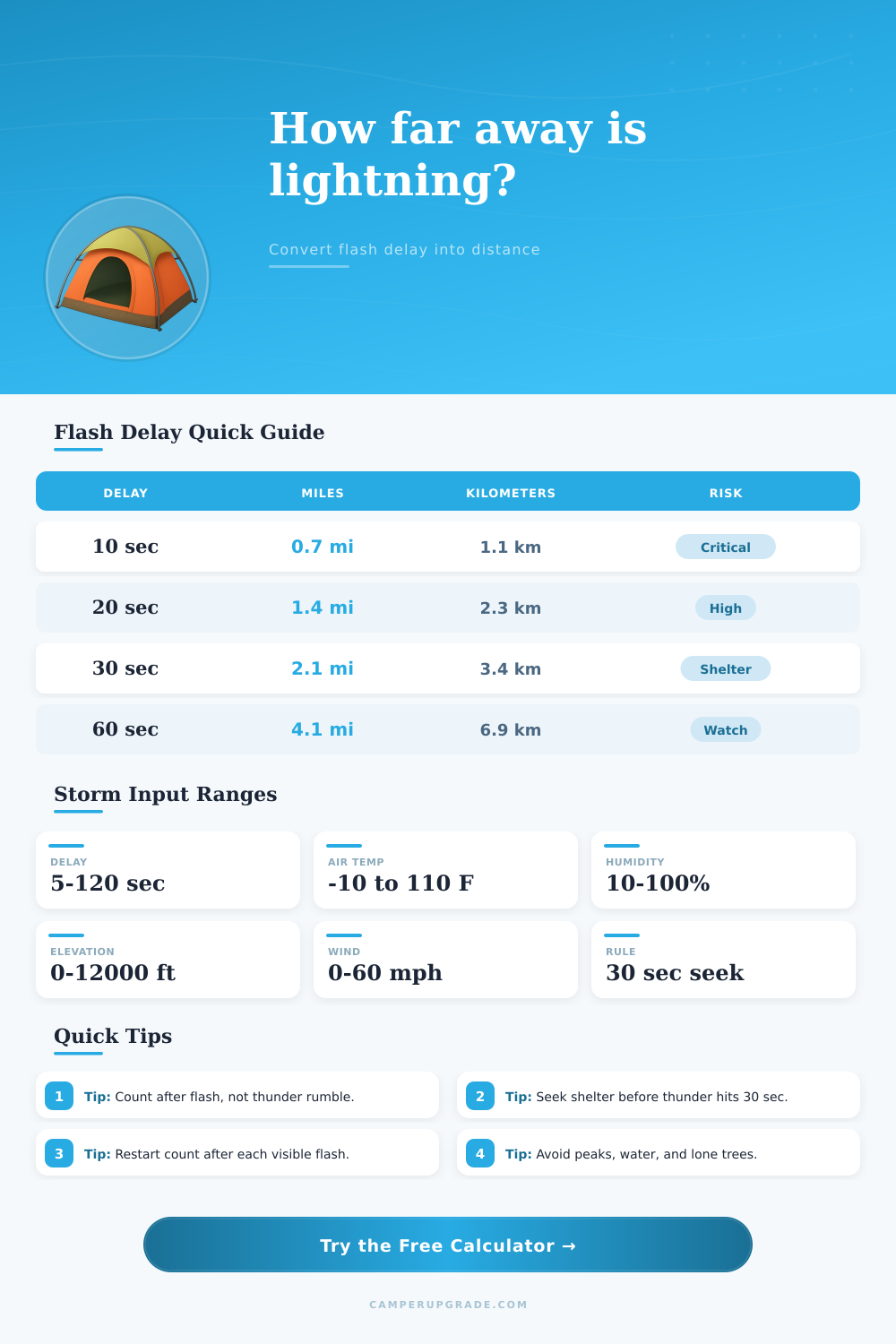
Lightning Distance Calculator
Estimate strike distance, closure time, and safety risk using flash delay plus weather conditions.
⛈Storm Presets
⚙Lightning Inputs
📊Safety Benchmarks
📘Reference Tables
| Flash Delay (s) | Distance (mi) | Distance (km) | Decision |
|---|---|---|---|
| 10 | 0.7 | 1.1 | Immediate hard shelter |
| 20 | 1.4 | 2.3 | Stop activity now |
| 30 | 2.1 | 3.4 | 30 second trigger reached |
| 45 | 3.1 | 5.1 | Monitor and move indoors |
| 60 | 4.1 | 6.9 | Watch for closure trend |
| 90 | 6.2 | 10.3 | Lower but active risk |
| Risk Index | Band | Typical Distance | Recommended Action |
|---|---|---|---|
| 0-24 | Low | 10+ mi | Track radar and sky only |
| 25-49 | Guarded | 6-10 mi | Prepare shelter route |
| 50-74 | High | 3-6 mi | Suspend exposed activity |
| 75-100 | Severe | 0-3 mi | Shelter immediately |
| Air Temp (F) | Humidity (%) | Sound Speed (m/s) | Sec Per Mile |
|---|---|---|---|
| 32 | 30 | 332 | 4.85 |
| 50 | 40 | 338 | 4.76 |
| 68 | 60 | 344 | 4.67 |
| 86 | 70 | 350 | 4.59 |
| 100 | 80 | 355 | 4.52 |
| Scenario | Delay Trend | Storm Track | Interpretation |
|---|---|---|---|
| 35s to 28s in 2 min | Faster | Toward | Rapid closure, evacuate now |
| 30s to 30s stable | Flat | Parallel | Maintain shelter standby |
| 26s to 34s in 4 min | Slower | Away | Risk easing but monitor |
| Any delay under 15s | Very fast | Any | Extreme local strike threat |
Lightning strikes can be dangerous for people, and lightning strikes have a potential to cause death. One way to estimate a distance of a lightning strike is to calculate the number of seconds between the flash of lightning and the sound of thunder. Sound travel at a certain rate through the atmosphere, and sound travels at a slower rate then light.
Under standard condition, sound travels at a rate of five second per mile. Thus, dividing the number of seconds between the lightning strike and thunder by five will provide an estimate of the distance between the lightning strike and the observer. Several environmental factor have the potential to alter the rate at which sound travels through the atmosphere.
How to Tell How Far Away Lightning Is
Warm air allows sound to travel at a faster rate than cooler air, meaning that if the air around the lightning strike is warm, an observer will calculate that the distance between the lightning strike and themselves is shorter than the actual distance. High levels of humidity allow sound to travel at a faster rate than dry air, meaning that high humidity will cause the sound of the thunder to reach the observer more quick. Air at high elevations tends to contain thin amounts of air, which slows the movement of sound.
Thus, an observer must account for these environmental factors to ensure the accuracy of the distance calculation. The movement of the wind can also affect the calculation of the distance between the lightning strike and the observer. If the wind is moving towards the observer, sound will travel towards the observer at a faster rate, which will create the illusion that the lightning strike is closer than it is.
If the wind is moving away from the observer, sound will travel towards the observer at a slower rate, which will create the illusion that the lightning strike is farther from the observer than it is. Finally, the movement of the storm also alters the distance between lightning and the observer. If lightning is occurring within a storm that is moving towards the observer, the distance between lightning and the observer will rapidly decrease.
Therefore, by calculating the time between lightning and thunder strikes over time, an observer can determine whether the lightning strike is moving towards themselves or moving away from themselves. Rather than relying upon a single calculation of the distance between lightning and themselves, an individual should calculate the distance several time over time. If the number of seconds between lightning and thunder decreases, the lightning strike is moving towards the observer.
If the number of seconds between lightning and thunder increases, the lightning strike is moving away from the observer. However, many individuals may make mistake when calculating the number of seconds between lightning and thunder if they are merely counting the echoes of thunder instead of the initial sound of thunder. To accurately calculate distance between lightning strikes and themselves, individuals should count the number of seconds between the initial sound of thunder and the lightning strike.
Lightning safety is often managed through the use of a 30-30 rule. According to the 30-30 rule, if an individual hears thunder less than thirty second after seeing a flash of lightning, they should seek shelter immediately. Additionally, the rule also states that an individual should wait at least thirty minutes after the last thunderclap before leaving shelter.
Open areas in the landscape, such as field or the high points in the area, pose a risk of lightning strikes. Thus, individuals should seek shelter in a sturdy building or a hard topped vehicle if they are in an open area. These factors, along with distance, wind, and weather conditions, create a level of risk for lightning strikes.
By calculating the time between lightning strikes and thunderclaps, individuals can determine whether that risk is increasing or decreasing. If the time between lightning strikes and thunderclaps decreases, the risk of lightning strikes are increasing. If the time between lightning strikes and thunderclaps increases, the risk of lightning strikes is decreasing.
Additionally, individuals should always remain vigilant for lightning strikes, even if those strikes may occur distant from the center of the storm. Finally, lightning strikes can occur even if it is not raining at the area of the individual.