
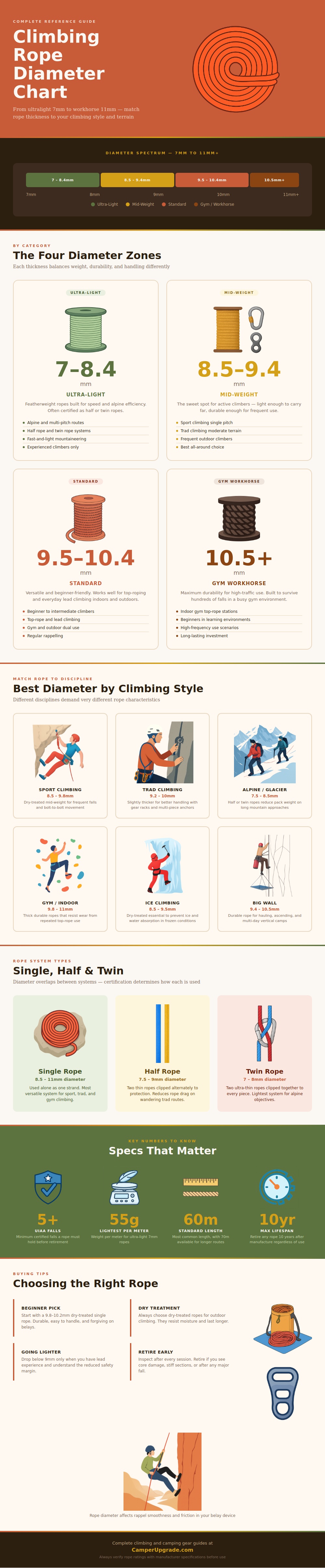
The right diameter of climbing rope depend on its use. Big thickness gives more durability and last stronger tension, for instance during falls, froto in rokrandoj, ŝtonŝutejoj or dirt. Even so thick strings weigh more and involves more space in the bag.
They operate well in belay devices.
Choose the Right Rope Thickness for Climbing
For gym climbing and top-roping, choose a single string with diameter between 9.6 mm and 9.8 mm. Those that does top-roping or sport climbing, profitiĝas of 9.8 mm until 10.2 mm for longer duration. Single strings usually have 8.7 mm until 9.9 mm, but many recline in 9.5 mm until 10.5 mm.
Newcomers or belayers find 9.9 mm until 10.2 mm ideal.
Strings of 9.4 mm until 9.8 mm are good centre: rugged, not too heavy and answer for all use, included of montaroĉa climbing. They quite a lot shine for local rocky walls. When wear reaches the nucleus during lead falls on heavy territories, descend to 9.4 mm until 9.6 mm for reliable strings.
For trad climbing or long multipitch, 9.1 mm until 9.5 mm helps. At multipitch climbing with long steps, returns and many rests, less thick diameter unloads weight and spare time. Here where protectors are used, climbers can go until 8 mm.
Lightweight slim strings lack durability, but they answer for alpine or multipitch climbing with few falls. Half ropes reclines in 7 mm until 9 mm, twin ropes in 7 mm until 8 mm. Half ropes are slim than single, but strong for catch fall in two-rope system.
Strings under 9.8 mm become more komunaĵo. Little diameters climb hardly because of little contact, during thick strings ease to keep.