Arrow Momentum Calculator
Model launch and downrange momentum using real grain weight, speed, broadhead style, and tune quality data.
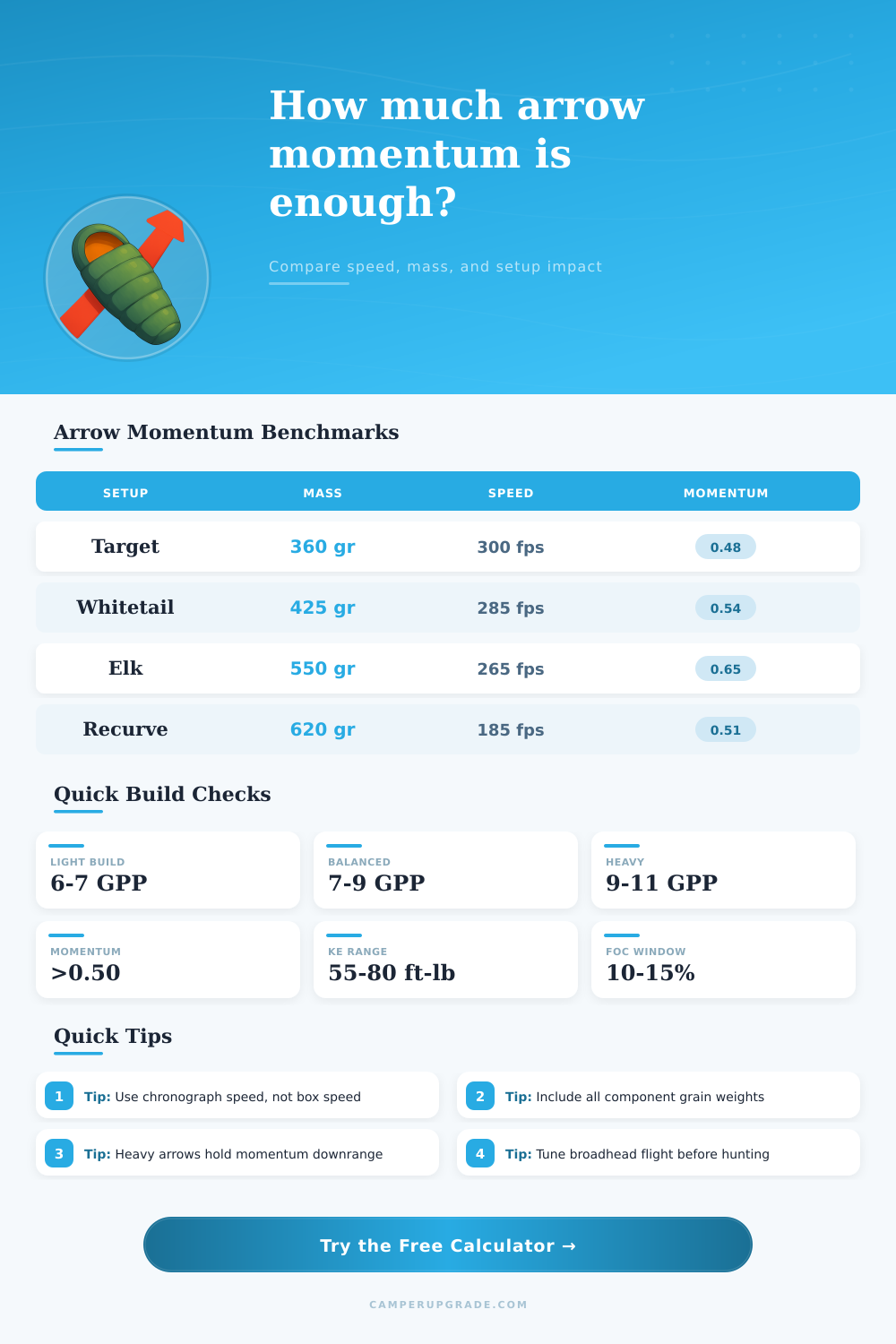
| Momentum (slug-ft/s) | Typical Use | Common Mass Window | Notes |
|---|---|---|---|
| 0.35-0.45 | Target / small game | 300-380 gr | Fast arrows, lower resistance margin |
| 0.46-0.54 | Whitetail general | 380-470 gr | Balanced speed and carry |
| 0.55-0.64 | Large game | 470-580 gr | Higher pass-through potential |
| 0.65+ | Heavy setup focus | 580+ gr | Best with strong tune and sharp heads |
| Total Mass | Speed | Kinetic Energy | Momentum |
|---|---|---|---|
| 350 gr | 300 fps | 69.9 ft-lb | 0.47 |
| 425 gr | 285 fps | 76.7 ft-lb | 0.54 |
| 500 gr | 270 fps | 80.9 ft-lb | 0.60 |
| 600 gr | 245 fps | 80.0 ft-lb | 0.65 |
| Item | Typical Range | Metric Equivalent | Calculator Impact |
|---|---|---|---|
| Broadhead | 85-150 gr | 5.5-9.7 g | Direct momentum and FOC gain |
| Insert/Outsert | 15-100 gr | 1.0-6.5 g | Raises front mass and stability |
| Nock + Vanes | 20-45 gr | 1.3-2.9 g | Rear mass affects FOC balance |
| Shaft Cut Length | 26-31 in | 66-79 cm | Changes total grains significantly |
| Distance | Typical Speed Loss | Momentum Retention | When Useful |
|---|---|---|---|
| 20 yd | 4-7% | 93-96% | Most treestand shots |
| 30 yd | 7-11% | 89-93% | Common western shots |
| 40 yd | 10-15% | 85-90% | Requires excellent tune |
| 50 yd | 14-20% | 80-86% | Wind and drag matter most |
Momentum shows as a good way to measure how much an arrow can keep its direction and force after it gets some resistence. Hunters, that like bows, want it most. It helps to figure out how much force it takes to stop the arrow, when it gets to the target.
That is different than kinetic energy, that figures the energy of arrow when it leaves. Although kinetic energy matters, it does not well show how much a bow, arrow, and head mix will go in. In physics you use momentum to figure the push, so the force used over time in one way.
How Arrow Weight and Speed Change How Deep It Goes
When you look at how an arrow moves, size and speed both play part. You get momentum by putting size times speed. Kinetic energy comes from a different count.
The main way to get kinetic energy is half of the size of the thing, put times the square of its speed. Because of squaring of speed, kinetic energy likes fast arrow. Momentum treats size and speed the same, so it stresses weight.
If all else matches, heavy arrow goes in more than light one. Arrow gets only part of the energy from pulling the bow. Thing without size does not move so does not have momentum.
Heavy arrow has some bad sides. It hits with more momentum, but flies slower and falls sooner. The heavier the arrow, the thicker the curve because of weight.
Arrow of 500 grains has 21 % more momentum than one of 350 grains when it leaves. In 50 yards the 500-grain arrow beats the 350-grain by 24,5 % of momentum. If you figure penetration by momentum, arrow of 510 grains gives 0,57, while 365-grain only 0,47.
Using light arrow means to lose 18 % of going-in skill. A lot of momentum from arrow frees in the target. When arrow hits, the tip pushes in the target and widen the enter hole, from sharp peak until biggest width.