Anchor Chain Catenary Calculator
Estimate chain sag, horizontal holding force, and rode tension for safer overnight anchoring setups.
⚓Anchoring Presets
⚙Catenary Input Setup
📊Rode Comparison Spec Grid
🔧Chain Weight Grid (lb per 100 ft)
📘Reference Tables
| Depth Setting | Depth (in) | Sq ft per cu yd | m² per m³ |
|---|---|---|---|
| Very light | 1 | 324 | 3.28 |
| Light | 2 | 162 | 1.64 |
| Standard | 3 | 108 | 1.09 |
| Heavy | 4 | 81 | 0.82 |
| Bulk vs Bags | Volume per Bag | Bags per cu yd | Coverage @ 3 in |
|---|---|---|---|
| 2 cu ft bag | 0.074 cu yd | 13.5 | 8 sq ft |
| 3 cu ft bag | 0.111 cu yd | 9.0 | 12 sq ft |
| 0.5 cu yd tote | 0.50 cu yd | 2.0 | 54 sq ft |
| 1.0 cu yd bulk | 1.00 cu yd | 1.0 | 108 sq ft |
| Common Project | Area (sq ft) | Volume @ 3 in | 2 cu ft Bags |
|---|---|---|---|
| Compact bow zone | 220 | 0.68 cu yd | 9 |
| Mid berth zone | 420 | 1.30 cu yd | 18 |
| Large bay swing | 900 | 2.78 cu yd | 38 |
| Deep cove swing | 1400 | 4.32 cu yd | 59 |
| Wind (kt) | Drag Factor | Load Multiplier | Use Suggestion |
|---|---|---|---|
| 10 | Low | 1.0× | Normal lunch stop |
| 20 | Moderate | 2.2× | Monitor swing room |
| 30 | High | 4.0× | Add scope and snubber |
| 40 | Very high | 7.1× | Prepare storm plan |
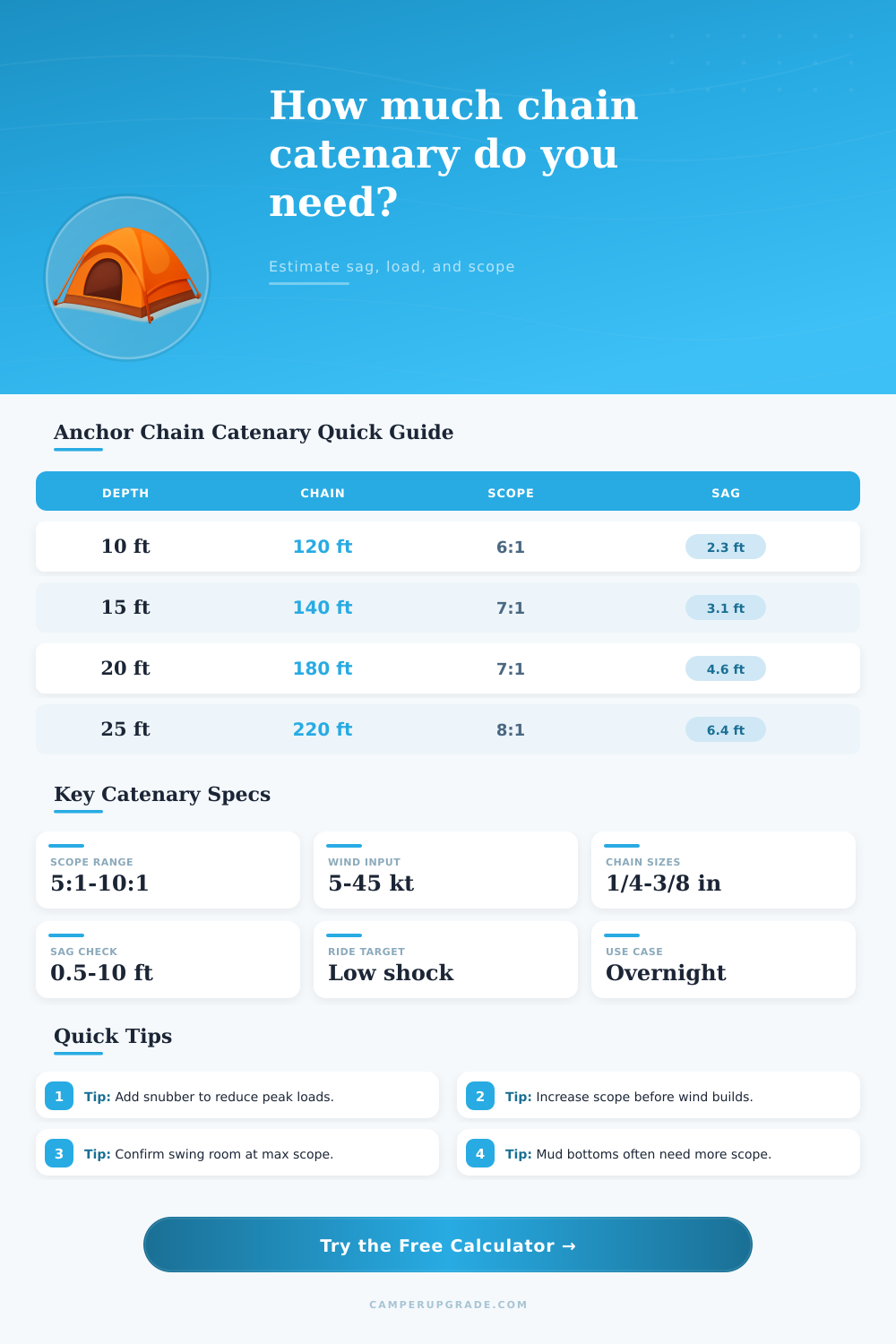
The anchor ride usually is made up of chain, cable or both. Weight of the anchor chain forms natural catenary curve between ship and anchor. That curve is the form that took flexible line, as chain, hanging between two spots.
These spots can be the edge of the boat and the seabed or the anchor itself. Curvature comes of weight of the string or chain, that does the line sink. If some swims down beside it, the line would start of the edge in a bit sharp corner, later slowly flatten out, until it would slip flat in the bottom.
Why the Anchor Chain Curve Matters
Catenary curve matters for good anchoring. It cares that the finish of the ride to the anchor stay horizontal. That gives horizontal pull on the anchor, and it is designed for resist that well.
Weight of the chain helps to keep the holding force more parallel to the seabed. Like this it stops the anchor from rising. When ship has whole chain ride, weight lowers the corner at the anchor.
So the flukes more strongly dig himself in the sea floor.
Are various opinions about chain catenary. Some think that long chain below keeps it better. Others noticed that whole chain ride stretches bare straight directly.
Heavier chain requires stronger pull for straighten, so the catenary curve stays more marked. Catenary also reduce shocking loads, so sudden pull, on the anchor. Increase of force first straightens the chain, before anchor feels it.
When anchored, you must have sufficient anchor ride, so string and/or chain, at least double in depth of water. You call that the scope. In heavy conditions more well give more chain, occasionally until tenfold depth.
When boat gently moves back, anchor bites in the soil and ride tightens. When gust strikes, catenary tightens. Parts of the chain can rise, but anchor stays in its place.
Catenary well operate in quite a lot deep water with right chain, but in shallow water it has little impact.