Tree to Firewood Calculator
Turn one standing tree estimate into cords, stack volume, split log count, and seasoned carry weight.
🪵 Project Presets
📏 Tree and Processing Inputs
📊 Yield Results
🧱 Species Weight and Energy Grid
📋 Reference Tables
| Species | Green lb/ft³ | MMBTU / cord | Drying pace | Burn profile |
|---|---|---|---|---|
| Red Oak | 57 | 24.6 | Slow | Long/high heat |
| White Oak | 58 | 25.7 | Slow | Very long coals |
| Sugar Maple | 55 | 24.0 | Medium | Steady clean heat |
| Yellow Birch | 52 | 20.2 | Medium | Quick startup |
| White Ash | 49 | 23.6 | Medium-fast | Easy to split |
| Shagbark Hickory | 60 | 27.7 | Slow | Maximum heat |
| American Beech | 56 | 24.0 | Medium-slow | Dense long burn |
| White Pine | 35 | 15.9 | Fast | Quick flames |
| Tulip Poplar | 34 | 13.8 | Fast | Light shoulder fuel |
| DBH (in) | Usable Height (ft) | Taper 78% | Volume (cu ft) | Full Cords |
|---|---|---|---|---|
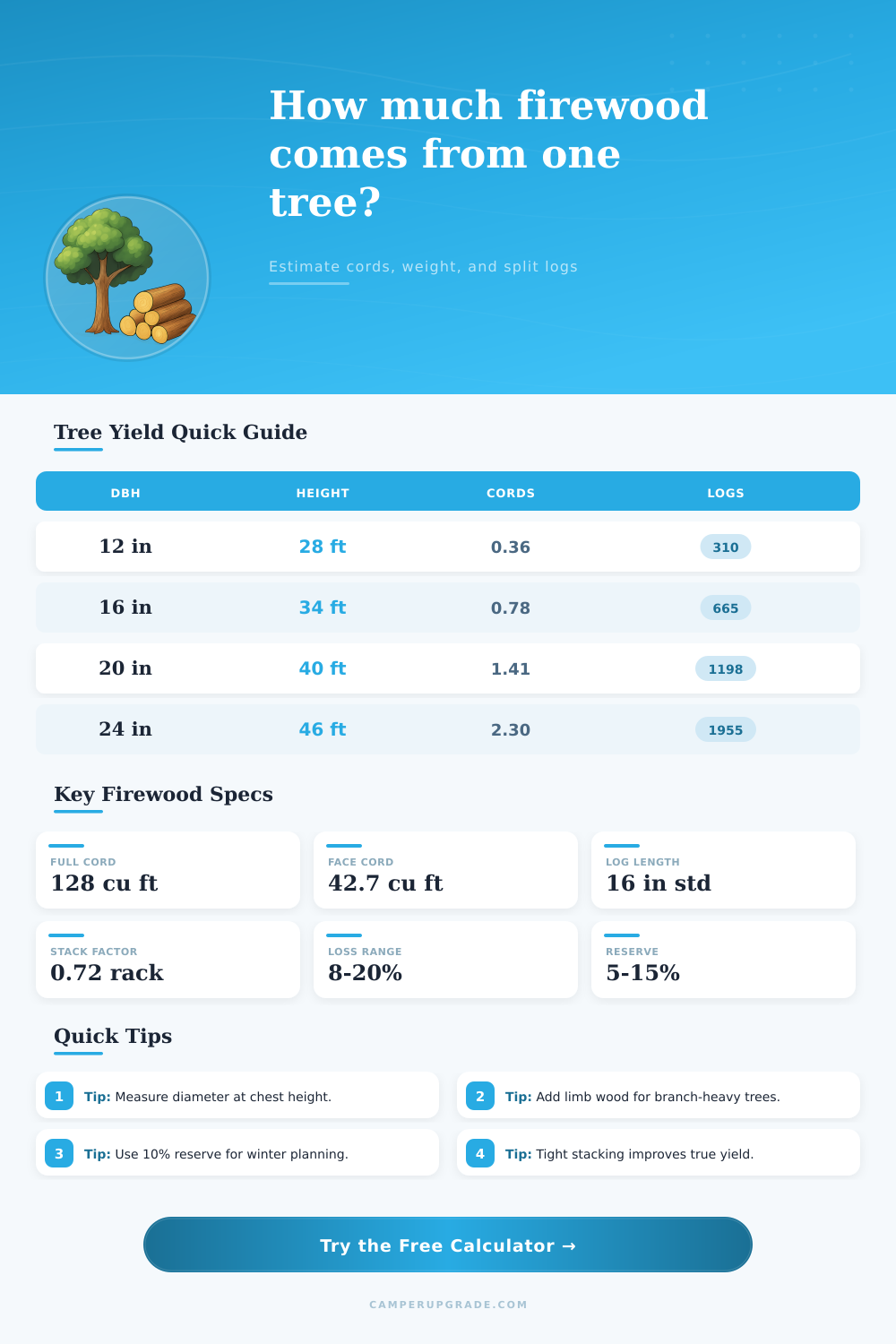
| 12 | 28 | Typical | 46.3 | 0.36 |
| 14 | 32 | Typical | 67.0 | 0.52 |
| 16 | 34 | Typical | 99.6 | 0.78 |
| 18 | 38 | Typical | 139.3 | 1.09 |
| 20 | 40 | Typical | 180.3 | 1.41 |
| 22 | 44 | Typical | 231.5 | 1.81 |
| 24 | 46 | Typical | 294.5 | 2.30 |
| Stack Type | Volume Block | Wood Factor | Solid Wood (cu ft) | Use Case |
|---|---|---|---|---|
| Loose tossed | 128 cu ft | 0.65 | 83.2 | Short-term staging |
| Rack stacked | 128 cu ft | 0.72 | 92.2 | Most wood yards |
| Tight hand stack | 128 cu ft | 0.80 | 102.4 | Storage optimized |
| Face cord (16 in) | 42.7 cu ft | 0.72 | 30.7 | Retail reference |
| 4×8 row (14 in) | 37.3 cu ft | 0.72 | 26.9 | Short firebox |
| 4×8 row (18 in) | 48.0 cu ft | 0.72 | 34.6 | Long firebox |
| Moisture Drop | Green to Seasoned | Weight Change | Handling Impact | Typical Time |
|---|---|---|---|---|
| 18% | Mild drydown | Light reduction | Small carry gain | 6-9 months |
| 22% | Seasoned target | Moderate drop | Easier loading | 9-14 months |
| 28% | Wet to usable | Major drop | Noticeably lighter | 12-18 months |
| 35% | Fresh cut baseline | Largest drop | Heavy handling relief | 18+ months |
⚙ Processing Comparison Grid
Manual Splitter
Electric 6 Ton
Gas 22 Ton
Skid Steer Cone
Choosing good firewood a lot helps for fires in nature. Various kinds of wood burn in different speeds. They give different amounts of smoke and have various smells.
During research of wood, dryness must be the main issue. The drier the wood, the more well it operates. Well-seasoned wood commonly has dark finishes with clear cracks.
How to Choose Good Firewood for Campfires
If you hear steam bubble or hiss outside the end grain during warming, then it is still wet or green. Such wood requires to dry more long before usage. Split and dry wood lights itself very easily.
If you must use starter log, probably the wood is poor quality. Fat wood can serve as starter.
Many trees answer for fires. In Northern Virginia oak stays classic for burn. It is faithfully operate.
White oak gives strong heat. Red oak heats well, but burn slowly and smells bad. Trees as maple, especially sugar and red varieties, well serve.
Big Leaf Maple, alder, ash, locust, walnut and dogwood all burn well. Fruit trees also deserve attention. Black locust favorated because of its density and long combustion.
Eucalyptus trees heat strongly and during long time. White ash weigh less than other good timbers and cracks easily into logs. Birch burns warm and crack nice.
Yellow and black birch impresses. White birch burns quickly and well lights.
Softwoods as pine, fir and spruce light quickly. They answer for light, but consume themselves soon and too warm, so you must add commonly. Because of their sap they create more creosote.
Cedar well lights, because it lights easily and burn quickly. It smells nicely and chases natural insects. Some trees, as yew, you should escape.
During camping more well buy wood beside the fire location. Transportation can propagate pests and tree diseases. In many areas do not allow to move wood between districts or from other state.
Local timbers protect the forests. You finds them at campground stores. Many buy dried wood in plastic bags at large chain stores.
Driving by means of motorhome, space lacks, so folks commonly choose wood at the place.