
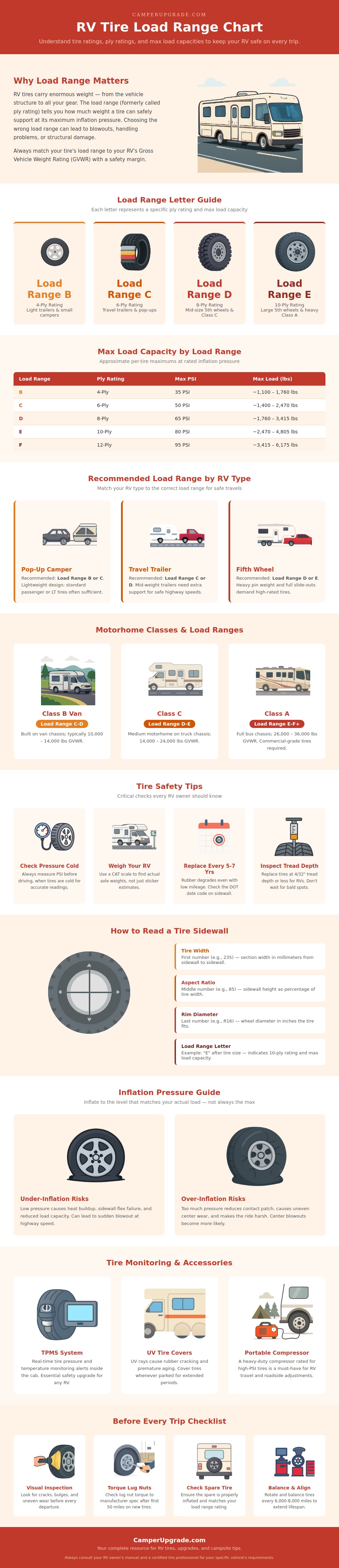
The RV tire load range seems complex but actually it is quite simple when you break it down. It stands on the side of the tire. You mark it with one letter, for instance B, C or D. If two tires have same size but one belongs to load range B and the other to D, that with D can bear heavier weight
For every load range the inflation pressure and the weight capacity change according to the size of tire. Because of that it matters to think not only of the amount and kind of plies. For instance, load range D commonly gives two more belt plies, speed limit of 70 MPH and inflation until 65 psi.
How RV Tire Load Ranges Work
Tires of load range E must inflate to 80 PSI, which can give a rougher ride. Load range F is 12 ply on 17.5 tires and some 19.5 tires. Load range H is 16 ply, used mostly for heavy uses in 22.5 and 24.5 sizes, as motorhomes.
Heavy tires, including Special Trailer tires, have a load range rating. Marked load range on tire points to the maximum weight that it carries at full PSI pressure. Same trailer tires can save lives.
Knowing the right load range helps to avoid terrible trailer tire blowouts.
Generally, the load capacity of trailer tire should be at least 20% more than the weight of the trailer. Each camper has a label on the side with size and required load range for tire. To choose right tire for RV, mind the load and speed index on the tire sidewall.
To avoid tire problems, do not overload the RV beyond its maximum weight and do not go faster than the speed limit.
The only good way to find the right inflation pressure for RV tires is to check the guide of the maker and measure the weight at every tire position while the loaded RV stands as during travel. If one axle end weighs more than the other, use that heaviest weight to set inflation pressure for all tires on that axle. Pressure should always be the same across the axle, but never surpass the maximum limit on the wheels.
Tires with high load range are on big fifth wheels, travel trailers and motorhomes. The speed rating of RV tire is important to know. Some owners choose higher load range than the label offers for extra safety.
High load range never hurts if you want to bear heavier weight.
