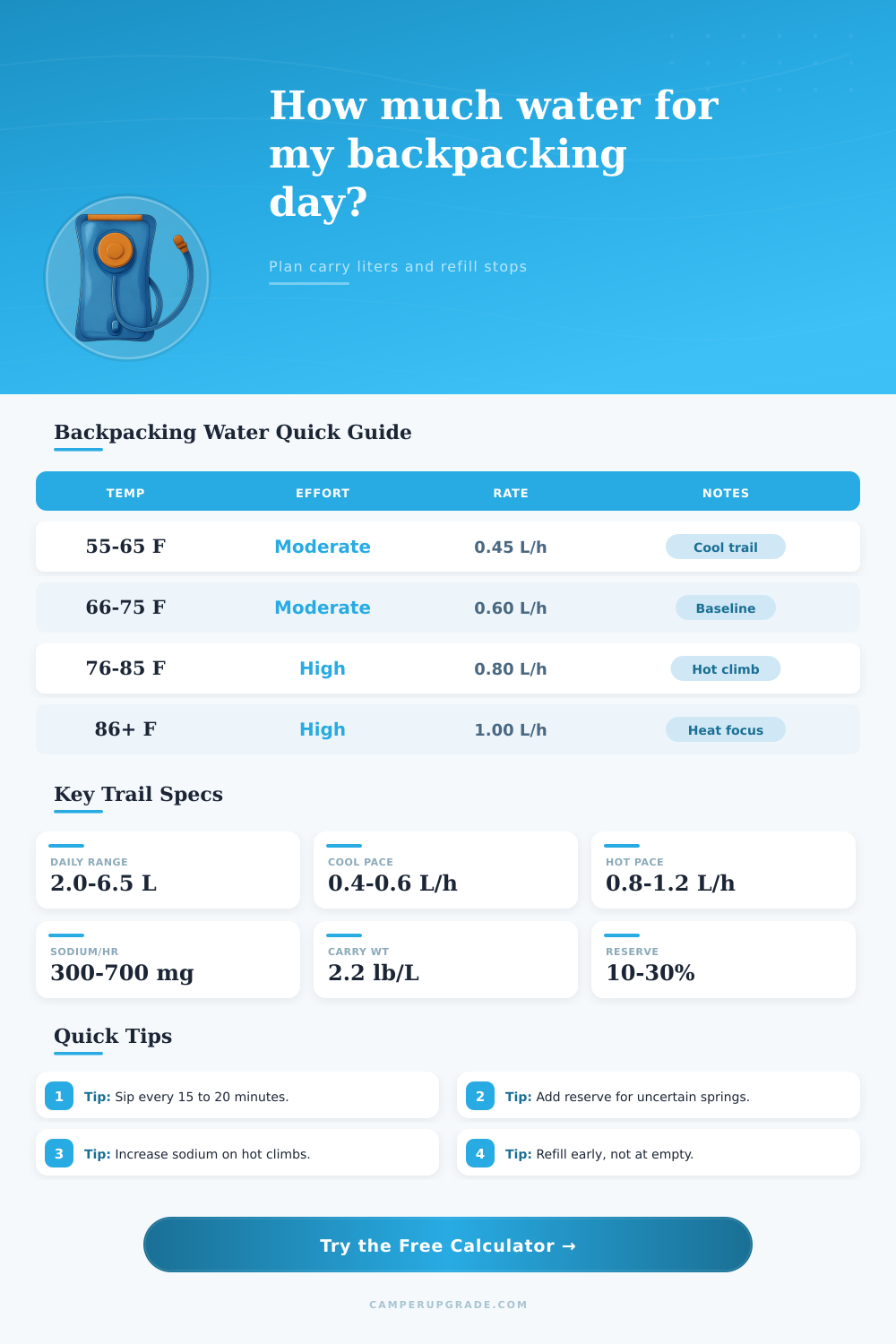
Backpacking Water Calculator
Estimate liters to carry, refill timing, and sodium targets by route effort and weather load.
🏕Trail Scenario Presets
⚙Hydration Inputs
📊Hydration Benchmark Grid
📘Reference Tables
| Air Temp Band | Base Intake Rate | Sodium Target | Planning Note |
|---|---|---|---|
| 50-60 F | 0.40 L/h | 300-400 mg/h | Cool moving pace |
| 61-75 F | 0.55 L/h | 350-500 mg/h | Moderate effort |
| 76-85 F | 0.75 L/h | 450-650 mg/h | Heat gain expected |
| 86-100 F | 0.95 L/h | 550-750 mg/h | Aggressive hydration |
| Terrain Profile | Effort Multiplier | Typical Speed | Hydration Effect |
|---|---|---|---|
| Smooth dirt trail | 1.00x | 2.5-3.0 mph | Baseline intake |
| Mixed roots and rocks | 1.10x | 2.0-2.5 mph | +10% intake |
| Loose talus sections | 1.18x | 1.5-2.0 mph | +18% intake |
| Steep scramble route | 1.28x | 1.0-1.8 mph | +28% intake |
| Water Carried | Weight Added | Typical Use Case | Container Mix |
|---|---|---|---|
| 1.5 L | 3.3 lb | Cool short day | 1L flask + 0.5L |
| 2.5 L | 5.5 lb | Standard day route | 2L bladder + 0.5L |
| 3.5 L | 7.7 lb | Hot exposed day | 2L bladder + bottles |
| 5.0 L | 11.0 lb | Sparse water segment | Bladder + hard bottles |
| Route Pattern | Hours Moving | Total Liters | Refill Plan |
|---|---|---|---|
| Easy 6 mi loop | 3.0 h | 1.8-2.2 L | No refill needed |
| Moderate 10 mi day | 5.5 h | 3.0-4.2 L | 1 planned refill |
| Steep 14 mi push | 8.0 h | 4.8-6.5 L | 2 refill points |
| Overnight segment | 10.0 h | 5.5-7.5 L | Camp source needed |
Backpacking water is one of the most important things you must plan before walking in the wilderness. For survival you need water, especially while backpacking. However the amount you must carry is a question that bothers many backpackers and the answer changes according to the trip.
A popular rule is to carry a liter of water for every two hours of hiking. In the south California desert, expert backpackers require almost a gallon daily if they are in good shape. Plan trips around water sources that are in reasonable distance of the campsite.
How to Carry and Clean Water When Backpacking
Always contact the local ranger station, that is the best choice. Rivers and strong springs are more reliable than brooks that can dry during months.
Some small jugs are betetr than one huge one because you can avoid leaks and easily pack them. Hydration bladders have big popularity because you can drink during hiking without stopping to remove the pack. They are made of flexible and light materials so you carry three liters or more in one vessel.
Many backpackers like Smartwater bottles of 1.5 liters because they fit well in the side pockets of the pack. Also one-liter bottles are usefull at the camp.
Treat or filter water from wild sources before you drink it. The Sawyer Squeeze on a rugged one-liter water bottle now is the gold standard for backpacking. Gravity filters operate superbly.
Katadyn produce good models. Iodine tablets work if you wait 20 until 30 minutes. Chemicals give extra security with minimal weight.
Boiling stays a sure reserve, bring water to rolling boil for one minute, or three minutes above 6500 feet. Only special filters remove chemicals from water, so that is a matter to think about according to the place of the journey.
Backpacking food is usually planned to avoid water weight and rehydrate at the camp, so you do not carry too much water except for drinking. A collapsible bag you fill at a water source, then pump through a filter into bottles or pots. Carrying a whole water supply without refills is difficult.
One backpacker mentioned that in Guadalupe Mountains National Park carrying his water almost ended him.
Using Smartwater or similar bottles, switch them out every so often. In hydration bladders, a bit of bleach and drying them outside help for cleaning. Combine carrying, caching and filtering or treatment of water settle most cases onthe trail.