Hammock Angle Calculator
Model suspension angle, lay height, and anchor load so your hang starts closer to the 30 degree comfort zone.
🛠Camp Hang Presets
⚙Hammock Geometry Inputs
📊Hang Spec Comparison Grid
📘Reference Tables
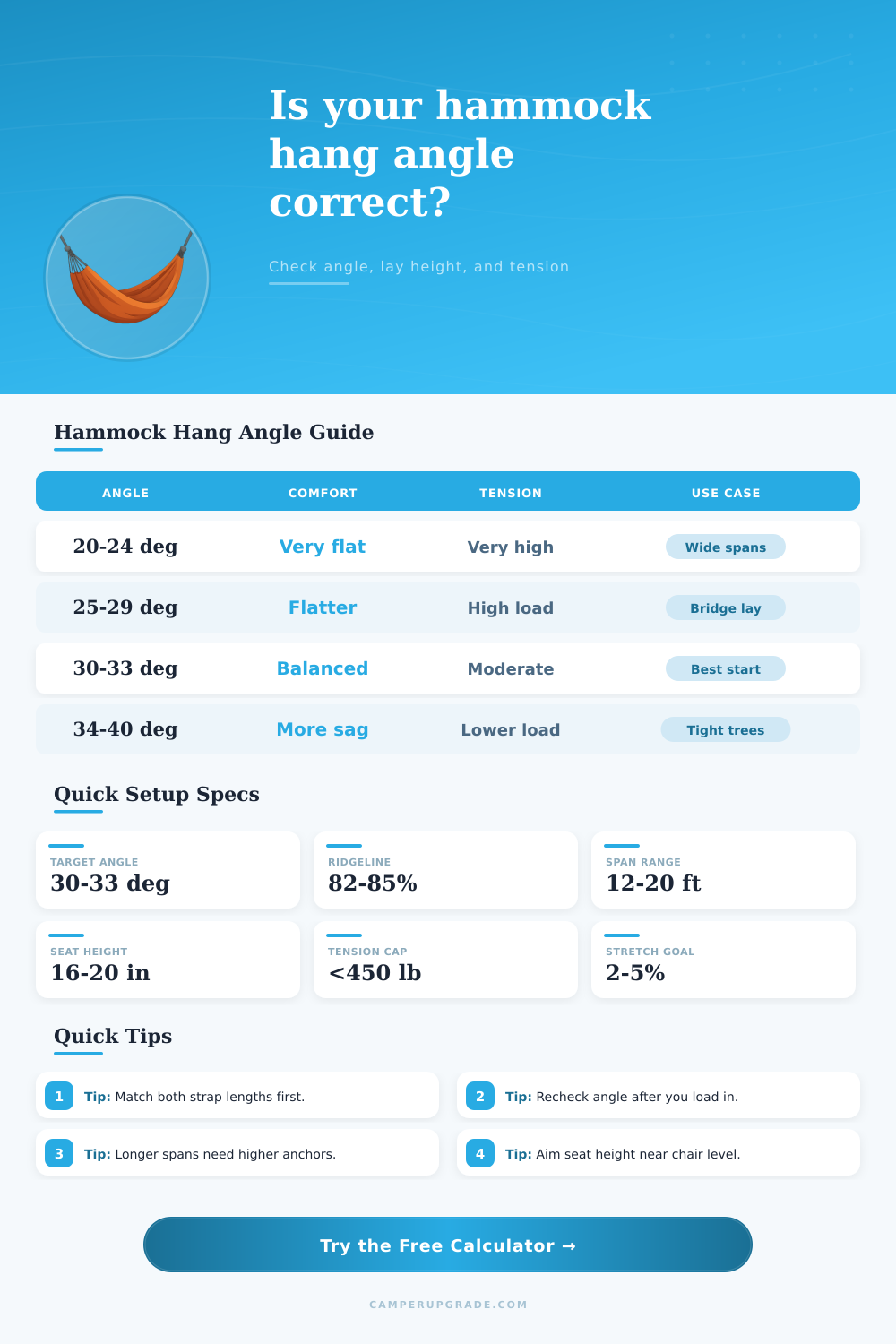
| Angle Band | Body Feel | Load Effect | Adjustment Priority |
|---|---|---|---|
| 20-24 deg | Flat and tight | High strap force | Raise angle immediately |
| 25-29 deg | Flat diagonal lay | Moderate-high force | Fine tune strap drop |
| 30-33 deg | Balanced comfort | Moderate force | Ideal baseline zone |
| 34-40 deg | Deeper sag feel | Lower force | Check sit height rise |
| Hammock Length | 82% Ridgeline | 83% Ridgeline | 85% Ridgeline |
|---|---|---|---|
| 10.0 ft | 8.20 ft | 8.30 ft | 8.50 ft |
| 10.5 ft | 8.61 ft | 8.72 ft | 8.93 ft |
| 11.0 ft | 9.02 ft | 9.13 ft | 9.35 ft |
| 12.0 ft | 9.84 ft | 9.96 ft | 10.20 ft |
| Tree Span | 30 deg Strap (each) | 32 deg Strap (each) | 35 deg Strap (each) |
|---|---|---|---|
| 13 ft | 2.89 ft | 2.73 ft | 2.57 ft |
| 15 ft | 4.04 ft | 3.82 ft | 3.60 ft |
| 17 ft | 5.20 ft | 4.91 ft | 4.63 ft |
| 19 ft | 6.35 ft | 6.00 ft | 5.66 ft |
| Camp Scenario | Span | Anchor Height | Angle Target |
|---|---|---|---|
| Small RV lot trees | 13-15 ft | 5.5-6.0 ft | 32-35 deg |
| Typical forest pair | 15-17 ft | 6.0-6.5 ft | 30-33 deg |
| Wide lake spacing | 17-20 ft | 6.5-7.5 ft | 28-32 deg |
| Winter tarp clearance | 14-16 ft | 6.5-7.0 ft | 31-34 deg |
This model assumes a centered gathered-end hammock and uses geometric approximations for loaded sag and suspension force.
The hammock angle leads to the position where the tree straps with the tree are and the suspension hangs compared to it. It should be around 30 degrees measured from the ground upward to the tree straps or webbing Almost all hammocks hang in a 30-degree down angle from the suspension to the hammock. That angle decides how the hammock sinks, how you stay in it and how much force loads the suspension.
30-degree angle is the best ideal. Some calculators let you choose between 5, 15, 20, 30 and 45 degrees according to preference. Aim for 30 degrees between tree straps and ground, with the hammock bottom around 18 inches above the ground.
Hang Your Hammock at 30 Degrees for Comfort and Safety
Too tight hammock between anchor points load the lines with huge force. The more you pull it, the more the pressure on suspension and anchors. Hence it matters to hang it loose.
If the tree straps are almost parallel, the internal pressure on the tree doubles the weight of the hammock per side. Higher angle expands the tension on tree and hammock material.
Fast trick: use thumb and forefinger for approximate 30 degrees. If hammock and tree straps stretch a bit, aim for 25 to 27 degrees to compensate. Polyester and polypropylene webbing tighten little, so the hammock less sinks overnight.
Nylon webbing extend too and should be avoided.
Young trees and little trees do not work for anchors. Loose hanging help to find the most comfortable position. The 30-degree rule means to adapt the suspension standing beside the hammock, which eases setup.
Measure without weight. 30 degrees on suspension lowers the drop enter, reduces tension on tree and gear and is widely comfortable.
Suspension tension also affects the structural ridgeline. Tight suspension forces the ridgeline to work more to keep the angle. The less tight the suspension, the less the ridgeline must work and the less it tightens.
For strain the ridgeline more, lower the hanging angle. That means attach more below on the tree and shorten the suspension.
Loose hammock hanging matter, because you need the whole width for sleep diagonally. Diagonal lying are usual for comfort in gathered-end hammocks. For instance in 275×140 cm hammock the hanging angle was around 30 degrees sleeping diagonally.