Catenary Curve Calculator (Tarp)
Model ridgeline geometry, support tension, and edge cut offsets for a cleaner storm pitch.
⛺Quick Design Presets
⚙Geometry And Fabric Inputs
📊Design Comparison Grid
📘Reference Tables
| Ridgeline Span | Sag % | Approx Center Sag | Use Case |
|---|---|---|---|
| 9 ft | 1.0% | 1.1 in | Low-distortion fair weather |
| 10 ft | 1.5% | 1.8 in | General backpacking |
| 11 ft | 2.0% | 2.6 in | Storm pitch stability |
| 12 ft | 2.2% | 3.2 in | Large tarp wind control |
| Fabric Type | Typical Stretch | Cut Bias | Practical Note |
|---|---|---|---|
| Silpoly | 0.5-1.2% | Lower | Holds pitch well in rain |
| Silnylon 20D | 1.5-3.0% | Moderate | Increase pre-tension margin |
| Silnylon 30D | 1.2-2.4% | Moderate | More forgiving for field use |
| DCF hybrid | 0.1-0.4% | Minimal | Smaller cut depths often enough |
| Guideline | Small Tarp | Mid Tarp | Large Tarp |
|---|---|---|---|
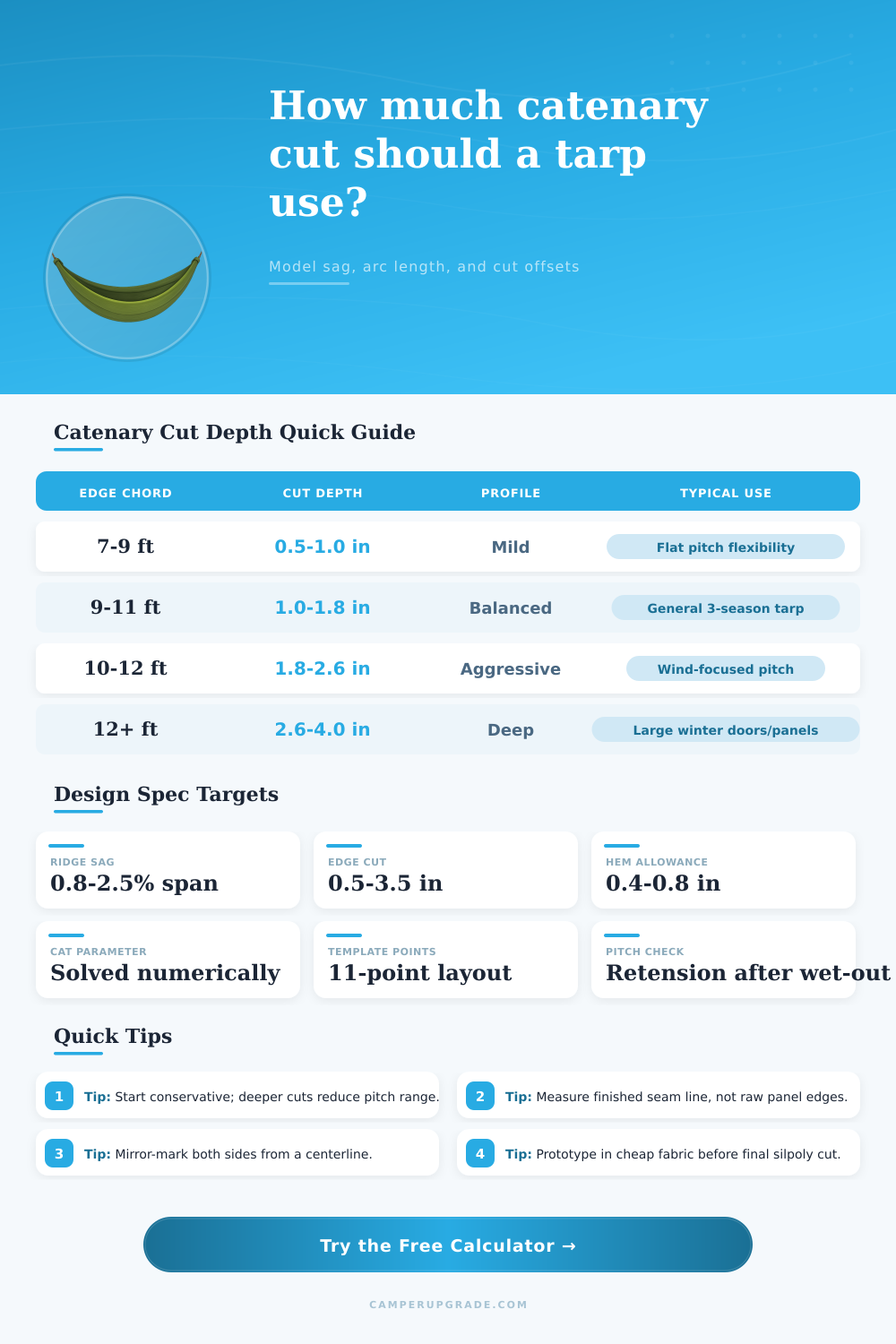
| Ridgeline sag ratio | 0.8-1.5% | 1.2-2.0% | 1.8-2.8% |
| Edge cut depth | 0.5-1.3 in | 1.0-2.0 in | 1.8-3.5 in |
| Hem allowance | 0.4 in | 0.5 in | 0.6-0.8 in |
| Template points | 7 | 9-11 | 11-13 |
| Template Station | Distance From Corner | Inward Cut Offset | Marking Note |
|---|---|---|---|
| 0% | 0.00 | 0.00 | Corner tie-out baseline |
Tarps are one of the most useful tools for camping and outdoor adventures. They last through bad weather thanks to strong material, and UV-protective versions work for year-round use. Lightweight tarps work well for bikepacking, wild camping and emergency shelters.
Waterproof tarps offer several setups, so they adapt to various situations.
Using Tarps for Camping
Ultralight flat tarps are the dream of minimalist explorers. Flat tarps give enough space for a single hiker with their gear. Whether you go to a distant place or do a cross-country bikepacking journey over rough soil, such a shelter sets up quickly and keeps everything safe and covered.
Full protective tarps weigh less than a pound, so you do not leave it home.
For install tarp, choose a piece big enough to protect the intended campsite. Using some strings as guy-lines and stakes, you set it flat. The classical A-frame setup gives the best coverage and is easy to put up.
First fix the two back corners, later the front ridgeline, front corners, back ridgeline, and finally adjust the back corners.
Cheap tarps work for starting. If camping with a tarp pleases you, then invest in a light and strong model for regular use. The main downside of cheap tarps is the noise.
For one person the smallest size is around 5 by 8 feet, but 6 by 9 or 8 by 10 work bettter. DD Tarp of 3 by 3 meters cost little without being cheap, with 19 strong guyout points and silicone coating.
Tarps do the same job as tents, but with much less weight. They give good rain protection, and with a bug net and ground sheet they cover bug protection and ground water protection. Tyvek house wrap or polycro work well as a ground sheet under a tarp, because it is cheap, light, strong and very compact.
Add a tarp under the tent to change everything. The tent bottom gets dirty and in the morning it is wet. Without a ground tarp, packing up takes longer because of dirt, pine needles and efforts to keep moisture away and avoid mold.
When you use a tarp beside a campfire, let it be high. The top edge should be 6 to 7 feet above the fire and 3 to 5 feet away from it, sloping away from the flames. Nylon melts at low temperatures, so a too low position causes holes from sparks.
Keeping the fire small, you avoid damages. Setting the tarp at a sharp angle with the higher edge over the fire helps during rain.
For owners of RVs tarps also are useful. Silver heavy-duty reflective tarp from Harbor Freight covers the roof to block sun and rain. They last around two years, reflecting sun rays while protecting against snow and rain.
Even so you usually prefer to use a special RV cover instead of a tarp, because those can problemize the ventilation.