Backpack Volume Calculator
Estimate main compartment, pocket, and usable liters with shape-aware pack dimensions.
🎒Quick Pack Presets
⚙Backpack Volume Inputs
📊Capacity Comparison Grid
📘Reference Tables
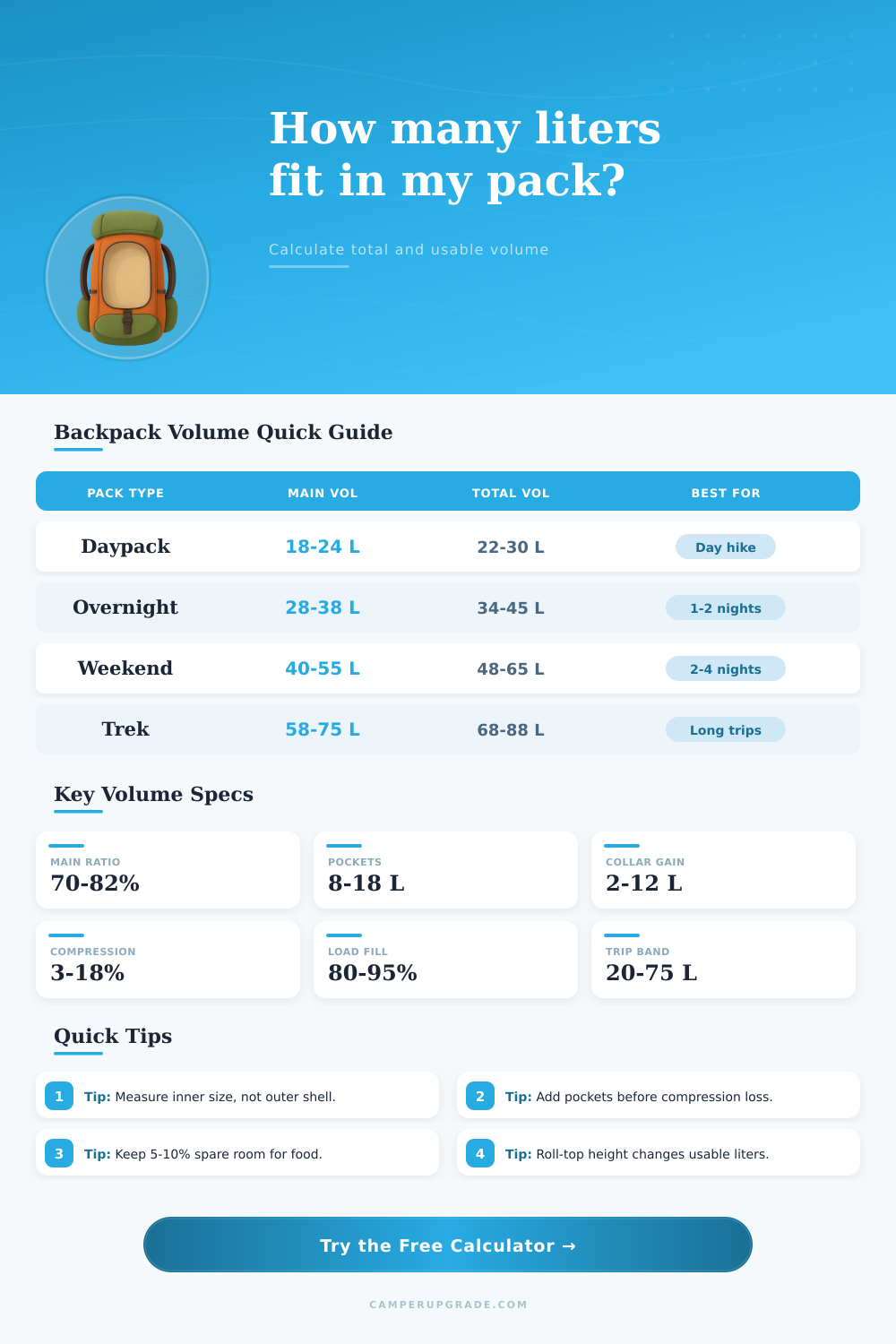
| Pack Class | Total Volume | Typical Trip | Load Behavior |
|---|---|---|---|
| Micro Day | 12-20 L | City essentials | Fast access focus |
| Daypack | 21-32 L | Day hike + shell | Water and layers |
| Overnight | 33-45 L | 1-2 nights | Compact sleep kit |
| Weekend | 46-60 L | 2-4 nights | Balanced bulk room |
| Expedition | 61-80 L | 4+ nights | Food-heavy carry |
| Main Body Geometry | Approx Factor | Use Pattern | Volume Accuracy |
|---|---|---|---|
| Rectangular box | 1.00 baseline | Structured packs | High repeatability |
| Tapered prism | 0.86-0.96 | Trail packs | Depends on taper |
| Cylinder body | 0.785 x box | Roll-top tubes | Stable estimate |
| Collar extension | +2 to +12 L | Overstuff mode | Fill-dependent |
| Pocket Type | Common Volume | Typical Contents | Access Priority |
|---|---|---|---|
| Front shove-it | 2-6 L | Shell, map, gloves | High |
| Side bottle pair | 2-5 L total | Bottles, filter | High |
| Hip belt pair | 0.8-2.5 L | Snacks, phone | Very high |
| Top lid pocket | 1-4 L | Headlamp, repair | Medium-high |
| Usable Liters | Suggested Day Count | Food Strategy | Packing Margin |
|---|---|---|---|
| 20-28 L | Single day | Minimal food | 10% spare |
| 29-40 L | 1-2 days | Dense snacks | 8-10% spare |
| 41-55 L | 2-4 days | Dry meal blocks | 8% spare |
| 56-75 L | 4+ days | Bear can plans | 5-8% spare |
A backpack, also called a knapsack, rucksack or haversack, in its simplest form is a fabric bag that you carry on the back and secure with two straps over the shoulders It is used to carry stuff from one place to another. This basic design makes it an important part of gear for camping and backpacking journeys.
Planning a backpacking adventure, nothing is more essential for a future traveler than a good quality backpack. It carries everything from your stuff on the way and becomes your home. It mainly helps to carry loads while your hands stay free.
How to Choose a Backpack
Bags on one shoulder, like messenger bags, often are clumsey, can slip, get in the way and do not spread the weight well across the body.
The most liked backpacks have 50 to 80 liters and work well for warm weather during three days or longer trips. They suit also for shorter journeys with a bit of fancy stuff or for several sports like backcountry skiing. For day hiking without overnight plans, a smaller bag for a windbreaker, down vest, flashlight, knife, liter of water and snacks work perfectly.
Osprey are one of the best brands for buying a reliable backpack for long trips. All their bags have a lifetime guarantee, and they will fix or replace it if it becomes unusable. For lighter models there are many local companies with prime lightweight options.
Gregory and Arc’teryx Bora also deserve attention.
Choosing a backpack, the bottom cushion should sit just above the hips, but not much higher. Like this you get maximum comfort during long hikes. A typical list for a backpacking journey carries underwear, clean shirt, zip front hoodie, extra socks, toiletries, food, water, small camp stove, utensils and a pillow bag.
The ultralight backpacking community stresses efficient motion, packing light and a base weight under 10 pounds according to Leave No Trace principles. You talk a lot about removing small weights from the bag. Some backpacks are made from high quality materials like 1000D CORDURA nylon fabric, which keeps them rugged during an active life.
The Backpack SS500 is even prime for truck camper, which shows the link with the RVworld also.