Hammock Ridgeline Length Calculator
Estimate structural ridgeline length, hang angle, seat height, and anchor force from your hammock geometry.
🏕️Quick Setup Presets
⚙Hammock And Hang Inputs
📊Quick Comparison Grid
📘Reference Tables
| Ridgeline Ratio | Feel | Diagonal Room | Best For |
|---|---|---|---|
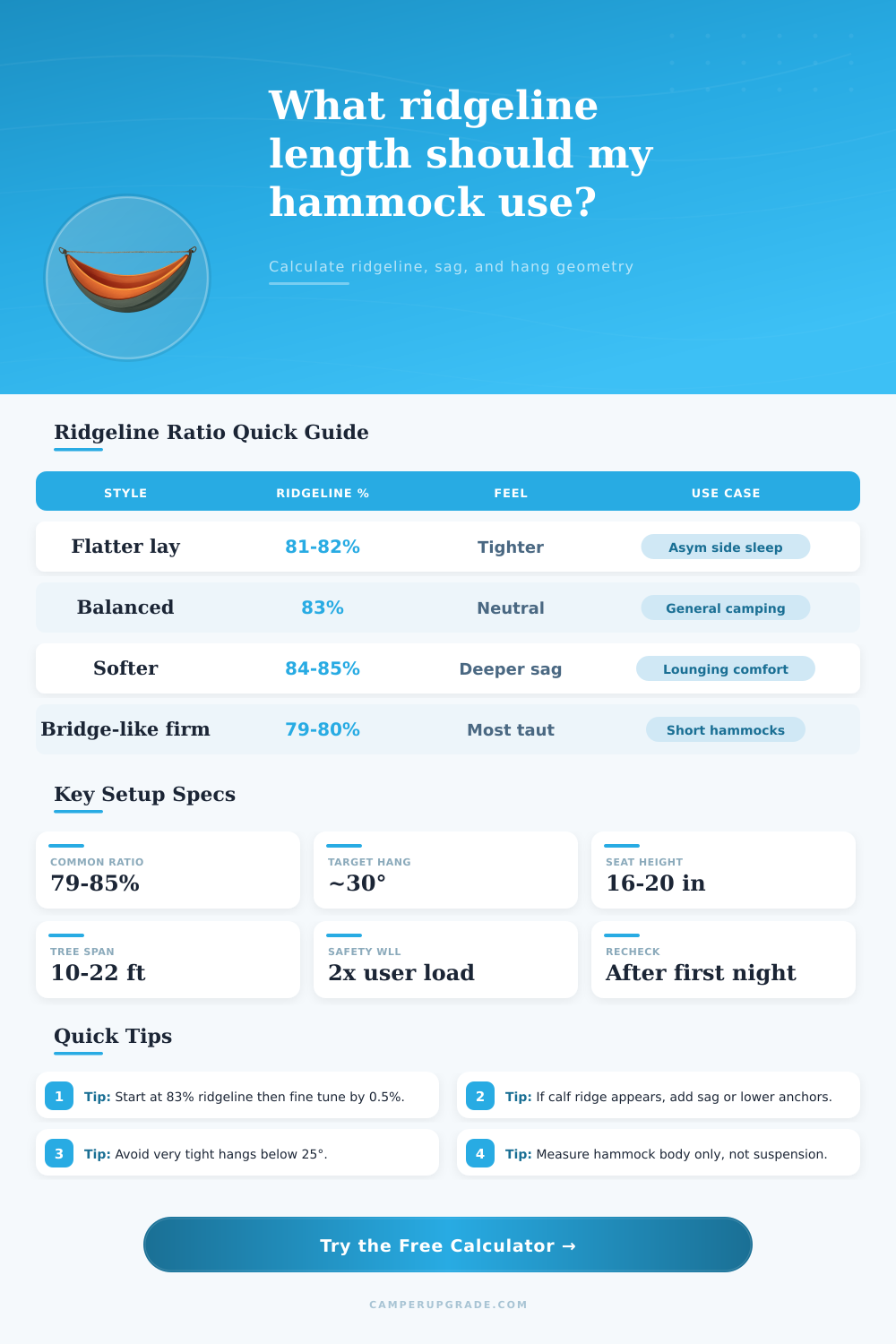
| 79-80% | Very taut | Least | Short hammocks, firm preference |
| 81-82% | Taut-balanced | Moderate | Back sleepers, flatter lay |
| 83% | Neutral baseline | Good | Most gathered-end hammocks |
| 84-85% | Deep cradle | High center sag | Lounge and gentle rock |
| Tree Spacing | Anchor Height | Typical Strap Angle | Adjustment Note |
|---|---|---|---|
| 10-12 ft | 4.5-5.5 ft | 35-40° | Short spacing, watch steep hang |
| 13-16 ft | 5.0-6.0 ft | 28-34° | Most common comfort window |
| 17-20 ft | 5.5-6.5 ft | 22-30° | Raise anchors to avoid tight suspension |
| 21+ ft | 6.0-7.0 ft | 18-26° | Force climbs quickly if hung too flat |
| Load Case | User Weight | Dynamic Factor | Per-Side Suspension Force* |
|---|---|---|---|
| Careful entry | 180 lb | 1.00 | ~180-220 lbf @ 30° |
| Typical movement | 180 lb | 1.15 | ~210-255 lbf @ 30° |
| Restless sleeper | 220 lb | 1.30 | ~285-350 lbf @ 30° |
| Aggressive sit/drop | 220 lb | 1.50 | ~330-405 lbf @ 30° |
| Hammock Body Length | 83% Ridgeline | 82% Ridgeline | 85% Ridgeline |
|---|---|---|---|
| 10.0 ft (3.05 m) | 8.30 ft | 8.20 ft | 8.50 ft |
| 10.5 ft (3.20 m) | 8.72 ft | 8.61 ft | 8.93 ft |
| 11.0 ft (3.35 m) | 9.13 ft | 9.02 ft | 9.35 ft |
| 11.5 ft (3.51 m) | 9.55 ft | 9.43 ft | 9.78 ft |
| 12.0 ft (3.66 m) | 9.96 ft | 9.84 ft | 10.20 ft |
The camper hammock ridgeline is that string that runs above the hammock and binds the sides of the suspensions, keeping everything in position so that the hammock itself must not do that
When you sit in it, the ridgeline should be at the head of the person. It holds the right sag of the hammock, and once well installed, it almost does not need more work.
What a Hammock Ridgeline Is and How to Use It
Ridgelines are in two types: structural and non-structural. Structural ridgelines are made from strong string and attach at every end of the hammock. It is meant to bear the weight of accessories like bug nets, tarps or lofts.
By doing that you unload the hammock, free the upper space and keep a tidy sleeping place. Non-structural ridgelines help to hang objects and show how much tension the suspensions need. Strained ridgelines show the right tension for the suspensions.
Ridgelines are suggested to be around 83% of the length of the hammock. Mathematically it would be 86.6%, but real experience shows that 83% gives the best balance between sag, lay and adjstability. For a 118-inch hammock that means a structural ridgeline of 98 inches.
Even so 83% is only a guide, no law, so slightly more or less long can work better. At wide hammocks deeper sag with a short ridgeline feel more comfortable, while for hammocks under 60 inches a longer ridgeline works well.
Fixed structural ridgeline of 108 inches is for an 11-foot hammock, for permanent sag and a pure sleeping lay. With accessories like carabiners or adjustable knots, you can set the sag and height for maximum comfort. Adjustable ridgelines mean you alter the sag step by step according to your taste.
Whoopie sling-style ridgelines serve that.
Many hammock campers use a ridgeline, because it eases the placing of the hammock and hanging of things. Little bags, lamps, phones and alike can hang off it. A ridgeline organizer like the Hammock Holdall is a nine-pocket bin, that hangs above the hammock and gives a lot of space for gear within arm-reach.
A bug net can hang from the ridgeline. A rain fly cannot, it has its own suspension. For a tarp use an adjustable prusik knot beside the end of the string for a continuous ridgeline system.
However such systems occasionally fail, when the prusik knots jam up and do not move without strong two-handed play. Ensure that the prusik on the ridgeline has a smaller diameter than the ridgeline itself.