Snow Load Calculator
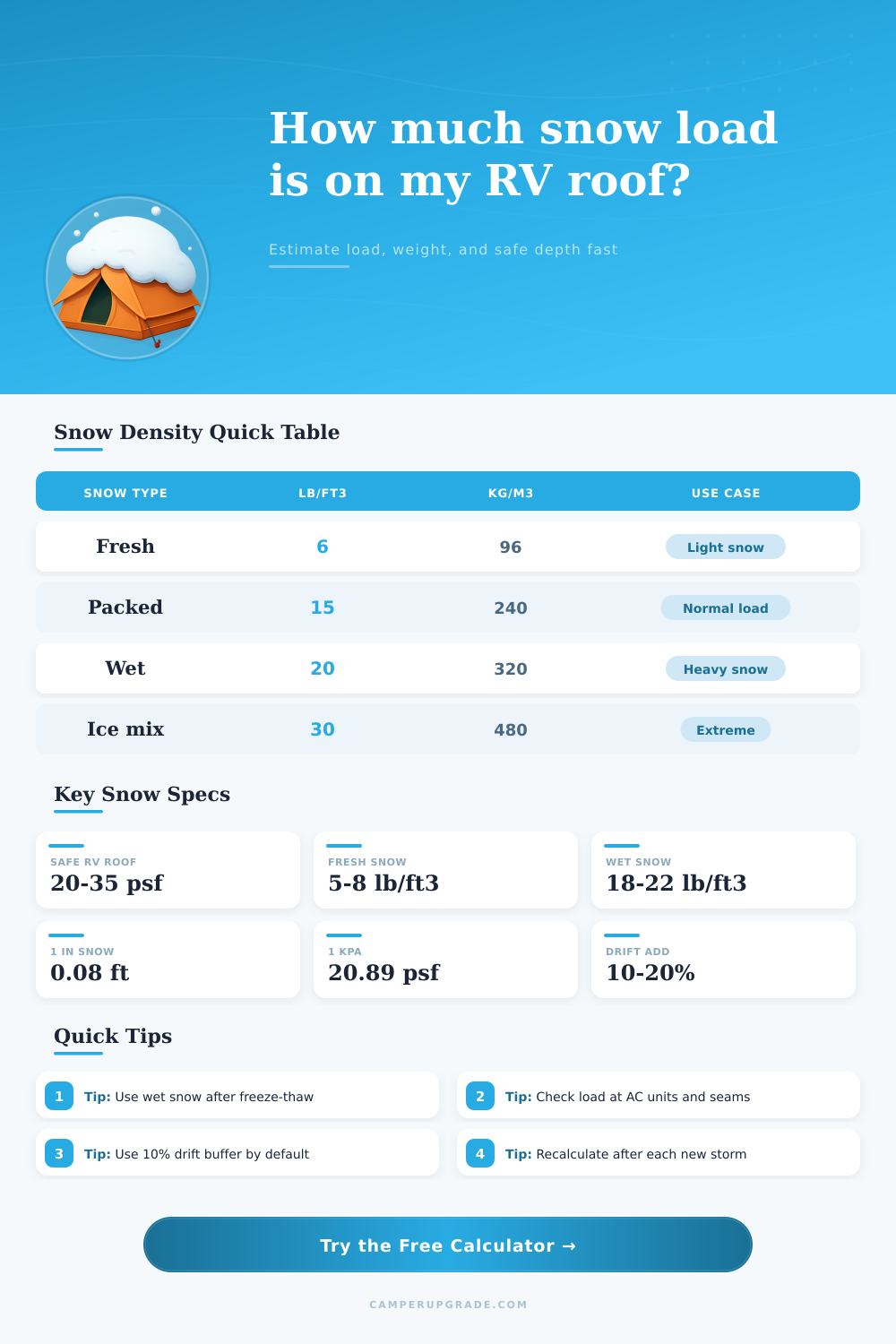
Estimate RV roof snow load, total weight, and safe depth margin with unit conversion and drift adjustments.
📋Project Presets
📏Snow Load Inputs
🧱Snow Density Material Grid
📊Coverage by Snow Depth
| Depth | Volume per 100 ft² | Volume per 10 m² | Packed Load (15 lb/ft³) |
|---|---|---|---|
| 3 in | 25 ft³ (0.93 yd³) | 0.76 m³ | 3.1 psf |
| 6 in | 50 ft³ (1.85 yd³) | 1.53 m³ | 6.3 psf |
| 9 in | 75 ft³ (2.78 yd³) | 2.29 m³ | 9.4 psf |
| 12 in | 100 ft³ (3.70 yd³) | 3.06 m³ | 12.5 psf |
| 18 in | 150 ft³ (5.56 yd³) | 4.59 m³ | 18.8 psf |
📘Roof Pitch & Exposure Factors
| Condition | Factor | When to Use | Effect on Load |
|---|---|---|---|
| Low slope 0–3:12 | 1.00 | Flat RV roofs, sheds | Baseline full load |
| Moderate 4–6:12 | 0.95 | Typical sloped roofs | Small slide-off reduction |
| Steep 7–10:12 | 0.85 | A-frame camper fronts | Lower retained snow |
| Very steep 11+:12 | 0.75 | Sharp gables | Strong reduction |
| Open windy site | 1.10 | Exposed ridge or lot | Higher drift potential |
| Drift-prone edges | 1.20 | Walls, AC units, steps | Localized load spike |
🛠Common RV & Campsite Roof Cases
| Project | Area | 9 in Packed Snow | Approx Total Weight |
|---|---|---|---|
| Travel trailer roof 8×32 | 256 ft² | 9.4 psf | 2,406 lb |
| 5th-wheel roof 8.5×38 | 323 ft² | 9.4 psf | 3,036 lb |
| Camper van roof 6.8×19 | 129 ft² | 9.4 psf | 1,214 lb |
| Awning section 8×20 | 160 ft² | 9.4 psf | 1,500 lb |
| Storage shed 10×16 | 160 ft² | 9.4 psf | 1,500 lb |
Snow load is the downward weight of accumulated snow and ice on roof. It genuinely risks campers, RVs and trailers in snowy regions. If the snow weight surpasses the designed limits of building or vehicle, it can crash the roof or whole frame
Two feet of snow on roof weigh between 6 and 42 pounds each square foot. Whether snow stays light and fluffy, or becomes wet and dense, that determines the difference. In 8 to 10 inches already risks light snow, but wet snow becomes a probelm in 4 to 6 inches.
Snow Load Risks for RVs, Trailers, and Tents
When temperature falls, wet snow turns into iced block, that is hard to erase without breaking antennas or other roof parts.
RV manufacturers well count snow loads and the skill of their roofs. Some roofs hold more than 200 pound person standing on one foot, so moderate snow spread well is usually no problem. For instance trailer with 208 square feet of roof and 20 pounds each square foot carry around 1,460 pounds, what could surpass the axle limit.
Distributed weight commonly more loads the axes than the roof self.
Some full-time RV users in snowy places never dump snow and succeed decades without cause. Vendors leave snow pile on products. Even so happened failures of roofs because of gross weights, especially above 2 to 4 feet of wet snow.
One RVer in Tahoe had his truck through 14 winters and climbed to remove snow only when it reached 4 feet high.
Snow rake with long handle well helps to drag snow off ground. Collapsible staircase beside trailer with plastic shovel also is useful. Some put heater cables on roof in winter for less snow.
Risk break fan or antenna sweep outside stay high, so remove carefully.
Snow covering fridge vents and sewer tubes create additional danger. Roof coverings made for snow weights deserve attention. Tent roofs face similar burdens.
Tent resisting snow is necessary for winter usage. Three-season tents commonly hold 7 inches of snow, although vestibule can crash, while others require added poles. Keeping snow load on a tent roof may mean clearing it a couple times eachnight.