Trekking Pole Height Calculator
Set precise pole length for flat trail, steep climbs, descents, and loaded packs.
🏔 Trail Presets
📏 Fit Inputs
⚙ Pole Material and Spec Grid
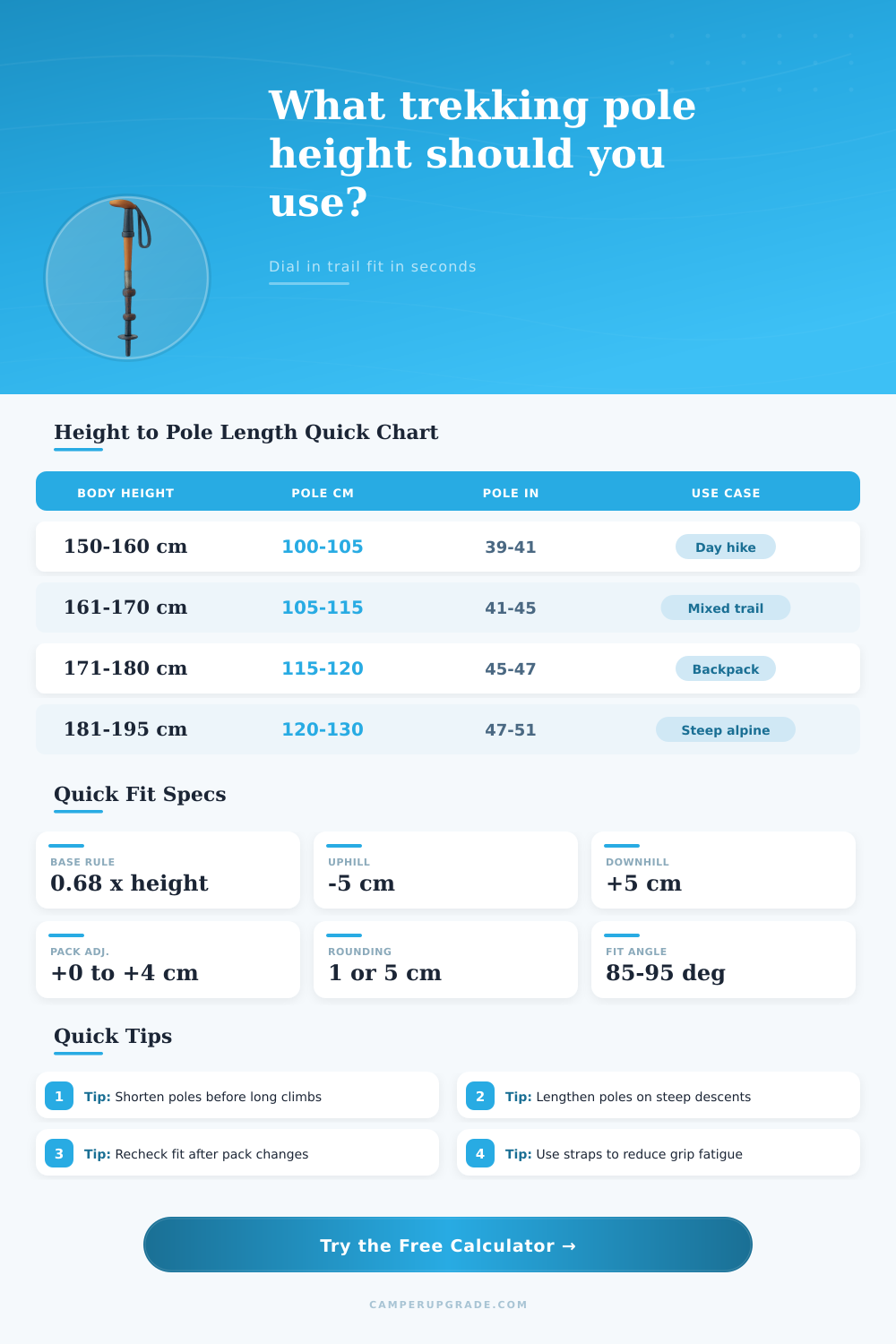
📊 Height-to-Pole Reference
| Body Height | Base Pole | Trail Pole Range | Closest Fixed Size |
|---|---|---|---|
| 150–160 cm (4'11–5'3) | 100–105 cm | 95–110 cm | 100 cm |
| 161–170 cm (5'3–5'7) | 105–115 cm | 100–120 cm | 110 cm |
| 171–180 cm (5'7–5'11) | 115–120 cm | 110–125 cm | 120 cm |
| 181–195 cm (5'11–6'5) | 120–130 cm | 115–135 cm | 125 cm |
⛰ Terrain Adjustment Table
| Terrain Type | Neutral Adj. | Uphill Delta | Downhill Delta |
|---|---|---|---|
| Mostly flat trail | 0 cm | -5 cm | +5 cm |
| Rolling singletrack | +2 cm | -4 cm | +6 cm |
| Long steep climbs | -3 cm | -6 cm | +4 cm |
| Long steep descents | +4 cm | -4 cm | +8 cm |
| Mixed alpine terrain | +1 cm | -5 cm | +6 cm |
🏃 Activity Adjustment Table
| Activity | Base Adj. | Target Elbow Angle | Reason |
|---|---|---|---|
| General hiking | 0 cm | 90° | Balanced comfort |
| Backpacking | +2 cm | 88°–92° | Load support |
| Trail running | -3 cm | 92°–96° | Faster cadence |
| Nordic walking | +5 cm | 84°–88° | Forward drive |
| Snowshoe travel | +4 cm | 86°–90° | Float and reach |
🚩 Pole Segment and Size Compatibility
| Pole Type | Increment | Typical Range | Best Use |
|---|---|---|---|
| Telescopic | 1 cm | 100–135 cm | All-around hiking |
| Folding | 2 cm | 105–130 cm | Fastpacking |
| Fixed length | 5 cm | 100–130 cm | Consistent fit |
| Kids/Youth | 5 cm | 80–110 cm | Smaller hikers |
Trekking poles, that some also call hiking poles or walking poles, are popular aid for hiking in mountains. It helps to keep rhythm, give stability and ease the pressure on joints during pace on difficult soil. Basically, trekking poles are like ski poles with handles, used during rise, and you almost always use them in pairs.
Is also kind called hiking staff, that differs from trekking poles
How to Choose and Use Trekking Poles
During downhill steps they remove a lot of weight off the knees and ankles. Pair of trekking poles together with good hiking boots, that grip well, can even save your life when you climb to big heights. More heavily they allow you to cross ways, that otherwise would be difficult.
On flat or varied terrain, as well as during pace on slopes, poles help to cover distance more quickly, real advantage. Reach balance on rocky soil without them is very hard, what brings big danger of slippng and falls.
You find trekking poles from lightweight carbon fiber or from strong aluminum. Aluminum costs less, but weighs more and bends a bit when it breaks. Carbon fiber is more rugged and lightweight, even so more expensive.
Carbon poles most probably serve more long, but can break sharply and loud. Poles under 12 ounces for pair are called ultralight, between 12 and 15.9 ounces are lightweight, while those in one pound or more suit most for severe use.
Properly long poles lay the elbows in 90-degree corner, when you keep them with the tips beside your feet on the soil. Many trekking poles have adjustable length, what eases that. Some however come with fixed size or in series of lengths.
Long handles are useful, to avoid commonly alter the length during sharp rises or downhill parts.
Flip-locks surpass twist-locks. Twist-locks commonly do not tighten and so are not reliable. Poles with removable leashes are practical.
The MSR DynaLock Ascent Carbon has Kevlar-strengthened carbon design, what makes it more permanent than the most of carbon poles and fit for all year usage with trekking and snow baskets. The Black Diamond Pursuit poles combine durability, versatility and comfort for hiking, backpacking and skiing.
Cascade Mountain Tech carbon cork poles bid good price. At Costco you get them in 70 dollars for two pairs, or around 44 dollars in pair on Amazon. The aluminum EVA-versions cost around 20 dollars.
They suit for river crossings, sharp climbings and full ways. If you use a tent for pitching with poles, many require length at least 125 cm, occasionally 130 until 135. Two poles well help to unload the legs and cross rivers.
One pole suffices for a bit of balance upward and down.