🏹 Archery FOC Calculator
Calculate your arrow's Front of Center (FOC) percentage using the AMO standard formula
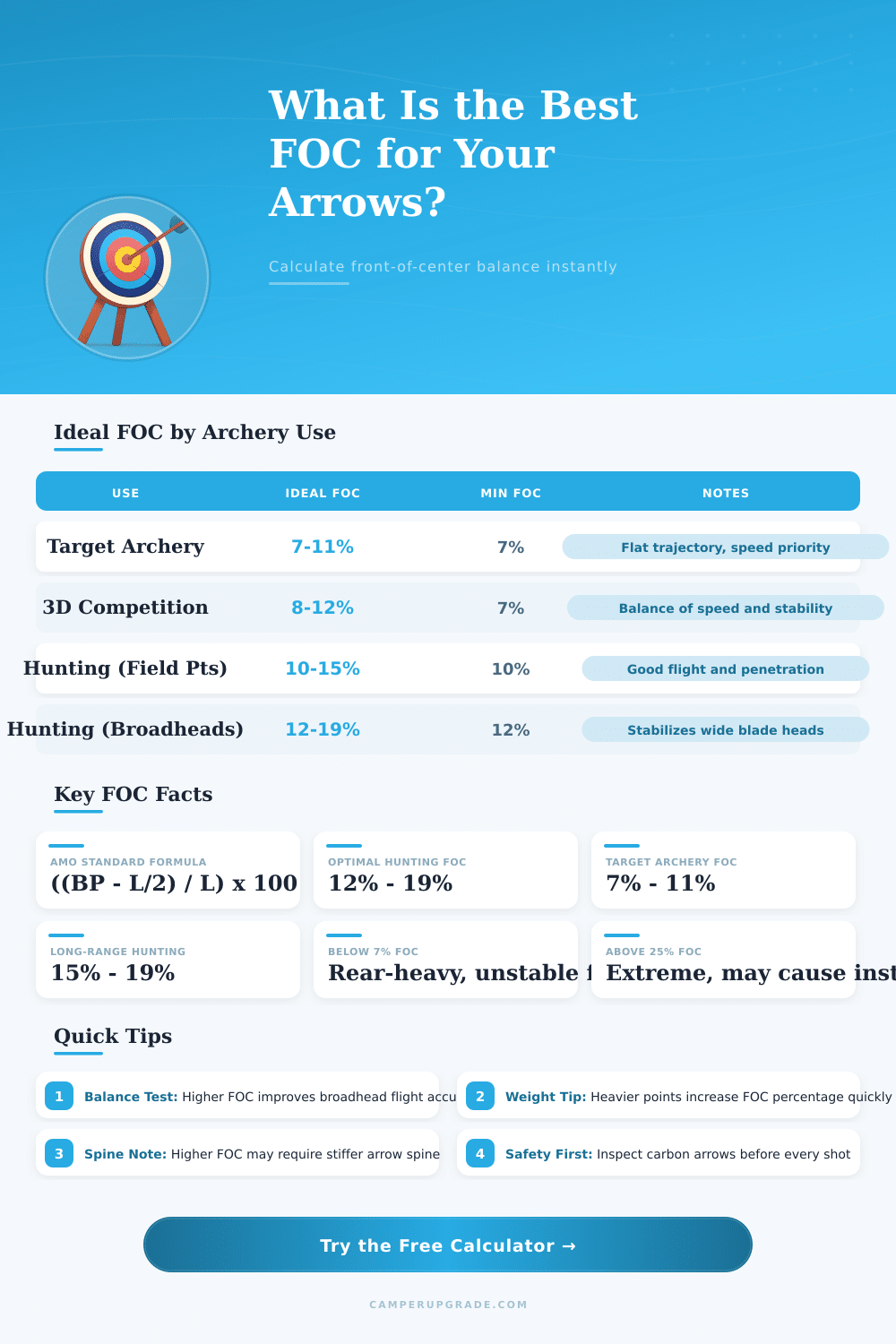
| Archery Use | Ideal FOC | Min FOC | Flight Notes |
|---|---|---|---|
| Target Archery | 7 – 11% | 7% | Flat trajectory, speed priority |
| 3D Competition | 8 – 12% | 7% | Balance of speed and stability |
| Hunting (Field Points) | 10 – 15% | 10% | Good all-around flight |
| Hunting (Broadheads) | 12 – 19% | 12% | Stabilizes wide-blade heads |
| Long-Range Hunting | 15 – 19% | 15% | Maximum downrange stability |
| Traditional Archery | 10 – 14% | 8% | Varies by bow design |
| Youth / Beginner | 10 – 15% | 10% | Forgiving setup recommended |
| Bowfishing | 10 – 20% | 10% | Short range, penetration focus |
| FOC Range | Flight Characteristics | Accuracy | Penetration |
|---|---|---|---|
| Below 7% (Rear-Heavy) | Unstable, porpoising, tail-kick | Poor at distance | Low |
| 7 – 11% (Target Optimal) | Flat, fast, consistent trajectory | Excellent | Moderate |
| 12 – 19% (Hunting Optimal) | Stable, forgiving, self-corrects | Very Good | High |
| Above 25% (Extreme) | Nose-heavy, may drop quickly | Reduced at distance | Very High |
Archery is a sport that requires a lot of focus, accuracy and presence. The whole process of drawing the bow creates a calm space that helps relax and clean the mind Gunners are obsessed with attention, because that is the main goal of the sport. To succeed, an archer needs laser-like focus on the target.
That means silencing the inner voice and blocking all distractions.
How to Focus and Aim in Archery
Actually, there are two different ways to focus. An archer with external focus looks at the target and imagines the arrow hitting the centre before shooting. On the other hand, an archer with internal focus pays attention to the feeling of the body, the tension of the shoulders and the position.
Which method works best depends on the type of archery, the distance, the target and personal prefrrence.
Where to look during aiming is a tricky thing. If one looks at the sight, the target becomes blurry. Like this an archer does not know exactly where the sight points.
He could think that he looks at the edge of the ten ring, but be outside. At short distances, one can focus entirely on the target. At longer distances, some archers use a mix of the target and the expected route of the arrow.
Focus on any part of the bow or arrow can ruin the form and alignment.
Choosing a spot on the target and staying set seems easy, but it really is not. It requires strong focus that one must keep always. Rhythm helps.
For instance: look at the target, choose a spot, start the draw and zoom in until hitting the anchor; that is a way that works well.
Practice using an empty bale is a great exercise to build focus. That means to shoot a target only three metres away. Because hitting is almost guaranteed at that distance, the mental pressure disappears and the archer can focus purely on the form.
One can do twenty to thirty focused shots, followed by two hundred unfocused shots. Simple exercises like empty bale, walk-back, timed shots and grouping help a lot.
Some archers struggle because they easily get distracted and focus more on the result than on the process. That pushes them to rush through the steps or even forget some. Using imaginary techniques can help clean the mind and restore the focus to the arrow in the bow, which is the most important arrow in that moment.
Following a shot sequence and focusing on the process are key in every aiming sport. Practice and consistency matter more than anything else.