🛶 Kayak Speed Calculator
Calculate speed, time, or distance for your kayak trip — with current & wind adjustments.
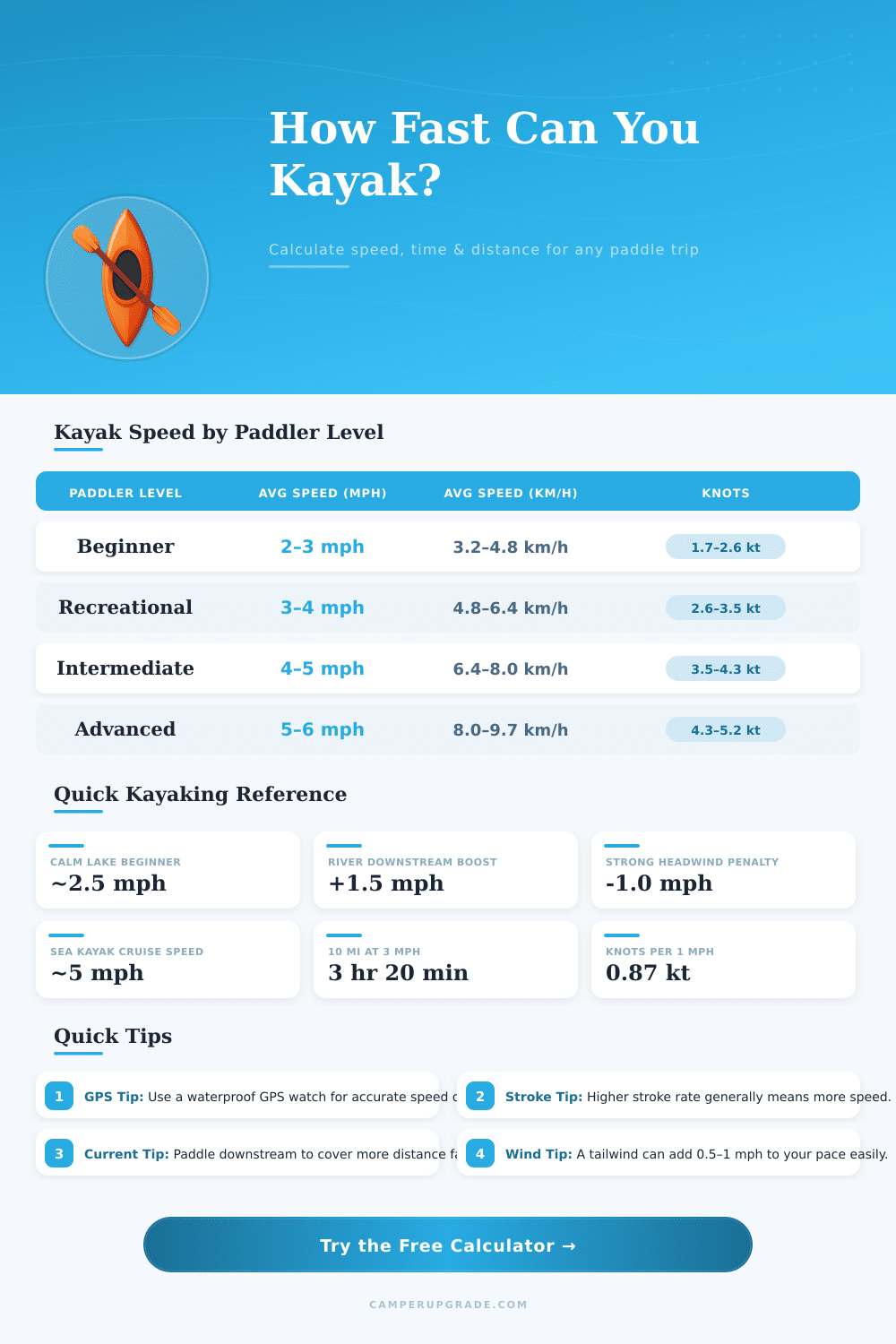
| mph | km/h | Knots | Notes |
|---|---|---|---|
| 2.0 | 3.2 | 1.74 | Slow beginner pace |
| 2.5 | 4.0 | 2.17 | Beginner average |
| 3.0 | 4.8 | 2.61 | Casual recreational |
| 3.5 | 5.6 | 3.04 | Steady recreational |
| 4.0 | 6.4 | 3.47 | Comfortable touring |
| 4.5 | 7.2 | 3.91 | Intermediate pace |
| 5.0 | 8.0 | 4.34 | Sea kayak cruise |
| 5.5 | 8.9 | 4.78 | Advanced touring |
| 6.0 | 9.7 | 5.21 | Race/sprint pace |
| Distance | @ 2.5 mph | @ 3.5 mph | @ 5.0 mph |
|---|---|---|---|
| 1 mile | 24 min | 17 min | 12 min |
| 3 miles | 1 hr 12 min | 51 min | 36 min |
| 5 miles | 2 hr | 1 hr 26 min | 1 hr |
| 8 miles | 3 hr 12 min | 2 hr 17 min | 1 hr 36 min |
| 10 miles | 4 hr | 2 hr 51 min | 2 hr |
| 15 miles | 6 hr | 4 hr 17 min | 3 hr |
| 20 miles | 8 hr | 5 hr 43 min | 4 hr |
How fast your kayak moves depends on more things than you would think. Most beginners on calm water reach around 2 to 3 miles per hour, that is 2 to 3 knots if you use nautical terms. When you put in a bit more effort, you can reach 3 to 4 mph, which feels like a good rhythm.
Even so, here is the point longer boats are simply faster than short ones. That is physics. Displacement hulls work quite consistently.
What Affects Kayak Speed
Take for example a moderately expert paddler in a standard 12-foot recreational kayak that is about 30 inches wide. On calm water, he probably cruises around 3.5 mph without much sweat. Beginners who use longer touring boats commonly move at 4 to 5 kilometers per hour.
When you have some real experience and fitness, speeds between 3.5 and 5 mph become possible. But keep 5 mph in a narrow 18-foot boat? That is genuinely exhausting for more than one or two stritches.
Reach 4 to 6 mph with a simple recreational kayak would be honestly impressive.
A 13-foot kayak allows you to glide in easy 4 mph, although you quickly will reach a ceiling if you try to push it. An 18-foot narrow design? It also can reach 4 mph without a lot of fuss, but it has more potential if you decide to work harder.
You can reach around 5.5 or 5.6 mph during very intensive efforts, although that is not possible to maintain long.
The flow of the river alters everything entirely. If you paddle at 5 mph and 2 mph currents push you forward, your pace over the ground jumps to 7 mph. But if you fight against that same flow?
Now you move only at 3 mph. The water slows near the banks and in broader parts, while deeper and narrow sections genuinely boost. The slowest brooks add maybe 0 to 1 mph, moderate rivers add 1 to 3 mph, and fast rivers?
Those add 3 mph or more.
Competition kayaks are an entirely different thing. The Flyak hydrofoil design sets itself apart, but for boats that you use usually, the formula stays the same: longer, narrower and lighter mean faster. The record for K1 on 200 metres is a bit more than 33 seconds, which is around 21 kilometers per hour.
Weight genuinely makes a difference. Lighter kayaks boost more easily and allow you to carry more gear without passing the weight limit. A thermoform kayak of 10 feet and 40 pounds is much more light than a rotomolded plastic version of the same length, which commonly weighs 50 or 60 pounds.
That light boat gives you more pace, and the V-hull helps it go straight.
Sea kayaks give a bit of maneuverability to win cruising speed, cargo space, stable tracking and general comfort during whole days. Some designs favor width for stability, which means losing tracking and speed. A hull with a removable skeg helps to keep a steady 3 mph without much effort.
That extra half of a mile per hour? It gives you approximately 30 to 45 minutes for fishing before the dayends.