⛰ Hiking Elevation Gain Calculator
Calculate total elevation gain, average grade, and difficulty score for any trail.
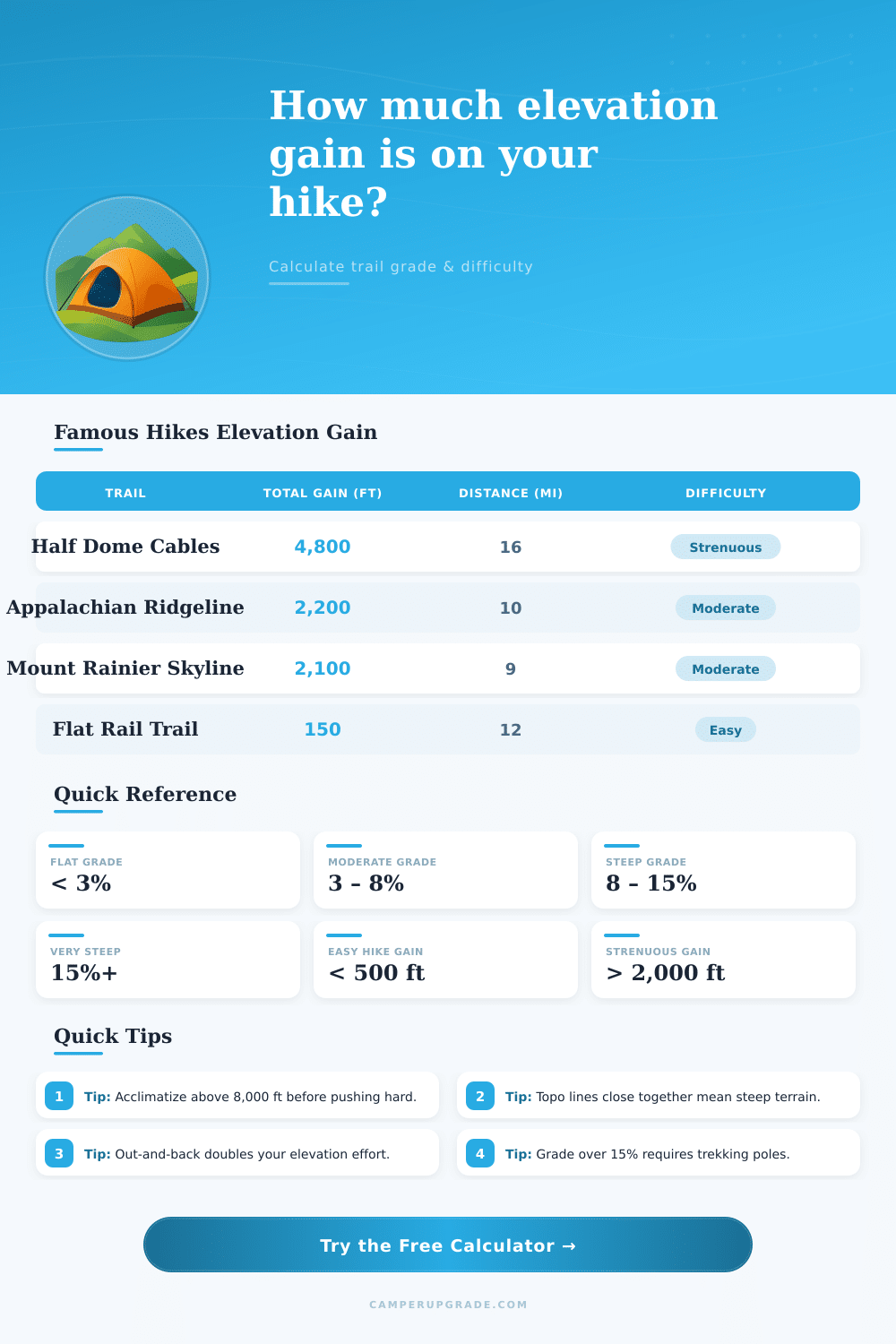
| Trail | Gain (ft) | Distance (mi) | Avg Grade | Difficulty |
|---|---|---|---|---|
| Half Dome Cables, CA | 4,800 | 16 | ~11% | Strenuous |
| Mt. Rainier Skyline Loop, WA | 2,100 | 9 | ~9% | Moderate-Hard |
| Appalachian Ridgeline, PA | 2,200 | 10 | ~8% | Moderate |
| Angels Landing, UT | 1,488 | 5.4 | ~10% | Strenuous |
| Flat Rail Trail, VT | 150 | 12 | ~0.2% | Easy |
| Rolling Hills Loop, CO | 900 | 7 | ~5% | Moderate |
| Canyon Descent Loop, AZ | 1,200 | 8 | ~6% | Moderate |
| Difficulty | Gain / Mile | Total Gain | Example |
|---|---|---|---|
| Easy | < 50 ft/mi | < 500 ft | Rail trails, beach walks |
| Moderate | 50–150 ft/mi | 500–1,500 ft | Forest loops, foothills |
| Hard | 150–300 ft/mi | 1,500–3,000 ft | Mountain day hikes |
| Strenuous | 300–500 ft/mi | 3,000–5,000 ft | Half Dome, Angels Landing |
| Extreme | 500+ ft/mi | 5,000+ ft | Alpine summits, volcanoes |
Hiking elevation gain is one of those things that seems simple but quickly becomes confusing. Basically, it relates to the total distance climbed during a hike. Many guides only subtract the initial height from the highest spot to find the result.
Even so, such a method loses many details
What elevation gain means and why it matters
The number that one must remember is the cumulative elevation gain. That means the total of every section where one goes upward. Times when a person goes down are not covered.
For instance, if someone climbs 1,000 feet, descends 500, and later again climbs 300, the total elevation gain is 1,300 feet. The descents are not subtracted from that amount.
Some folks confuse elevation gain with the net elevation gain. Net gain is only the difference between the highest and lowest spot. On a round-trip hike that returns to the initial place, the net gain always is zero.
That certainly does not help to understand how hard the journey indeed was.
Occasionally one describes elevation gain and loss together as cumulative. If a hike goes 1,000 feet upward and later back down, it has 2,000 feet of combined elevation gain and loss. That can fool some if they do not read the text attentive.
To find the real elevation gain of a trail, use services like AllTrails, because trails commonly have many ups and falls. Tracking apps also help, although they are not always precise. One comparison showed that AllTrails had a 15 percent mistake, and another app around 10 percent on a loop hike.
On an out-and-back hike over the same way, the mistakes even surpassed 70 percent.
The trouble does not depend only on the total elevation gain. A hike of 4 miles with 2,000 feet of elevation gain is moderate to difficult. But the way becomes much more heavy if all that elevation gain happens in only one mile.
Looking at the profile of the trail helps to estimate which parts will be most tough. Formulas exist to combine distance and elevation gain, but they still do not consider the terrain or very sharp short parts.
Training for big elevation gain requires a bit of thinking. A useful method is to use a stairmaster or treadmill with an incline of around 5 percent, and slowly increase until it feels like real climbing. It also helps to alter the distance, the weight and the incline separately.
When one increases the elevation gain in training, it is smart to first reduce the other two factors. Climbing stairs, for instance in a high building or stadium, also creates the right fitness.
In terms of energy, one mile of cumulative elevation gain is almost equal to 10 miles of flat way. That helps to put things in the right perspective very quickly.